

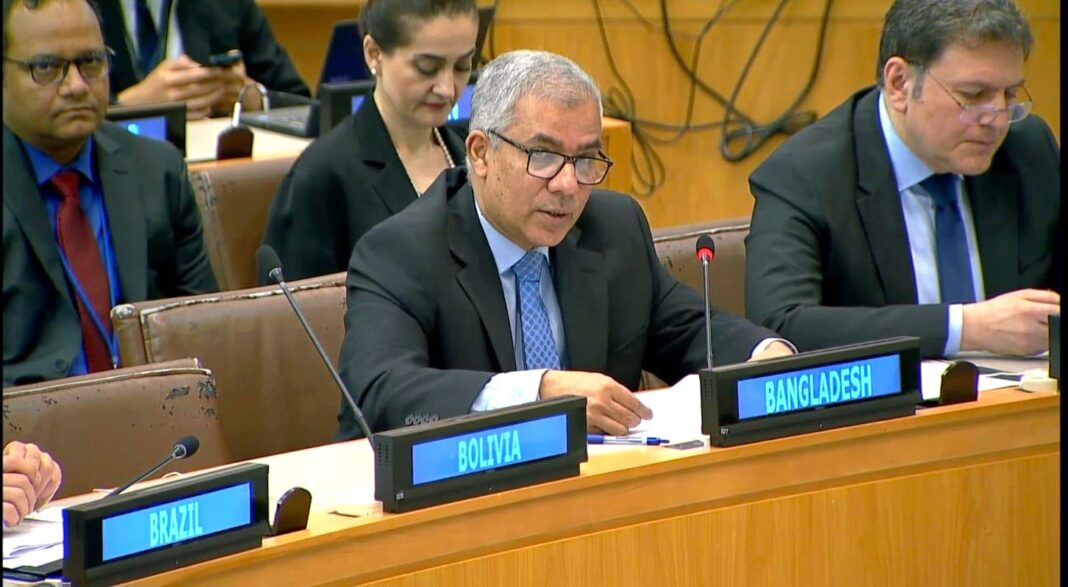
Bangladesh has called for enhanced support from the United Nations Development Programme (UNDP) to strengthen climate resilience, improve access to international climate financing mechanisms, and ensure a smooth and sustainable transition from its Least Developed Country (LDC) status.
Speaking at the Annual Session of the Executive Board of UNDP, UNFPA and UNOPS at United Nations Headquarters on Wednesday, June 10, Bangladesh’s Permanent Representative to the United Nations, Ambassador Salahuddin Noman Chowdhury, reaffirmed Bangladesh’s commitment to working closely with UNDP under its Strategic Plan for 2026–2029.
Addressing delegates from member states, UN officials and development partners, Ambassador Chowdhury highlighted Bangladesh’s remarkable socio-economic progress over the past decades, describing the country as a development success story that has achieved significant gains in poverty reduction, education, healthcare, women’s empowerment and economic growth despite facing multiple global and domestic challenges.
The ambassador noted that Bangladesh is preparing for its graduation from the UN’s Least Developed Country category in 2026, a milestone that reflects years of sustained economic and social progress. However, he stressed that the transition must be carefully managed to avoid disruptions to trade preferences, development assistance and investment flows that have helped support the country’s growth trajectory.
“Bangladesh looks forward to continued support from UNDP and the broader United Nations system to ensure a smooth, sustainable and inclusive graduation process,” he said.
Ambassador Chowdhury also highlighted Bangladesh’s recent national elections and expressed appreciation for UNDP’s support through the BALLOT Project, which helped strengthen voter participation and promote democratic engagement across the country.
Climate change featured prominently in Bangladesh’s intervention. As one of the countries most vulnerable to the impacts of rising sea levels, extreme weather events, flooding and climate-induced displacement, Bangladesh emphasized the urgent need for increased international cooperation and financial support.
The ambassador called on UNDP to expand its technical assistance in helping developing countries access climate financing from major global funds, including the Green Climate Fund (GCF) and the Global Environment Facility (GEF). He said many climate-vulnerable nations continue to face significant challenges in navigating complex funding procedures despite having urgent adaptation and mitigation needs.
“Access to climate finance remains critical for countries like Bangladesh that are on the frontlines of the climate crisis despite contributing only a small fraction of global greenhouse gas emissions,” he stated.
Bangladesh has long been recognized internationally for its leadership in climate adaptation and disaster preparedness. The country has invested heavily in coastal protection, cyclone preparedness systems, resilient infrastructure and community-based adaptation programs. Nevertheless, experts warn that climate-related losses and damages continue to pose significant risks to economic development and human security.
The ambassador further underscored the importance of strengthening multilateral cooperation at a time when developing countries are grappling with the combined effects of climate change, geopolitical tensions, economic uncertainty and global financing constraints.
The Annual Session of the Executive Board serves as a key platform for member states to review the work and future priorities of UNDP, the United Nations Population Fund (UNFPA) and the United Nations Office for Project Services (UNOPS). Discussions this year have focused on sustainable development, climate action, governance, poverty reduction and support for countries facing complex development challenges.
Bangladesh reiterated its support for a stronger, more responsive and adequately funded UNDP capable of addressing the evolving needs of developing nations and advancing the goals of the 2030 Agenda for Sustainable Development.