
June 11 was unlike any other morning.
As I put on my FIFA World Cup volunteer uniform and stepped outside, everything felt different. Perhaps the sunlight was brighter, or perhaps it was simply the realization that this was no ordinary day. In a city like New York, surrounded by millions of people, loneliness often becomes an invisible companion. But not today.
Today, the eyes of the world were fixed on one event—and I had the privilege of standing at its heart as a volunteer during the opening day of the FIFA World Cup 2026.
Three nations—the United States, Mexico, and Canada—have come together to host football’s greatest celebration.
It is, in many ways, an extraordinary partnership.
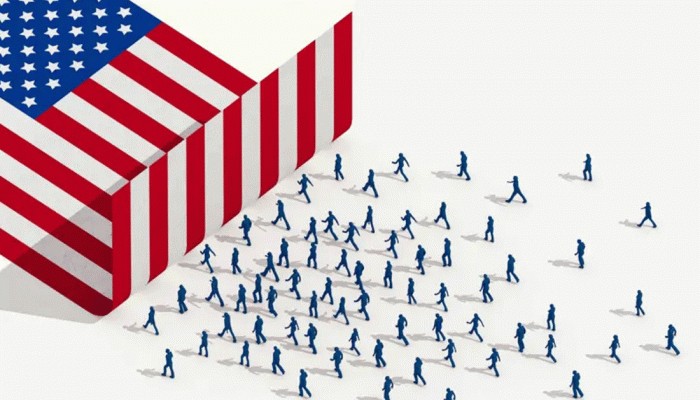
These neighbors have spent years arguing over immigration, tariffs, border security, and politics. Yet, despite those differences, they have united to welcome the world with one simple invitation:
“Come. Celebrate with us.”
Politics may divide nations.
Football unites them.
That is why Mexico City’s sky shimmered in green and yellow, Toronto proudly displayed the Maple Leaf, and Los Angeles overflowed with supporters wrapped in the red, white, and blue of the American flag.
For the first time in FIFA history, the World Cup opened simultaneously across three countries—with spectacular ceremonies in Mexico City, Toronto, and Los Angeles.
The celebration at the legendary Azteca Stadium was unforgettable.
Shakira returned to the World Cup stage sixteen years after “Waka Waka,” joining Burna Boy to perform the tournament’s official song, “Dai Dai.”
Andrea Bocelli and Korean pop sensation IZE performed the official anthem, “DNA,” while South African star Tyla delivered an emotional rendition of her country’s national anthem.
Watching from inside the event, one thought kept returning to my mind.
There was a message hidden beneath the lights, music, and celebration.
The world may be divided by politics, religion, borders, and ideology.
Football speaks only one language.
It requires no visa.
No passport.
Only a ball.
And suddenly my thoughts travelled thousands of miles—to Bangladesh.
A nation that passionately celebrates every World Cup but has never had the opportunity to compete in one.
I remembered my childhood.
In our village, I watched Gias Uddin, one of Bangladesh’s finest footballers of his generation. Barefoot, wearing a faded shirt, he danced past defenders on dusty village fields. What he created with a football was pure art.
His talent deserved a much bigger stage.
So did many others.
I remembered emerging footballers and freedom fighters like Shaheed Saif Uddin Chowdhury Sufi, Azad Uddin, Asab Uddin, Faruk Uddin, Roiob Ali, and Velay Mia.
They played not for money, but for passion.
Back then, many families could not even afford a football.
We stitched balls together from old clothes.
Two bamboo poles became our goalposts.
Yet from those humble fields emerged footballers whose talent could have flourished internationally—if only they had been given the opportunity.
During Pakistan’s rule, East Pakistani footballers such as Nazir Bhai, Taher Bhai, and Nurul Haque Ambia often spoke of discrimination.
Being Bengali meant fewer opportunities.
Less talented players from West Pakistan were selected ahead of gifted players from the East.
History records how Bangladesh’s football team carried the spirit of the Liberation War onto football fields around the world.
But somewhere along the journey after independence, that spirit faded.
More than fifty years later, Bangladesh’s greatest World Cup achievement seems to be passionately supporting Argentina or Brazil.
We cannot play.
But we know how to celebrate others.
Is that heartbreaking?
Or is it simply another expression of love?
The answer isn’t simple.
Every government has promised to improve sports.
Every administration has spoken of football development.
Yet politics has often overshadowed the game itself.
Football federations have too frequently become places for political influence rather than sporting excellence.
Players struggle for financial security.
Training facilities remain inadequate.
Youth development is neglected.
Promises are made.
Promises are forgotten.
And another generation grows up waiting.
Somewhere today, in a muddy field in rural Bangladesh, a barefoot teenager is chasing a football.
Perhaps he possesses extraordinary talent.
Perhaps he could one day stand where Lionel Messi once stood.
But talent alone is never enough.
Without academies.
Without coaching.
Without investment.
Without vision.
Dreams disappear before they are even discovered.
Still, hope survives.
Perhaps one day someone will lead Bangladeshi football—not for politics, not for personal ambition—but purely for the love of the game.
Until then, millions continue waiting.
The football itself did not disappoint.
Mexico defeated South Africa 2-0 in the opening match through goals by Julián Quiñones and Raúl Jiménez.
Yet the final score tells only part of the story.
Quiñones scored within ten minutes, sending nearly eighty thousand Mexican supporters inside Azteca Stadium into unforgettable celebration.
Their voices echoed far beyond the stadium walls.
But the night’s most emotional moment belonged to Raúl Jiménez.
When he scored in the 67th minute, he fell to the ground in tears.
The reason touched everyone watching.
In 2020, while playing in England, Jiménez suffered a devastating skull fracture during a Premier League match.
Doctors questioned whether he would ever play football again.
Six years later, at the age of thirty-five, he scored his first World Cup goal.
It was more than football.
It was the triumph of courage over adversity.
The match also entered the history books for another reason.
Three players received red cards—the highest number ever shown in a World Cup opening match.
South Africa’s Mudau and Joane were sent off, along with Mexico’s César Montes, whose suspension will be a significant setback for Mexico in its next game.
After the match, Mexico coach Javier Aguirre described it as “the perfect day” for Jiménez.
Fittingly, Aguirre himself had coached Mexico against South Africa in the opening match of the 2010 World Cup.
Outside the stadium, emotions poured across social media.
Mexican supporters wrote that Jiménez’s tears made them cry.
South African fans said they remained proud despite defeat.
One American football fan posted:
“I’ve watched the Super Bowl and the World Series. But now I understand—the World Cup is something entirely different.”
A Bangladeshi supporter summed up what many of us were feeling:
“When will my country finally play on this stage?”
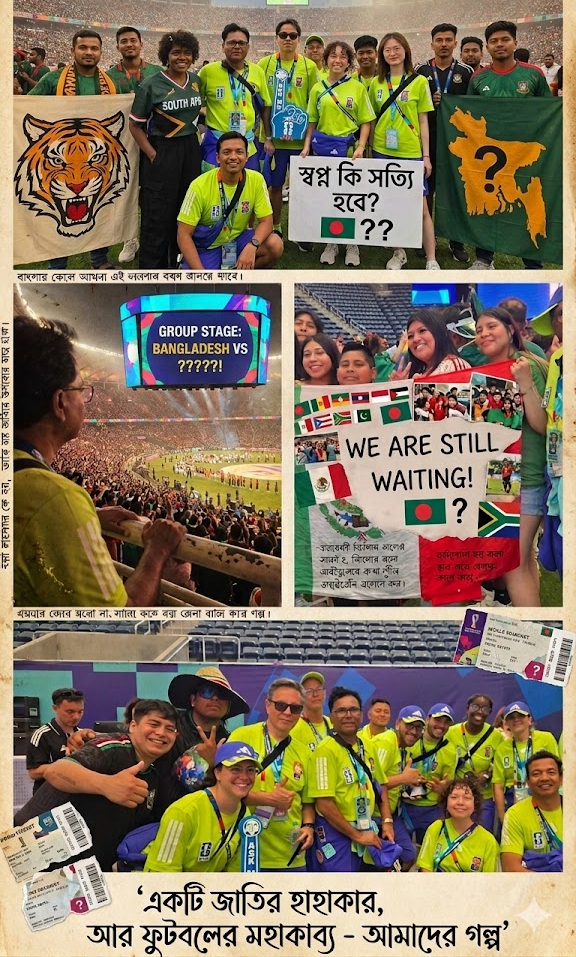
As I completed my volunteer shift, I realized something important.
Football brings millions together.
Yet the people helping create that experience often remain invisible.
I am one of them.
I am a Bangladeshi.
My country is not playing in this World Cup.
But I am here.
Wearing the uniform.
Welcoming supporters from more than eighty countries.
Helping strangers find their seats.
Answering questions.
Sharing smiles.
Playing a tiny role in the world’s greatest sporting celebration.
Is that enough?
No.
Because I still remember that village football field.
I still remember Gias Uddin.
He never played in a World Cup.
But he loved football with everything he had.
That love still lives.
Perhaps one day it will carry a Bangladeshi footballer onto football’s greatest stage.
Many of us may not be alive to witness that moment.
But dreams do not belong only to those who see them come true.
Sometimes, dreaming itself is an act of hope.