

New York City’s Department of Transportation (DOT) has issued a cease-and-desist letter to the developer of a walking-tracker app, demanding that it stop using the name WalkNYC, arguing that it infringes on the city’s trademark.
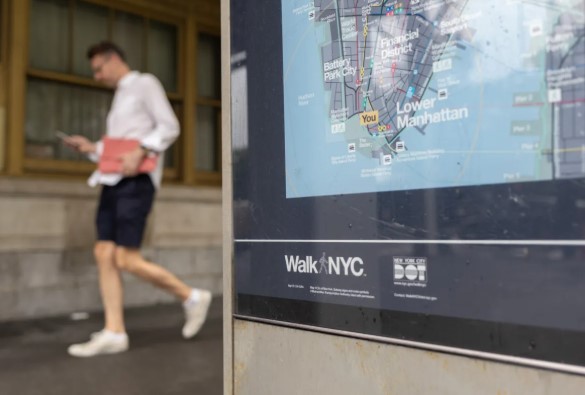
The free app, which allows users to track every city block they have walked, shares its name with the DOT’s WalkNYC wayfinding programme, which provides maps and directional signage on sidewalks, near Citi Bike stations and inside subway stations.
In a letter dated July 20, the DOT said the app uses branding and colours that are “nearly identical” to the city’s official WalkNYC materials. The department argued that the similarities have caused confusion among residents and visitors, creating the impression that the app is affiliated with the New York City government.
The city has instructed the app’s developer to stop using the WalkNYC name and branding, disable the website and app, and remove all promotional materials bearing the disputed identity.
In response, developer Joe Puccio added a banner to the app reading: “NYC DOT sent me a cease and desist. Tell them why you use WalkNYC.” The message links users to a form where they can explain how the app has influenced their walking habits and express support for keeping the name.
The form states: “Like the DOT, I want to support the walkers of this city, and I’m hopeful we can work something out with them given that shared goal.”
Puccio did not respond to media requests for comment.
The DOT said its goal is not to shut down the app but to ensure it adopts a different name and visual identity.
“We appreciate every New Yorker who enjoys strolling through the most walkable city in the country, but app developers cannot use the city’s trademarked branding for their products without permission,” DOT spokesperson Vincent Barone said. “We do not want there to be any confusion between this product and the city’s wayfinding programme.”
The US Patent and Trademark Office granted New York City a federal trademark for WalkNYC in 2014, and the registration was renewed for another 10 years in 2024, giving the city exclusive rights to use the name in connection with related services.
Intellectual property lawyer Stacy Grossman said the similarities between the app and the city’s programme—including the use of a walking-person icon—could reasonably confuse consumers.
“Taken together, these factors suggest consumers could be misled, and the app should change its name,” Grossman said, adding that entrepreneurs should conduct trademark checks before launching new products.
Another intellectual property lawyer, Tracy Jong, said the dispute could still be resolved through an agreement allowing the app to retain its name under certain conditions, such as changing its logo or adding a disclaimer stating that it is not affiliated with New York City.
Launched on the App Store in May, the app lets users mark every city block they have walked, highlights completed routes in green on a digital map, and includes leaderboards, distance tracking and walking-time statistics.
When introducing the app, Puccio said his goal was to walk every block in Manhattan and described the project as his “little love letter” to New York City.