

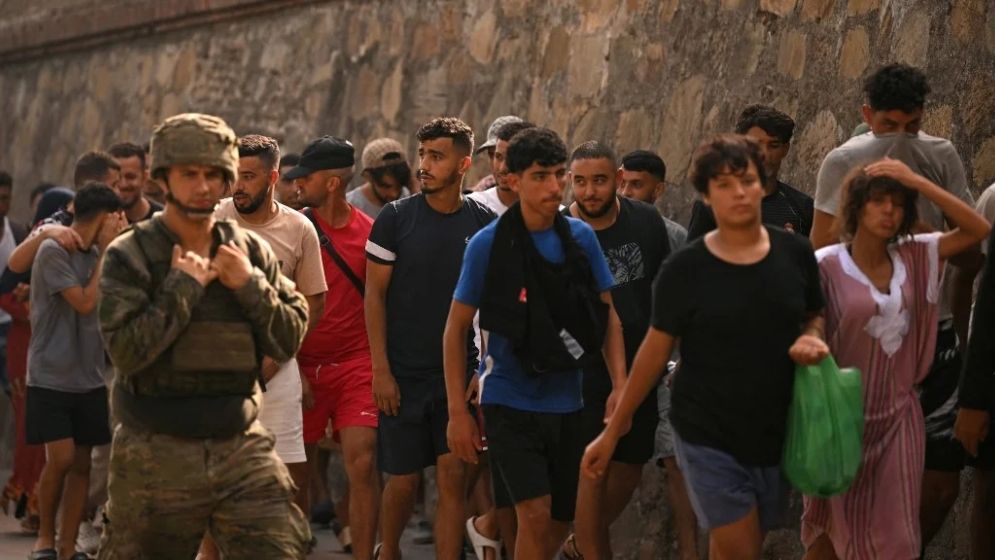
A senior Spanish minister has suggested that Israel may have played a role in the recent migration surge into Spain’s North African enclave of Ceuta, after around 60,000 migrants reportedly crossed from Morocco within days, triggering a political and humanitarian crisis.
The speculation gained momentum after Israel’s Ambassador to the United Nations, Danny Danon, posted on X criticising Spain over its migration policies. He said Spain, which often criticises Israel, had now declared a state of emergency in Ceuta and questioned why Madrid continues to maintain what he described as “colonial enclaves” in North Africa.
Responding to the post, Spain’s Transport Minister Óscar Puente wrote that “everything now seems to be making sense,” a remark widely interpreted as implying possible Israeli involvement, although he did not provide evidence to support the suggestion.
Several Spanish politicians and commentators have also argued that Spain may have become the target of political pressure because of its criticism of Israel’s military campaign in Gaza and its stance on broader Middle East issues. Gabriel Rufián, parliamentary spokesperson for the Republican Left of Catalonia, claimed the crisis ultimately served the interests of both the United States and Israel.
Spanish journalist José Vizner shared a 2019 social media post by Yair Netanyahu, the son of Israeli Prime Minister Benjamin Netanyahu, in which support was expressed for separatist sentiments involving Ceuta. Actor Javier Bardem also alleged in a video message that Israel had been involved in the events surrounding the migration surge, though no evidence was presented to substantiate the claim.
Former Portuguese minister and political analyst Bruno Maçães said it remains unclear whether the United States or Israel had any involvement before the crisis unfolded. However, he argued that both countries appeared to use the situation politically after it emerged, particularly in criticism of Spain’s current government.
Ceuta, along with Melilla, is one of Spain’s two autonomous territories on Morocco’s Mediterranean coast and represents the European Union’s only land border with Africa. According to the Spanish government, around 60,000 migrants entered Ceuta from Morocco during the week, including nearly 8,000 children.
Videos circulating online showed large numbers of migrants swimming around border barriers, with some using flotation devices to reach the enclave. Spain later announced that approximately 48,000 migrants had already been returned to Morocco with assistance from the Spanish military.
Authorities fear that at least 67 people may have died while attempting the dangerous crossing.
The cause of the sudden migration surge remains unclear. Similar incidents have occurred before, most notably in 2021, when around 8,000 migrants entered Ceuta during a diplomatic dispute between Spain and Morocco over Western Sahara. At the time, Spain accused Morocco of easing border controls to exert political pressure, while Moroccan officials argued the move reflected deteriorating bilateral relations.
Some analysts believe recent diplomatic tensions between Morocco and Spain may also have contributed to the latest developments. Others point to Spain’s recent engagement with Algeria, Morocco’s regional rival and Spain’s largest natural gas supplier, as a possible source of friction.
Lorenzo Gabrielli, a migration researcher at Pompeu Fabra University in Barcelona, told The New York Times that such a large-scale border crossing would have been difficult without at least some degree of Moroccan involvement.
Ceuta President Juan Jesús Vivas described the mass crossing as a violation of Spain’s territorial integrity. Morocco’s ambassador to Spain, Karima Benyaich, rejected suggestions that Rabat had encouraged the migration, saying the country remains committed to safe, orderly and legal migration and that the crossings occurred against the wishes of the Moroccan government.
Meanwhile, US President Donald Trump described the situation as a “disaster,” warning that similar migration pressures could affect the United States if stronger border controls were not maintained.
This report is a rewritten version based on the information provided in the source. Allegations regarding the involvement of Israel or other countries remain unverified unless supported by independent evidence.