

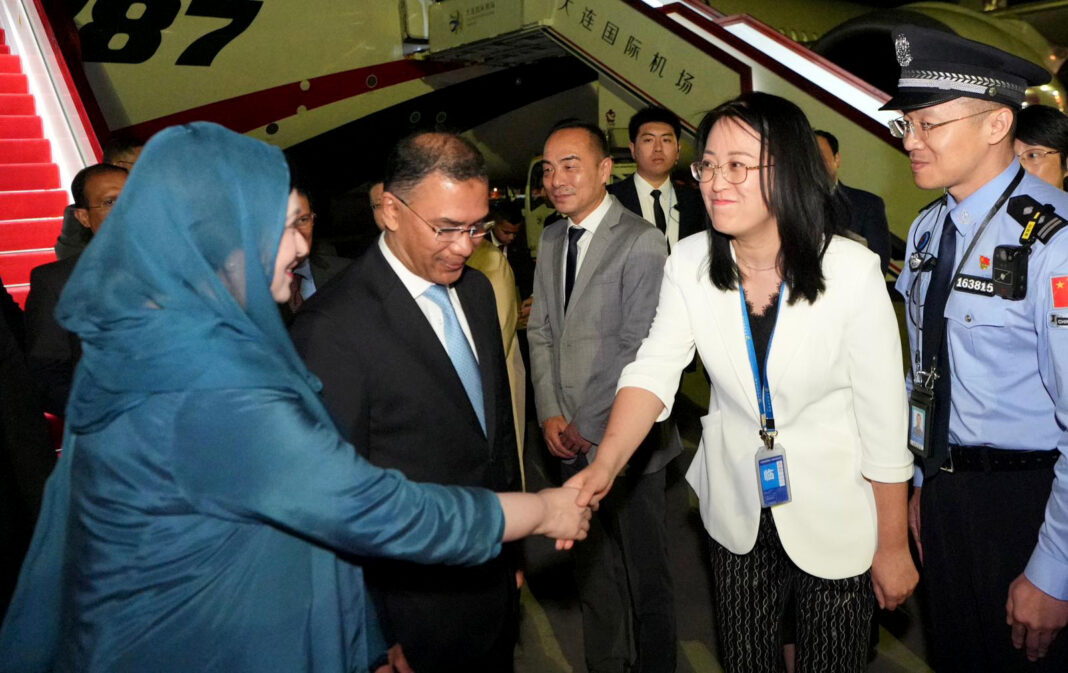
Prime Minister Tarique Rahman’s first foreign tour is far more than a ceremonial diplomatic engagement. His six-day visit to Malaysia and China carries messages about attracting investment, expanding overseas employment opportunities, and defining the priorities of Bangladesh’s foreign policy. Yet the most pressing question is this: amid the strategic tug-of-war among India, China, and the United States, where exactly does Bangladesh stand, and does this visit clarify or complicate that position?
The fall of Sheikh Hasina in August 2024 was not merely a change of government in Bangladesh. It was a geopolitical earthquake in South Asia. The “special relationship” that had evolved between Dhaka and New Delhi over one and a half decades effectively collapsed overnight. For the next eighteen months, Bangladesh-India relations remained strained, marked by growing mistrust and a cooling of political, diplomatic, and
intelligence cooperation.
Into this vacuum stepped Tarique Rahman, who came to power in February 2026, campaigning under the slogan of “Bangladesh First.” The slogan reflected popular frustrations over the state of Bangladesh-India relations. Yet the practical meaning of that policy remains under scrutiny. This China visit may provide the first real test.
After nearly two years of sluggish engagement, Bangladesh is seeking to reinvigorate Chinese investment and infrastructure financing. Officials have indicated that Dhaka will seek approximately $6 billion in Chinese funding for infrastructure and development projects. Rahman is scheduled to meet Chinese Premier Li Qiang on June 25 and President Xi Jinping on June 26. He will also participate in the World Economic Forum’s Summer
Davos gathering in Dalian.
Bangladesh may additionally announce its participation in China’s Global Development Initiative, a flagship framework linked to the United Nations Sustainable Development Goals and promoted by Beijing as a cornerstone of its international development strategy.
India had extended an official invitation to Tarique Rahman before China did. Yet the Prime Minister chose Beijing for his first major bilateral visit. In diplomatic language, such a choice is itself a statement.
Dhaka insists that relations with India and China are not a zero-sum game. Rahman himself has remarked that Bangladesh’s relationship with one country does not negate its relationship with the other. The statement sounds balanced. Reality, however, is more complicated.
Several unresolved issues continue to burden Bangladesh-India relations.
The first is the question of Sheikh Hasina’s extradition. Despite the existence of a bilateral extradition treaty, New Delhi has reportedly declined Dhaka’s request, arguing that the matter falls under the treaty’s political offense exception. The issue has become a recurring
topic in diplomatic exchanges.
Second, Bangladesh recently summoned India’s Deputy High Commissioner following reports that one of Rahman’s advisers, Zahedur Rahman, was detained for an extended period at Delhi airport. It was the second such diplomatic protest since February 2026.
Third, the 1996 Ganges Water Sharing Treaty expires in December 2026, while the long-delayed Teesta agreement remains unresolved. Both issues have direct implications for Bangladesh’s agriculture, food security, and long-term water management.
Trade relations also remain structurally imbalanced. Bilateral trade exceeds $13 billion, but Indian exports dominate the relationship. This asymmetry has fueled resentment in Bangladesh for years and continues to shape public perceptions.
Washington’s role in this visit may not be visible, but it is hardly absent.
The United States views Bangladesh as an important component of its Indo-Pacific strategy. Bangladesh’s strategic geography ensures that both India and China will continue competing for influence in Dhaka.
Many analysts have cautioned Bangladesh against becoming entangled in geopolitically sensitive projects. For example, they argue that major initiatives such as the Teesta Barrage Project should involve multiple partners—including countries like Japan—rather than relying solely on Chinese financing. Such recommendations reflect broader American
strategic thinking regarding China’s expanding regional footprint.
Economic realities further complicate Bangladesh’s choices.
The United States remains Bangladesh’s largest export destination. India shares a 4,000-kilometre border with Bangladesh and remains one of its most important sources of imports. No matter how close relations withChina become, Dhaka cannot afford to ignore either Washington or New Delhi.
Energy security presents another challenge.
Bangladesh imports roughly 63 percent of its crude oil from the Middle East. Recent tensions involving Iran, Israel, and the United States exposed the country’s vulnerability to external shocks. Although diplomatic efforts have eased immediate concerns, any prolonged regional conflict could significantly impact Bangladesh’s economy. The energy
question has placed Dhaka in a difficult position: it needs long-term Chinese financing for infrastructure while simultaneously relying on regional cooperation, particularly with India, to maintain short-term stability.
For decades, Bangladesh has proclaimed a foreign policy of “friendship to all, malice toward none.” In today’s geopolitical environment, however, neutrality carries an increasingly high price.
Maintaining Chinese investment while avoiding excessive dependence is essential. As strategic competition intensifies across the Indo-Pacific, Chinese-funded infrastructure projects are facing greater scrutiny worldwide. Likewise, efforts to rebuild Bangladesh-India relations cannot rest on sentiment alone; they require durable institutional foundations.
Choosing China for his first major foreign visit sends a clear strategic signal. Dhaka seeks economic acceleration, and Beijing can often provide capital, infrastructure, technology, and market access with remarkable speed.
Yet China’s offerings are only one part of the equation.
India provides energy security, transit opportunities, border stability, and regional connectivity.
The United States offers market access, technological cooperation, and broader security partnerships.
Draw too close to any one of these powers, and the other two may begin to distance themselves.
Bangladesh’s geography leaves little room for exclusive alignments. Every major power has strategic interests in the country, and each seeks to preserve its influence.
The real test for Tarique Rahman begins after this visit, not during it.
Signing agreements is easy. Paying the political price for implementing them is considerably harder.
Ultimately, Bangladesh must decide whether it wishes to be a piece on the geopolitical chessboard or a player moving the pieces. The difference lies not in rhetoric, but in the depth, balance, and wisdom of its decisions.
This version is edited for international readership while preserving the central argument and the reflective, analytical style characteristic of your opinion writing.