
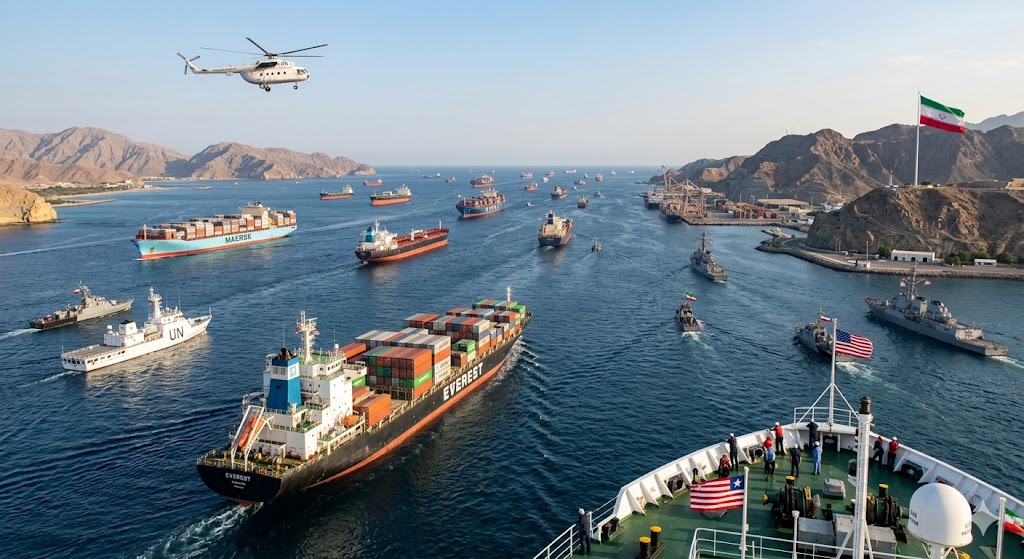
Late Sunday night, the United States and Iran reached a preliminary agreement to reopen the Strait of Hormuz and further extend the ongoing ceasefire. If implemented, the agreement would restore the flow of much-needed oil and natural gas to global markets. However, the full text of the agreement has not yet been released, and Iran has stated
that none of its provisions will take effect until the final document is formally signed. Pakistan, the principal mediator, announced that the signing ceremony will take place in Switzerland on Friday.
The road to this agreement was far from smooth. Fighting between Israeli-backed forces and the Iranian-backed Hezbollah in Lebanon has not completely ceased. On Sunday alone, Israeli airstrikes targeted southern Beirut, nearly derailing the negotiations. Another highly
sensitive aspect of the agreement is the decision to allow only 60 days to resolve disputes over Iran’s stockpile of highly enriched uranium and its nuclear program—a remarkably short timeline compared with the years it took to negotiate the 2015 nuclear agreement. It is worth recalling that during his first term, President Donald Trump withdrew the United
States from that accord, a move widely viewed as a major factor behind the subsequent escalation of tensions.
The announcement came on the same day President Donald Trump celebrated his 80th birthday at a UFC cage-fighting event hosted at the White House. Posting on social media, Trump wrote, “Congratulations to everyone!” and initially announced that he had authorized the immediate lifting of the naval blockade around the Strait of Hormuz. He later clarified that the strait would not reopen until after Friday’s signing
ceremony.
Iranian Deputy Foreign Minister Kazem Gharibabadi confirmed the preliminary agreement on state television but stressed that implementation would not begin before the official signing. He said Qatar had also played an important role in facilitating the negotiations. Pakistani Prime Minister Shehbaz Sharif announced that both sides had agreed to permanently halt military operations on all fronts, including Lebanon, and that technical negotiations would begin later this week under international mediation.
Financial markets responded positively to the news. Asian stock markets rose, while benchmark Brent crude oil prices fell by more than three dollars per barrel. Even so, energy analysts cautioned that restoring normal oil and gas supplies could take months, as shipping and insurance companies will first seek assurances that the agreement is durable and sustainable.
The agreement has also exposed divisions within the Republican Party in the United States. Senator Lindsey Graham praised Vice President J.D. Vance as the architect of the negotiations but warned that Washington and Tehran may have significantly different interpretations of what has actually been agreed upon. It also remains unclear who will formally sign the agreement on behalf of Iran. Vice President Vance told Fox News
that he plans to attend the ceremony and that President Trump may also be present.
The conflict itself has dramatically reshaped Iran’s political leadership. Iran’s Supreme Leader, Ayatollah Ali Khamenei, was killed during the opening phase of the war. His son, Mojtaba Khamenei, has since assumed the responsibilities of Supreme Leader, although he has not appeared publicly since the conflict began. Reports indicate that his approval was essential before Tehran agreed to the ceasefire framework. At the same time, signs of internal disagreement have emerged within Iran, with government officials warning that domestic divisions could weaken the country’s negotiating position.
If successfully implemented, the agreement would largely restore the region to its pre-war status. Yet the human cost has been enormous, with thousands of lives lost. Iran also appears determined to retain control of the Strait of Hormuz as an important source of future leverage. The country still possesses a substantial arsenal of ballistic missiles and
is believed to maintain enough highly enriched uranium for multiple nuclear weapons. According to current assessments, much of that uranium remains buried beneath three nuclear facilities damaged during last year’s U.S. strikes. Washington wants the material removed from Iran, with Russia offering to receive it, but Tehran has firmly insisted that
the stockpile will remain under Iranian control.
The next 60 days will therefore be a critical test—not only for the United States and Iran, but for the entire international community. Whether this fragile peace evolves into a lasting settlement or collapses into renewed confrontation remains the defining question.