
Since coming to the United States in 1980, I have regarded the Liberation War of Bangladesh in 1971 as our greatest achievement and the genocide committed during our War of Independence as our greatest sorrow. I have devoted myself to preserving that history. As the son of a martyred family and a first-year medical student, I joined the rebel
2nd East Bengal Regiment in Sector 3 from the very beginning of the Liberation War and fought in direct combat against the invading Pakistani forces. I survived the war, but the sense of responsibility has followed me throughout my life.
Beginning in 1986, I traveled throughout New York presenting my own slide documentary on Bangladesh’s Liberation War. During the rule of President Ershad, very few people, either in Bangladesh or abroad, spoke publicly about the Liberation War. Yet I often watched audiences sit silently while tears rolled down many faces.
In 2005, while serving as President of the Bangladesh Medical Association of North America, I was invited to attend a meeting of the Pakistani Medical Association. There, I publicly urged them to apologize for the genocide committed by the Pakistani military in 1971. The following year, during our conference in Washington, D.C., the President of the Pakistani Medical Association formally expressed regret and apologized for the massacre of Bengalis by the Pakistani military. It was a remarkable achievement.
In 2008 and 2009, I participated in organizing two international, day-long seminars at Kean University in New Jersey advocating for global recognition of the Bangladesh genocide. Since then, Bangladesh’s genocide has been included in Kean University’s Holocaust studies
program. Through various events, we have honored many foreign friends who stood beside Bangladesh during the Liberation War.
In 1990, I also produced a documentary about the courageous “Blockade” movement in the United States, highlighting the role of ordinary American citizens and members of Congress who challenged their own government’s policies. The documentary told the story of poor but deeply humanitarian African American dockworkers who refused to load weapons
onto Pakistani ships. Although the U.S. government opposed Bangladesh’s struggle, the support of ordinary Americans helped accelerate our victory.
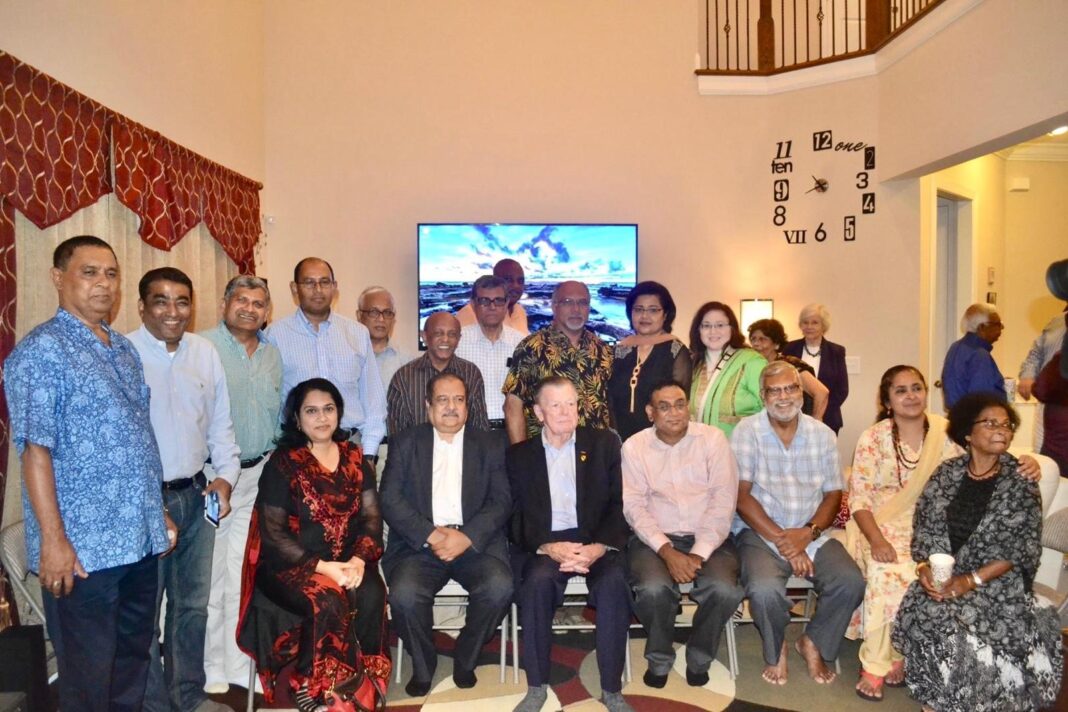
Yet many of us still do not know how many foreign friends risked their lives for Bangladesh’s freedom. Through Rashidul Islam Rubel and his wife, Dr. Tasnim Islam, of Raleigh, North Carolina, I had the privilege of meeting one such remarkable individual. They invited me from Philadelphia to attend a small gathering at their home.
At that time, Joseph L. Galloway was already a well-known figure in America. He was a leading advocate for the rights and dignity of American war veterans, especially those who had returned from Vietnam.
Even at the age of seventy-eight, he and his wonderful wife, Grace, traveled tirelessly to public events. His powerful voice consistently spoke against war and in support of veterans.
Joseph Galloway was a legendary war correspondent who personally covered many of the world’s conflicts. His books became highly acclaimed, especially We Were Soldiers Once… and Young, widely regarded as one of the finest books ever written about the Vietnam War. It was later adapted into a successful Hollywood film.
Galloway visited Dhaka twice in 1971—first during the turbulent months leading to Bangladesh’s Liberation War and again in December, during the final days of victory.
The memories of Bangladesh remained deeply embedded in his heart. As a young correspondent, he not only witnessed the genocide, brutality, and crimes against humanity committed by the Pakistani military against millions of unarmed Bengalis, but also demonstrated extraordinary personal courage.
In March 1971, Galloway was staying at the InterContinental Hotel in Dhaka with other foreign correspondents. After launching Operation Searchlight on the night of March 25, the Pakistani military arranged a carefully controlled tour for foreign journalists in an attempt to convince them that life in East Pakistan had returned to normal. They flew the journalists over selected areas before putting them on planes to leave the country. From the aircraft, Galloway could clearly see entire slums burned to ashes along the railway tracks.
He immediately decided he had to remain in Bangladesh and continue reporting.
Pretending to be seriously ill, he told the soldiers, “I have severe stomach pain. I can’t get out of bed. You’ll have to carry me if you want me to leave.”
The soldiers eventually left without him.
Soon afterward, Galloway quietly stepped onto the bloodstained streets of Dhaka. Pakistani soldiers began following him, but as he reached Segunbagicha, he suddenly slipped through the gates of the American Embassy before they could stop him and found refuge inside.
There he met Archer Blood, the U.S. Consul General in Dhaka, another true friend of Bangladesh. Blood openly shared his deep concern over the genocide and atrocities being committed by the Pakistani military. Taking considerable personal risk, Archer Blood allowed Galloway to establish a temporary office inside the American Consulate.
From there, Galloway secretly gathered information. Sometimes he
personally investigated events, while at other times he relied on
courageous local employees of the U.S. Consulate, who provided firsthand
accounts of massacres, destruction, suffering, and human tragedy. He
sent these reports to Reuters, allowing the world to learn about the
genocide taking place in Bangladesh.
Later, he returned to the United States but continued writing about
Bangladesh.
In mid-December 1971, Galloway returned to Dhaka and witnessed the final
stages of Pakistan’s surrender. When the InterContinental Hotel was
placed under the protection of the International Committee of the Red
Cross as a neutral zone, Galloway assumed responsibility for its
administration.
At the final Pakistani military press conference, he insisted that
General A.A.K. Niazi remove his military badge and sidearm before
entering. Niazi threatened to shoot him. Galloway, together with another
British journalist, replied, “You may kill us, but then you won’t have a
press conference.”
Reluctantly, Niazi complied.
At the conference, Niazi claimed that Pakistani forces remained well
organized around Dhaka and were fully prepared to resist any attack.
Galloway and several other journalists left immediately afterward to
inspect the city’s outskirts. They were astonished to discover that
Pakistani troops had already abandoned virtually every approach to
Dhaka. Their defenses had collapsed, and many soldiers had fled.
Throughout the war, Galloway continued reporting directly from Dhaka.
Immediately after victory, he visited the Rayerbazar killing fields,
where Bangladesh’s leading intellectuals had been murdered, and strongly
condemned those atrocities. Throughout Bangladesh’s nine-month struggle
for independence and the birth of the new nation, Joseph Galloway
remained a courageous witness to both its suffering and its triumph.
Fifty years later, at that small gathering hosted by the Bangladeshi
community in North Carolina, Galloway expressed his sincere regret for
U.S. policy toward Pakistan during 1971. He pledged to work toward
securing recognition by the U.S. Congress and the international
community that the atrocities committed against the people of Bangladesh
constituted genocide.
A year later, retired American generals and military journalists
nominated him for one of the highest civilian honors awarded by the
President of the United States. Surprisingly, many of them were unaware
of his extraordinary role in Bangladesh until they heard the story.
“This is our Joe,” they said. “Who else would have done something like
this?”
They invited us to a meeting and requested our assistance in obtaining
official support from Bangladesh.
Russell and I joined those efforts and promised to seek written
endorsement from the Government of Bangladesh. Sadly, despite repeated
requests, the Foreign Minister of Bangladesh—someone we had known
personally for many years—declined to provide any written recognition,
saying simply, “I don’t know him.”
With no alternative, we approached Bangladesh’s Ambassador in
Washington. Showing remarkable courage and integrity, the Ambassador
personally wrote a heartfelt letter thanking Joseph Galloway for his
invaluable contribution to Bangladesh’s Liberation War. Although the
letter ultimately could not be used in support of his medal nomination,
it brought us a measure of comfort.
Before America’s highest presidential civilian honor could be officially
awarded, our dear friend Joseph Galloway passed away.
What a profound loss.
Knowing him was itself an honor and a privilege. Wherever you are now,
dear friend Joe, may you rest in peace. Bangladesh will always remember
you.