
The smoke of war has not yet fully cleared from the skies of the Middle East. More than one hundred days of tension between Iran and Israel had raised fears of another major escalation. But at a critical moment, U.S. President Donald Trump is said to have altered the course of events with a phone call.
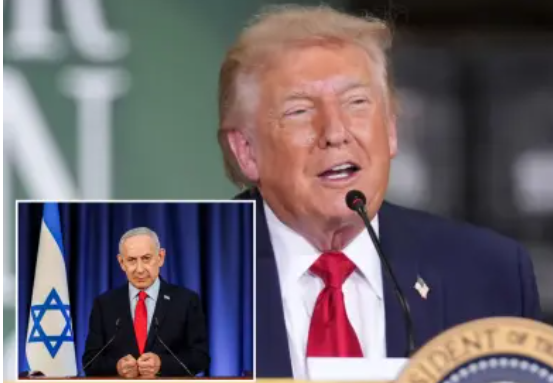
According to reports, Trump directly warned Israeli Prime Minister Benjamin Netanyahu that if Israel resumes a full-scale war against Iran, it may have to bear that burden alone.
In an interview with Israel’s Channel 12, Trump said, “I told Bibi, think very carefully about what you are doing, because you could find yourself standing alone against Iran very quickly.”
The remarks have created fresh waves across the diplomatic landscape of the Middle East. For decades, the United States has been viewed as Israel’s most dependable ally. Now, Washington appears to be sending a message of restraint rather than encouraging further military action.
Sources say Trump personally contacted Netanyahu following the latest exchange of missile strikes between Iran and Israel. At the time, the
conflict had reached its one-hundredth day. Trump claims that Tehran had
conveyed a ceasefire proposal, with one primary condition: Israel must
refrain from launching new military attacks.
A White House official said the administration does not view Iran’s
recent missile strike on Israel as a signal that full-scale war is about
to resume. Instead, Washington believes there is still an opportunity to
keep the situation under control.
According to individuals close to Netanyahu, the Israeli leader did not
interpret Trump’s phone call as a direct demand. Rather, he viewed it as
a friendly request. During their conversation, Netanyahu reportedly
argued that failing to respond to Iranian attacks would weaken Israel’s
deterrence capability and regional standing.
Nevertheless, Israel ultimately refrained from launching a major
military response. At the same time, it offered no commitment to halt
operations against Hezbollah in Lebanon. Israel’s position remains that
a ceasefire may apply to the Iranian front, but not necessarily to other
fronts.
Another significant development emerged the following morning when Iran
reportedly contacted Washington directly to express interest in a
ceasefire. Trump then called Netanyahu again and urged him to keep
tensions from escalating further.
According to Trump, the prospects for reopening the Strait of Hormuz to
normal shipping traffic and restarting negotiations over Iran’s nuclear
program are more realistic now than at any point in recent months.
Vice President J.D. Vance has also expressed cautious optimism, saying
Iran has brought some “real and meaningful” proposals to the negotiating
table. However, he warned that it remains too early to assume all
parties are acting in complete good faith.
Pakistan’s Prime Minister Shehbaz Sharif, who has been involved in
mediation efforts, described the situation in positive terms, saying
that “the final objective is now within reach.”
Despite the diplomatic optimism, significant obstacles remain. Tehran
has made it clear that it is not interested in a major agreement unless
economic sanctions are eased and billions of dollars in frozen Iranian
assets are released.
Washington’s position remains firm. Secretary of State Marco Rubio told
Congress that sanctions relief will only be considered if there is
genuine progress on Iran’s nuclear activities.
Meanwhile, Iran has announced that the Strait of Hormuz has been
reopened, but under certain conditions. Only vessels that pay designated
transit fees are being allowed to pass. The Trump administration has
opposed that policy from the beginning, insisting that international
waterways must remain open to unrestricted navigation.
For now, the drums of war in the Middle East have grown quieter. But the
crisis is far from over. Trump’s message appears unmistakable:
Washington does not want another major war. The question now facing
Netanyahu is whether he will choose diplomacy or once again risk pushing
the region toward a wider conflict.