

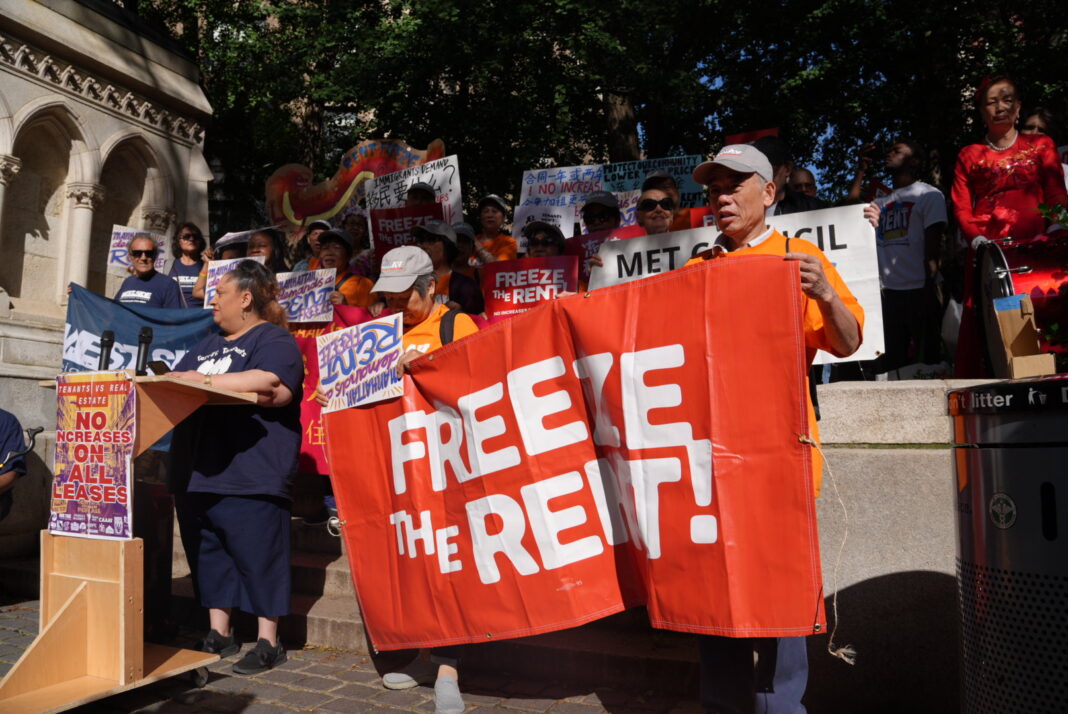
Tenant advocacy groups rallied in Manhattan on Tuesday, calling for a rent freeze for approximately 2.4 million New Yorkers living in rent-stabilized apartments.
The demonstration was organized by the **New York State Tenant Bloc**, **CAAAV**, and several Manhattan-based tenant organizations ahead of the New York City Rent Guidelines Board’s final vote on rent adjustments for rent-stabilized leases.
The event began at Joan of Arc Park with cultural performances, drumming, and dance before participants marched to Symphony Space, where speakers urged the Rent Guidelines Board to approve a 0% rent increase, arguing that tenants cannot afford additional housing costs amid ongoing economic challenges.
Organizers noted that during its preliminary vote last month, the Rent Guidelines Board included a **0% increase** among the proposed options for both one-year and two-year lease renewals. According to the groups, this marks the first time the board has considered a rent freeze for two-year leases as well.
Sumathi Kumar, Executive Director of the New York State Tenant Bloc, said tenants are facing mounting financial pressures, including inflation, reductions in federal social benefits, and immigration enforcement actions. At the same time, she argued that landlords’
operating profits have increased in recent years, making a rent freeze both reasonable and necessary.
Advocates said rent-stabilized housing remains one of the few safeguards protecting low- and middle-income New Yorkers from displacement, particularly in Manhattan, one of the city’s most expensive boroughs. They also cited recent analyses suggesting that a rent freeze would not significantly harm most property owners and noted that a variety of
public assistance programs are available to help landlords maintain their buildings.
Among the speakers was longtime Chinatown resident and CAAAV tenant leader Shuzhen Liu, who said ownership of her building has changed multiple times over the past 31 years without meaningful improvements in maintenance or living conditions.
“Rent increases only reward irresponsible landlords,” Liu said, calling on the Rent Guidelines Board to adopt a rent freeze for all lease renewals.
Tenant organizations estimate that renters make up roughly 70 percent of New York City’s population. They argue that while rents have continued to rise in recent years, many tenants have seen little improvement in building conditions. Instead, complaints about inadequate heat, hot water, and other essential services have persisted. Some advocates also alleged that certain landlords have prioritized paying down debt or acquiring additional properties over investing in building maintenance.
Landlord organizations, however, have consistently argued that rent increases are necessary to offset rising operating expenses, including property taxes, insurance premiums, maintenance costs, and utility bills. They maintain that reasonable rent adjustments are essential to preserving the city’s housing stock.
The Rent Guidelines Board is expected to consider testimony from both tenant advocates and property owners, along with economic data, before issuing its final decision.
That decision is now being closely watched by millions of tenants and thousands of landlords across New York City.