
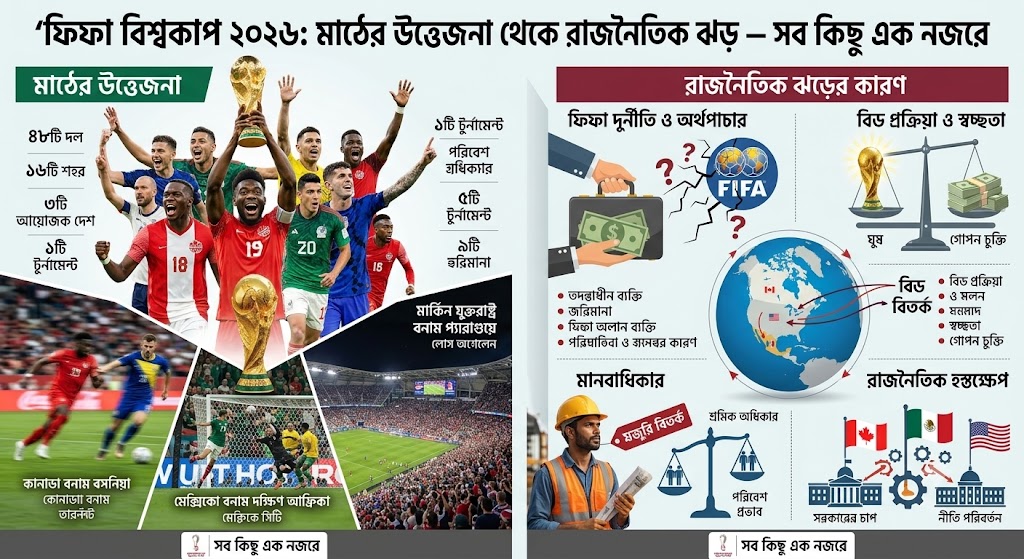
The world’s biggest football festival has arrived. The FIFA World Cup 2026, set to begin on June 11, is already being described as the largest, most controversial, and most political tournament in history. Co-hosted by the United States, Canada, and Mexico, the unprecedented event will feature 48 nations competing in 104 matches across 16 venues.
The tournament will kick off with Mexico vs. South Africa at the iconic Azteca Stadium in Mexico City, while the historic final will be played on July 19 at MetLife Stadium in New Jersey. Yet, what is happening off the field is, in many ways, overshadowing the action on it.
Perhaps the most significant and emotional storyline of this World Cup revolves around Iran. The Iranian national team, known as Team Melli, will compete in Group G alongside Belgium, Egypt, and New Zealand. Iran’s opening match is scheduled for June 15 in Los Angeles against New Zealand. However, their road to the tournament has been anything but smooth.
Iran and the United States have effectively been in a state of conflict since February, although a fragile ceasefire has been in place since April. The Trump administration suspended visa issuance for citizens of Iran and 11 other countries after designating Iran as a state sponsor of terrorism. As a result, thousands of Iranian supporters have been unable to travel to the United States. Iran was even unable to fully participate in the World Cup group draw held in Washington last December because senior federation officials were denied visas.
The Iranian Football Federation described the situation as “one of the most disgraceful political interventions in sports” and formally lodged a complaint with FIFA. U.S. officials later clarified that visas had been granted to Iranian players, coaches, and technical staff, although several support personnel were denied entry due to alleged discrepancies
in their applications. Iran has been permitted to base its team operations in Mexico during the tournament. Meanwhile, supporters at the team’s farewell rally in Tehran chanted anti-American slogans, and the federation has reportedly canceled previously sold supporter tickets, citing political interference.
Many observers are already calling this the most political World Cup ever staged. FIFA President Gianni Infantino’s close relationship with President Donald Trump has drawn considerable criticism. During the World Cup draw ceremony in Washington last December, Infantino presented Trump with FIFA’s first-ever “Peace Prize,” a move that sparked
international backlash and prompted formal ethical complaints against FIFA.
Trump’s tariff policies and immigration crackdown have also strained relations between the United States and its co-hosts Canada and Mexico, despite the three countries jointly organizing the tournament. Reports of Immigration and Customs Enforcement (ICE) agents operating around World Cup venues have raised concerns among foreign visitors and
supporters.
Lawmakers and football fan groups across Europe have called for boycotts of the tournament, citing opposition to Trump’s immigration policies and controversial statements regarding Greenland. Meanwhile, the Democratic Republic of Congo is participating amid an Ebola outbreak, prompting all three host nations to implement Ebola-related travel restrictions.
Many international observers view the tournament as more than a sporting event, seeing it instead as a display of American geopolitical influence. Analysts at the Council on Foreign Relations argue that the Iran conflict, immigration enforcement measures, and Trump’s travel restrictions have dramatically increased the political stakes surrounding the World Cup.
Despite the controversies, European teams remain the favorites on the field. Spain currently leads most betting markets, followed closely by France. England is ranked third, ahead of Brazil and Portugal. Defending world champion Argentina sits sixth among bookmakers’ favorites.
Questions remain about whether Lionel Messi will play in the tournament, although prediction markets currently place the likelihood at around 93 percent. The 38-year-old superstar was recently rested during a friendly against Honduras because of a minor muscle issue.
Brazil enters the competition under new head coach Carlo Ancelotti, with a squad built around stars such as Vinicius Junior and Raphinha. However, critics point out that the team has had limited time to develop chemistry under its new leadership.
Host nation United States will compete in Group D against Turkey, Paraguay, and Australia. Many analysts believe home-field advantage could make the Americans one of the tournament’s surprise teams.
Ticket prices have become another major source of controversy. Under FIFA’s dynamic pricing model, the cheapest group-stage tickets start at around $60. However, final match tickets have reached unprecedented levels.
According to figures released in April, the most expensive ticket for the final was priced at $10,990—more than seven times the original estimated price of $1,550. Prices for knockout-stage matches increased by as much as 39 percent during the second lottery phase. On FIFA’s official resale platform, final tickets are reportedly listed between
$9,538 and $57,500.
Matches involving the host nations—the United States, Canada, and Mexico—have seen particularly high demand and soaring prices for premium seating categories.
Overall ticket sales have also been staggering. FIFA reports that more than one million tickets have already been sold to buyers from 212 countries and territories. The largest purchasing markets are the United States, Canada, and Mexico, followed by England, Germany, Brazil, Spain, Colombia, Argentina, and France.
The tournament’s 104 matches will offer approximately 7.1 million seats in total. Public officials, including the Mayor of New York City, have criticized the soaring ticket prices. FIFA President Infantino, however, insists that the prices simply reflect market demand. More than 500 million ticket applications have reportedly been submitted worldwide.
When the opening whistle blows in Mexico City on June 11, the world’s attention will not be focused solely on football. Political tensions between Iran and the United States, the controversial relationship between Trump and Infantino, visa restrictions, record-breaking ticket prices, and public health concerns surrounding Ebola will all form part of the backdrop.
This may well become the most complex and politically charged World Cup in history. Yet football has always possessed a unique ability to rise above controversy. That hope remains alive across the globe.
Will Messi lift the World Cup trophy one final time? Will Spain write a new chapter in football history? Or will an unexpected underdog shock the world?
The answers will come on July 19 at MetLife Stadium in New Jersey.