
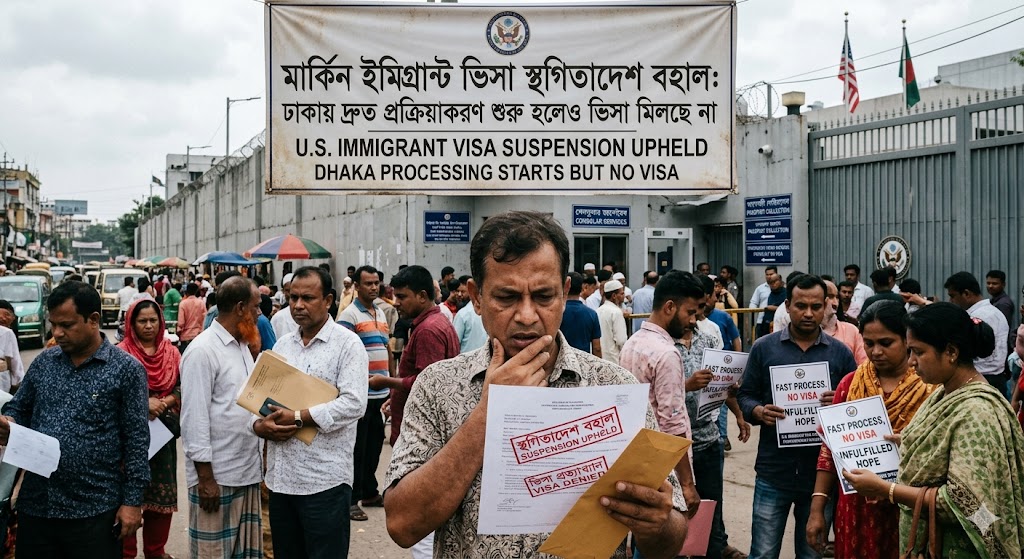
The suspension of U.S. immigrant visa issuance remains in effect, leaving thousands of applicants in uncertainty. According to the Trump administration’s policy, immigrant visas for citizens of 75 countries, including Bangladesh, have been suspended indefinitely since January 21, 2026. The policy remains active today and is currently being challenged
in federal court in New York.
Despite the ongoing suspension, the U.S. Embassy in Dhaka introduced a new processing system on June 1 aimed at speeding up immigrant visa applications. Under the new procedure, all immigrant visa cases will be processed within two business days. Applicants may continue to submit applications and attend visa interviews as usual, and embassy officials will complete the administrative processing of their cases.
However, because the suspension remains in place, no immigrant visas will be issued, even after applications have been fully processed. As a result, applicants will not receive immigrant visas in their passports unless the policy is lifted.
The U.S. Department of State has defended the suspension by arguing that immigrants from the affected countries are at greater risk of becoming dependent on government assistance programs after arriving in the United States, a concern commonly referred to as becoming a “public charge.”
Immigration advocates, attorneys, and civil rights organizations strongly dispute that justification. They argue that imposing a blanket suspension based solely on nationality violates fundamental principles of U.S. immigration law.
In the federal lawsuit **CLINIC v. Rubio**, currently pending in New York, attorneys for the plaintiffs contend that the **Immigration and Nationality Act** explicitly prohibits discrimination in the issuance of immigrant visas based on nationality. They argue that the broad suspension affecting citizens of 75 countries may therefore be unlawful.
The lawsuit was filed on February 2, 2026, in the U.S. District Court for the Southern District of New York. Plaintiffs include the National Immigration Law Center, Democracy Forward, the Legal Aid Society of New York, the Center for Constitutional Rights, and several U.S. citizens who say they have been separated from family members because of the policy.
The plaintiffs are asking the court to declare the suspension unlawful, permanently block its enforcement, require the State Department to resume evaluating immigrant visa applications on an individual basis, and provide new opportunities for applicants whose cases were negatively affected by the policy.
The case is currently in the cross-motion for partial summary judgment stage, with a final decision still pending.
Legal observers note that the situation is unlikely to change unless either a federal court orders the suspension to be lifted or the administration voluntarily withdraws the policy.
Importantly, the suspension applies only to immigrant visas, meaning individuals seeking permanent residency or Green Cards are the primary group affected. Non-immigrant visa categories—including tourist (B-1/B-2), student (F-1), and employment-based temporary visas such as H-1B—remain unaffected by the suspension.
At the same time, reports indicate that Bangladeshi applicants for B-1/B-2 visitor visas may now be required to post a bond of up to $15,000 under a separate policy measure.
For now, although immigrant visa applications in Dhaka can be processed more quickly than before, the central issue remains unresolved: when, or if, immigrant visa issuance will resume for affected applicants.