
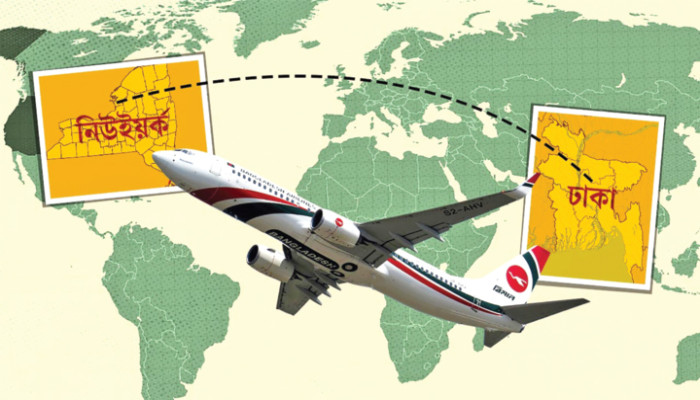
For Bangladeshis living in New York, flying home on Bangladesh’s national flag carrier has been a dream for nearly two decades. The ideal is simple: no long layovers in Doha, Dubai, Abu Dhabi, Istanbul, or elsewhere—just a direct flight, or at least a flight operated by Biman Bangladesh Airlines, from New York to Dhaka.
Yet after almost 20 years, that dream has increasingly come to resemble an old story that never comes true.
Governments have changed, ministers have come and gone, Biman’s management has changed, and newer aircraft have joined its fleet. Each time, however, the same promise has resurfaced: the Dhaka–New York route will reopen, negotiations are underway, preparations are nearly complete, or flights will begin as soon as regulatory approval is secured.
But Biman has still not returned to New York with a regular passenger service.
The latest optimism came from Civil Aviation and Tourism Minister M. Rashiduzzaman Millat. On August 23, he reportedly said that if Bangladesh achieves the necessary standards in an International Civil Aviation Organization (ICAO) audit, the country could have an opportunity to launch Dhaka–New York flights next year. The government is also considering leasing 10 aircraft.
Some media reports presented the statement even more optimistically, suggesting that direct Dhaka–New York flights could begin as early as January.
The reality, however, is considerably more complicated.
The latest promise is difficult to reconcile with statements made by the government only two months earlier. On June 21, then-Civil Aviation and Tourism Minister Afroza Khanam said Bangladesh could need at least five years to obtain new Boeing aircraft, making an early return to New York unrealistic.
At the same time, Air Vice Marshal Mostafa Mahmud Siddiq, chairman of the Civil Aviation Authority of Bangladesh (CAAB), reportedly said that Biman was unlikely to resume New York flights before 2028.
According to the CAAB chairman, Bangladesh must first pass several stages of international safety and security assessments. An ICAO safety audit is expected in October 2026, while a full safety audit is scheduled for October 2027.
Even after that, another major hurdle remains: the U.S. Federal Aviation Administration’s (FAA) International Aviation Safety Assessment classification.
Bangladesh is currently listed as a **Category 2** country under the FAA’s international aviation safety assessment system. Category 2 means that the country’s civil aviation safety oversight system does not fully comply with ICAO standards. Until Category 1 status is achieved, restrictions remain on new or expanded operations to the United States.
This means that passing an ICAO audit alone would not automatically allow Biman to begin flying to New York.
A successful Dhaka–New York operation would require several elements to come together: internationally recognized safety oversight, FAA approval, suitable long-haul aircraft, route planning, airport slots, regulatory permissions, and a commercially sustainable business model.
### A Route That Closed Nearly 20 Years Ago
Biman Bangladesh Airlines first began serving New York in 1993. At various times, its New York service operated through cities including Delhi, Dubai, Amsterdam, Brussels, and Manchester.
But the route gradually became increasingly difficult to sustain because of persistent losses, aging DC-10 aircraft, technical problems, and regulatory obstacles in the United States.
Biman operated its final New York flight on July 29, 2006.
At the time, the airline was reportedly losing as much as Tk 5.2 million on each New York flight. Even when the route was being shut down, members of the Bangladeshi community in New York urged the authorities not to discontinue the service.
Since then, nearly every government has revived the idea of bringing the route back.
In 2008, Biman said it was actively considering reopening the New York route. A high-level Bangladeshi delegation was also expected to travel to Washington to discuss the issue with U.S. authorities.
In the years that followed, the reasons for optimism changed: sometimes it was new aircraft, sometimes aircraft leases, sometimes FAA approval, and sometimes improvements in aviation safety standards.
But Biman’s New York ticket counter never reopened.
For many expatriates, the pattern has become painfully familiar: **the year changes, the government changes, but the promised launch date simply moves further into the future.**
### More Than Just a Flight
For Bangladeshis living in New York and elsewhere in the United States, the Dhaka–New York route represents more than a commercial aviation service.
It is tied to national identity, convenience, and emotion.
For elderly parents traveling home, a direct flight would eliminate the stress of changing aircraft midway. Families traveling with young children would face shorter and easier journeys. Passengers could begin their trip surrounded by familiar language, Bangladeshi food, and Bangladeshi cabin crew.
Many expatriates also believe that having the national flag carrier connect Dhaka with New York—home to one of the world’s largest Bangladeshi communities—is a matter of national prestige as well as business.
The same emotions were visible when the route was closed in 2006. Two decades later, the demand from the diaspora remains largely unchanged.
Today, many passengers traveling from Bangladesh to the United States rely on hubs in the Middle East, Turkey, or Europe. Airlines such as Qatar Airways, Emirates, and Turkish Airlines have built significant business around Bangladeshi passengers traveling to New York.
That raises a straightforward question:
**If there is such a large passenger market between Bangladesh and New York, why has Biman still been unable to return?**
### Passengers Alone Do Not Make a Route Profitable
The answer is that passenger demand is only one part of the equation.
The economics of a long-haul route depend on aircraft utilization, fuel costs, crew expenses, airport slots, ground handling, route rights, connecting passengers, regulatory requirements, and—critically in this case—U.S. safety approval.
Biman’s previous New York operation demonstrates the problem. Even with substantial passenger demand, the airline reportedly suffered major losses, eventually leading to the route’s closure.
Therefore, a political announcement or the acquisition of a new aircraft will not be enough this time.
Bangladesh needs a comprehensive commercial and regulatory plan.
Even if the October 2026 ICAO safety audit produces a positive result, the full safety audit scheduled for 2027 and the FAA Category 1 process would still remain. Without a detailed roadmap, it is difficult to see how a Bangladeshi airline could launch a new, regular service to the United States within only a few months.
Several basic questions remain unanswered.
Which aircraft would operate the route? How many flights would be operated each week? Has Biman secured the necessary slots and approvals at John F. Kennedy International Airport? When could Bangladesh realistically achieve FAA Category 1 status? And how would the airline ensure that the route is financially sustainable this time?
The government has yet to publicly provide clear answers to these questions.
### The Diaspora Wants Proof, Not Another Announcement
Bangladeshis in the United States naturally want to believe that this time will be different. But nearly 20 years of broken promises have made them cautious.
Since the New York route was discontinued, Bangladesh has gone through multiple governments and major political changes. Biman has added modern Boeing 787 Dreamliners to its fleet. Hazrat Shahjalal International Airport has also undergone major expansion, including the development of a new terminal.
Yet the airline’s connection with New York never returned.
Now the promise has surfaced once again: **Biman is coming back to New York.**
Perhaps this time it really will.
That is certainly what Bangladeshi Americans want.
But after two decades of hearing the same promise, they are unlikely to be satisfied with another announcement. They want to see measurable progress: **FAA Category 1 status, aircraft ready for service, regulatory approvals completed, JFK slots secured, and an actual ticket-sale date announced.**
And then, one day, if a red-and-green Biman aircraft really takes off from the runway at John F. Kennedy International Airport for Dhaka, the nearly two-decade wait will finally be over.
Until then, the latest promise remains just that—a promise.
For the Bangladeshi diaspora, the question is no longer whether they want a Dhaka–New York flight.
They do.
The real question is: **Will it finally happen this time, or is this just another “Ashaṛhe golpo”—another tall tale about a flight that never arrives?**