
Featuring reflections from the Opening Day diary of FIFA World Cup 2026 volunteer Ibrahim Chowdhury
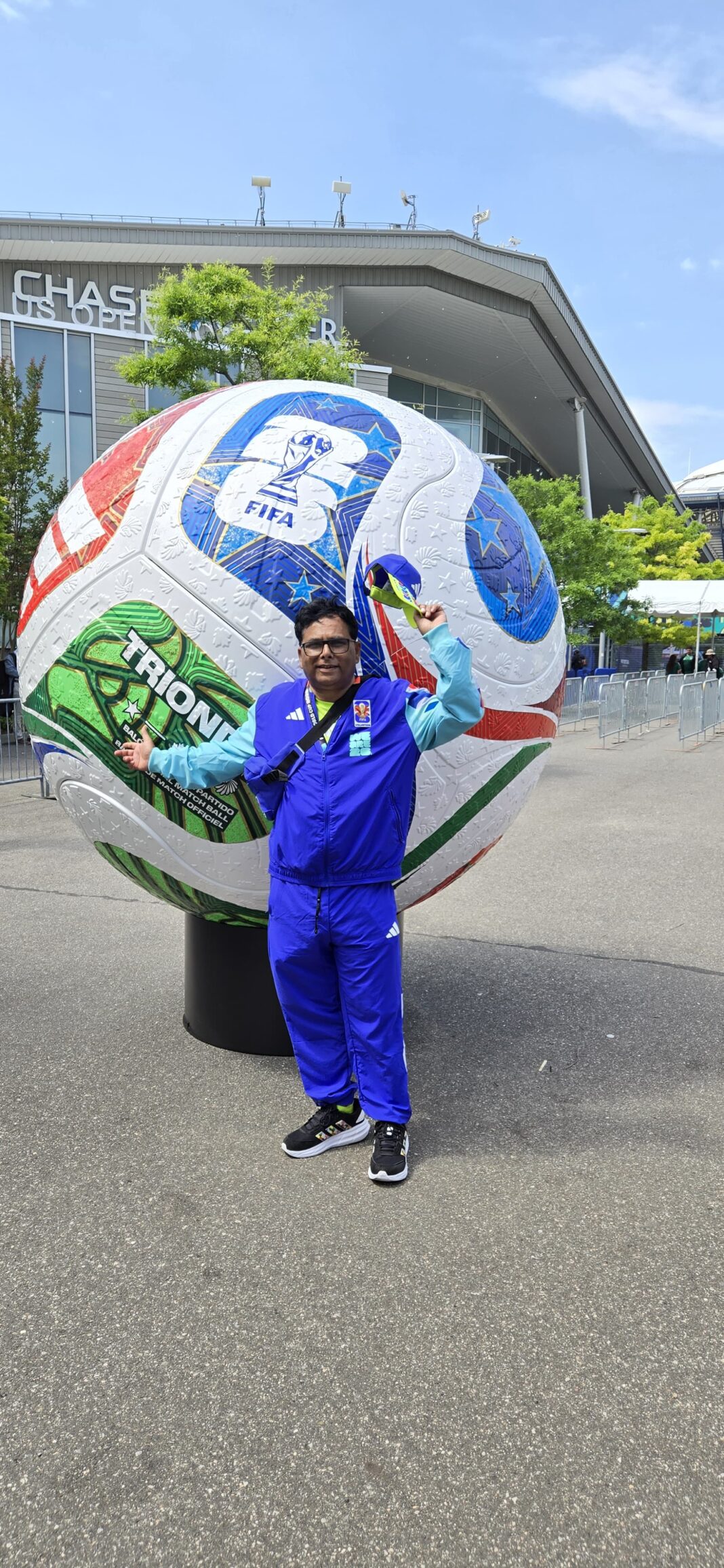
NEW YORK — Thursday morning, and Ibrahim Chowdhury felt something shift before he’d even stepped outside. He pulled on his volunteer uniform, and for once, the sunlight pouring over New York seemed sharper, brighter, more alive. In a city of millions where anonymity is its own kind of weather, today there was no room for it. The entire planet had turned its eyes toward one event, and somewhere inside that vastness, Chowdhury, a Bangladeshi volunteer reporting for his very first shift, had a place to stand.
The occasion was the official kickoff of the FIFA World Cup 2026, the biggest the tournament has ever been. Forty-eight nations, 104 matches, and 39 days of football spread across three host countries: the United States, Mexico, and Canada. For the first time in the competition’s history, three separate opening ceremonies unfolded on the same day, in three different nations, Mexico City, Toronto, and Los Angeles.
It’s no secret that relations between these co-hosts haven’t always been smooth, border walls, tariff disputes, immigration standoffs make the headlines often enough. Yet here they were, three nations sharing one stage, telling the world: come. For a few hours, at least, politics could wait. Football runs on a simpler currency, goals and on opening day, that currency flowed freely. Mexico City’s skyline turned green and gold with flags and jerseys; maple leaves fluttered through the streets of Toronto; and in Los Angeles, a tide of red, white, and blue rolled toward the stadium gates.
At the legendary Azteca in Mexico City, the ceremony itself was a riot of colour and raw emotion. Shakira and Burna Boy delivered the tournament’s title track, “Dai Dai”, Shakira’s return to a World Cup stage sixteen years after she had the planet dancing to “Waka Waka.” Andrea Bocelli joined K-pop artist EJAE for the official anthem, “DNA,” while South Africa’s rising star Tyla took the mic for her country’s national anthem.
Watching it all unfold, Chowdhury found himself struck by something simple: whatever divides the world , and there’s plenty that does, football doesn’t ask for a visa or a passport. It speaks one language, and on opening day, billions of people were fluent in it.
And that’s exactly when his thoughts drifted home, to a country that can watch this spectacle, but never quite step onto it.
Chowdhury remembers a boy from his village named Giyas Uddin, one of the finest footballers of his generation, though almost no one outside their corner of Bangladesh ever knew his name. Barefoot, in a torn vest, on a rough village pitch, his footwork was something close to art, raw, unrefined, but unmistakably real. Alongside him played names Chowdhury still carries with him: Saif Uddin Chowdhury Sufi, later a freedom fighter who gave his life for the country, and Azad Uddin, Asab Uddin, Faruk Uddin, Raiob Ali, and Bhelai Mia. They played with nothing but dreams in their chests, footballs stitched from old rags, goalposts made of two bamboo poles driven into the mud. From fields like that, players with genuinely international talent emerged, talent the world never got the chance to see.
Even earlier, in the era of East Pakistan, Bengali footballers like Nazir Bhai, Taher Bhai, and Nurul Haque Ambia carried the same complaint to their graves: kept off the national team simply for being Bengali, while less talented players from West Pakistan were handed their places.
During the Liberation War, Bangladesh’s footballers played with the spirit of the nation stitched into their shirts a chapter still remembered with pride. But more than fifty years on, where did that spirit go? If there’s one “achievement” Bangladeshi football has to show for the decades since independence, it might be this: an entire nation pouring its heart into supporting Argentina and Brazil, because it has no team of its own to follow. We can’t play. But we can certainly weep for someone else’s victory. Is that tragic, or is it just love, finding its own strange outlet?
Ask who’s responsible, and the question is simple, but the answer never is. Government after government has promised to develop the sport, then moved on. Federations have been filled with political appointees who’ve never competed and don’t understand the game, but know exactly how to hold onto power. Players go unpaid for months. Pitches go undeveloped. Every crisis gets the same answer, “we’ll sort it out next time.” Next time never comes. To this day, the bigger argument is over who sits in the federation chair, not who wears the national jersey.
And yet, somewhere out there, on a waterlogged pitch during monsoon season, there’s a barefoot kid who might have the makings of a Messi. With no academy, no pathway, no one looking, that talent simply dies on the field where it was born. Chowdhury doesn’t know how the cycle ends. Maybe one day someone comes along, outside politics, outside self-interest, in it purely for the game, and that’s the day the real journey begins. Until then, everyone keeps waiting.
Out on the pitch in Mexico City, the World Cup’s opening match had already delivered its verdict: Mexico 2, South Africa 0. But the scoreline barely tells the story. Just ten minutes in, Julián Quiñones found the net, and the eruption from a crowd of seventy to eighty thousand fans in green and gold didn’t stay inside the stadium, it rolled out across Mexico City’s skies.
The moment everyone will remember, though, came in the 67th minute, when Raúl Jiménez scored, and immediately broke down in tears on the pitch. The reason hits hard. Back in 2020, playing for Wolverhampton Wanderers against Arsenal, Jiménez suffered a horrifying collision that fractured his skull. He underwent emergency surgery, and doctors weren’t sure he’d play professional football again. Six years of recovery later, at age 35, in his first-ever World Cup start, he scored his first World Cup goal. For a player once told his career might be over, it was nothing short of a certificate of rebirth.
The match made history for a less celebratory reason too: three red cards in total, a record for any World Cup opening match. South Africa saw two players sent off, Mudau and Zwane, while Mexico lost defender César Montes, a real blow, with the suspension ruling him out of their next group match against South Korea in Guadalajara.
Mexico’s head coach, Javier Aguirre, summed it up afterward: a perfect day, he said, for his 35-year-old forward. There’s a nice symmetry to it, this is Aguirre’s third stint in charge of Mexico, and back in 2010, he was also the man on the bench the last time Mexico opened a World Cup against this very same South African side.
Reactions poured in from everywhere, stadium concourses, social media feeds, tea stalls back home. Mexican fans admitted Jiménez’s tears brought them to tears too: “That wasn’t just a goal off his boot. That was a human being’s goal.” South African supporters, gracious even in defeat, pointed to the two red cards as the turning point, “Without those, it might have been different. Still, we’re proud.” One American fan put it bluntly: “I’ve watched Super Bowls. I’ve watched World Series. After today’s opening ceremony, I get it now, the World Cup is something else entirely.” And one Bangladeshi expat, watching from afar, wrote the line that stayed with Chowdhury longest: “Watching all this, I just keep wondering, when will our country ever get to play on this stage?”
Working his shift, Chowdhury kept coming back to one thought. Football brings the world together but the people who do the work of bringing it together usually stay out of frame, behind the curtain. He’s Bangladeshi. His country isn’t part of this tournament. But he is, in his uniform, smiling, pointing fans from 81 different countries toward their gates, helping make someone else’s day a little brighter.
Is that enough? Not really, he admits. He keeps thinking about Giyas Uddin, the boy from his village, the one with the magic feet. That boy never got near a World Cup. But his love for the game, barefoot, in the mud, soaked through in the monsoon rain, never once wavered. Maybe, Chowdhury thinks, that same love is what eventually carries a Bangladeshi boy onto a stage like this one. Many of us won’t be around to see it. But nobody’s stopped us from dreaming about it.
Back home, those who know him call him “Bagha Ibrahim”, Tiger Ibrahim, the kind of all-rounder who’s never quite been able to sit still. If his presence at the World Cup proves anything, it’s that chasing a dream onto the world’s biggest stage was never about age, or background, or what your passport says. It was about showing up. For Bangladeshis watching from thousands of miles away, having one of their own inside the gates, even far from the pitch itself, feels like its own small victory. And maybe, just maybe, a hint of what could be possible if the door back home ever swings open.
His first shift is over. But the World Cup has only just begun, 39 days of football lie ahead, running through to July 19. And so does the diary.