

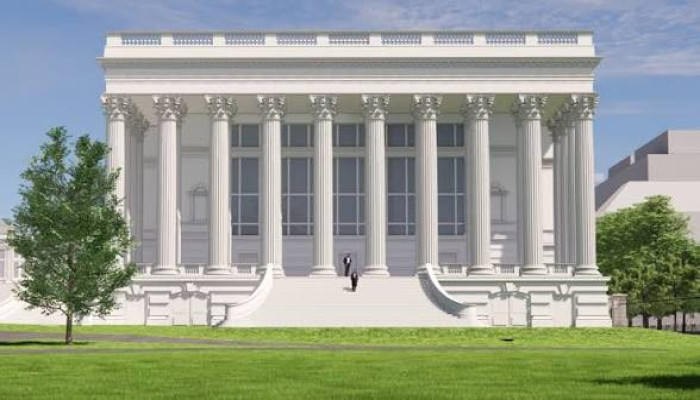
U.S. Chief Justice John Roberts has temporarily allowed construction to continue on President Donald Trump’s proposed $400 million White House ballroom project.
In an interim order issued Friday, August 21, Roberts temporarily blocked a lower court ruling that would have halted above-ground construction on the project within hours. His order will remain in effect until the Supreme Court takes further action on the Trump administration’s emergency appeal.
The one-page order did not explain the reasoning behind the decision or indicate when the full Supreme Court might issue its next ruling.
Because emergency appeals from Washington, D.C., fall under the chief justice’s jurisdiction, Roberts initially handled the matter. However, the full Supreme Court could consider the case at a later stage.
### Trump Welcomes the Decision
Trump welcomed the court’s decision during a political event in South Carolina on Friday, saying it was a positive development that the project could continue.
Later, on social media, Trump claimed that construction was ahead of schedule and that the project remained within budget.
### A Larger Question About Presidential Power
The legal dispute over the ballroom has grown beyond a disagreement over a construction project. It has raised broader constitutional and legal questions about how much authority a president has to make major changes to the White House and other federal properties without congressional approval.
The Trump administration argues that the president has broad authority to renovate and modify government buildings. It has also claimed that parts of the ballroom project involve national security considerations, making it important to complete the work quickly.
However, when Trump first announced the project, national security was not a central justification. At the time, he said the project would be funded through private donations and that he would personally contribute money.
### Dispute Over Demolition of the East Wing
The National Trust for Historic Preservation, an organization dedicated to protecting historic sites, has challenged the project in court.
The organization argues that the president does not have unilateral authority to demolish historic portions of the White House and undertake such a major project without congressional approval. The East Wing has already been demolished to make way for the ballroom.
The organization’s lawyers argued that the administration was rushing construction in an effort to make the court case effectively meaningless by advancing the project while litigation was still underway.
The National Trust does not consider Roberts’ Friday order a final victory for the administration and said it is waiting for the Supreme Court’s next decision.
### A Massive 90,000-Square-Foot Ballroom
Under the current plans, the new ballroom would cover approximately 90,000 square feet, or about 8,400 square meters.
The Trump administration says roughly 65 percent of the project has already been completed. According to documents filed by the Justice Department, workers have been working approximately 20 hours a day, seven days a week, to advance construction.
So far, approximately $200 million in private donations has reportedly been spent or pledged toward the project.
### Project Faced Obstacles in Lower Courts
Last April, a federal district court in Washington ordered a halt to above-ground construction. Although that order was temporarily stayed, a panel of an appeals court later reinstated the lower court’s position.
U.S. District Judge Richard Leon had allowed only underground work involving a bunker and military infrastructure to continue.
On a subsequent appeal, two of the three judges on the panel ruled that approval of a project of this scale falls within Congress’s authority and cannot be undertaken unilaterally by the executive branch.
The third judge, who was appointed by Trump, disagreed, arguing that the organization challenging the project lacked the necessary legal standing to bring the case.
The Trump administration has emphasized that argument in its appeal to the Supreme Court. Solicitor General D. John Sauer described the lower court’s construction halt as extraordinary and unlawful, while arguing that completing the project was important for national security.
### All Eyes on the Full Supreme Court
Chief Justice Roberts’ Friday order gives the Trump administration temporary relief, but it does not resolve the central legal questions surrounding the project.
If the Supreme Court ultimately allows construction to continue for an extended period, the administration could potentially complete much of the ballroom while the broader litigation continues.
If the Court reinstates the lower court’s ruling, above-ground construction could once again be halted.
The future of one of the most expensive and controversial renovation projects in White House history therefore remains dependent on the Supreme Court’s next decision.