
In Gaza, the struggle is no longer limited to protecting the living. Families are also facing an increasingly painful challenge: finding a place to bury those they have lost.
Continued Israeli airstrikes have caused the death toll to rise, while numerous cemeteries have been damaged or destroyed. With burial space becoming scarce, some families have resorted to reopening older graves, creating temporary burial sites or laying their loved ones to rest amid the rubble of destroyed buildings.
A burial ground with almost no space left
Mohammad Al-Sawhi, 40, was killed by gunfire on June 10 near the area known as Gaza’s “Yellow Line,” a military zone designated by Israel.
His 20-year-old son, Omar, took his father’s body to the Zeitoun cemetery in Gaza City. But when he arrived, he found little room left for a new grave.
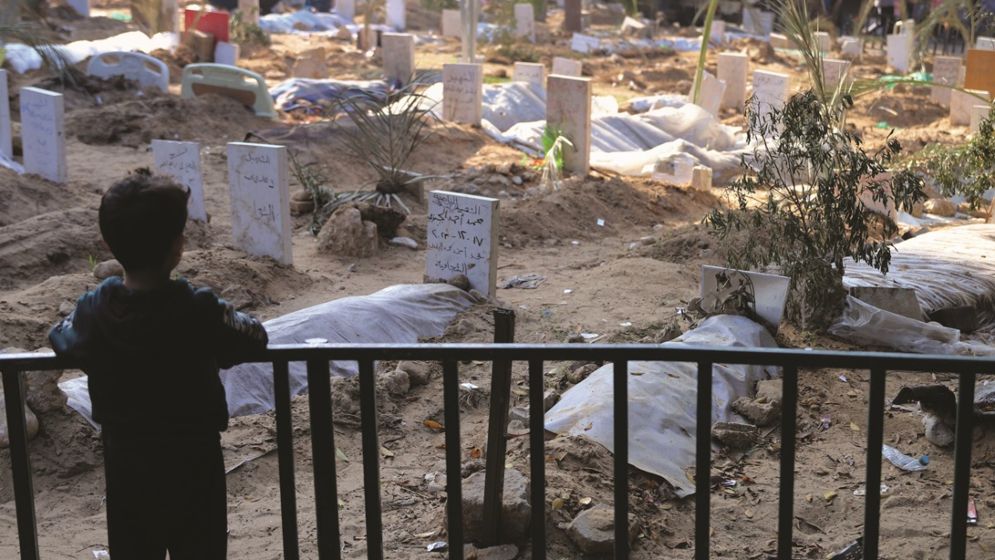
Many of the graves were already occupied by Palestinians killed during the war. Some had no proper headstones or permanent markers, with only stones or pieces of paper bearing the names of the dead.
Omar said he saw bodies buried beneath piles of sand and graves marked with little more than a stone and a handwritten name.
A new grave can cost around 500 shekels, or roughly $167. For Omar’s family, the expense was difficult to afford, while finding an available plot was equally challenging. Eventually, they buried Mohammad in his father’s grave.
Burials amid the rubble
Gaza’s hospitals, municipal services and other civilian infrastructure have been severely disrupted by the war. Ongoing attacks have also made it difficult to identify and recover many bodies. Thousands of Palestinians have at various stages been listed as missing.
Some bodies were temporarily buried in residential yards, tent camps, school grounds and hospital compounds.
After a ceasefire was announced in October 2025 with US mediation, the intensity of Israeli attacks temporarily declined. Some families used the opportunity to recover relatives from temporary graves or the ruins of destroyed homes and rebury them.
According to Gaza authorities, at least 1,200 Palestinians were killed even after the ceasefire was announced. Authorities also said 529 bodies were recovered from seven mass graves located within hospital compounds.
More than 40 cemeteries destroyed
The shortage of burial space is not solely the result of the large number of deaths. Many cemeteries themselves have also been damaged or destroyed during the conflict.
According to Gaza’s Ministry of Religious Affairs and Endowments, more than 40 cemeteries have been destroyed since the war began.
There have also been complaints of severe restrictions on access to cemeteries in areas under Israeli control, further limiting families’ options for burying their relatives.
Repeated bombardment and evacuation orders have forced large numbers of Palestinians from their homes. Some areas that were previously used as cemeteries are now being occupied by displaced families seeking shelter.
The shortage of construction materials, including gravestones, has also pushed up burial costs. Gaza authorities estimate that a burial can now cost between 700 and 1,000 shekels, or approximately $235 to $335.
Unable to afford permanent markers, some families use bricks and stones recovered from destroyed buildings, mud or sheets of corrugated metal to mark graves.
From 60 graves to nearly 6,000
The scale of the crisis is particularly visible at the Khan Younis cemetery.
Tafesh, a cemetery worker, said the site had around 60 graves before the war. Today, the number is estimated at nearly 6,000.
At one point during the conflict, he was preparing around 35 graves a day.
He said he had never witnessed such extensive loss of life. On some days, dozens of people must be buried at the cemetery.
Many of the victims brought to him are women and children, including newborns. When an Israeli strike destroys an entire house, vehicle or tent, several members of the same family are sometimes brought to the cemetery together.
For families in Gaza, the devastation therefore does not end with displacement, destroyed homes or the loss of loved ones. Even finding a final resting place for the dead has become another struggle shaped by the war.