

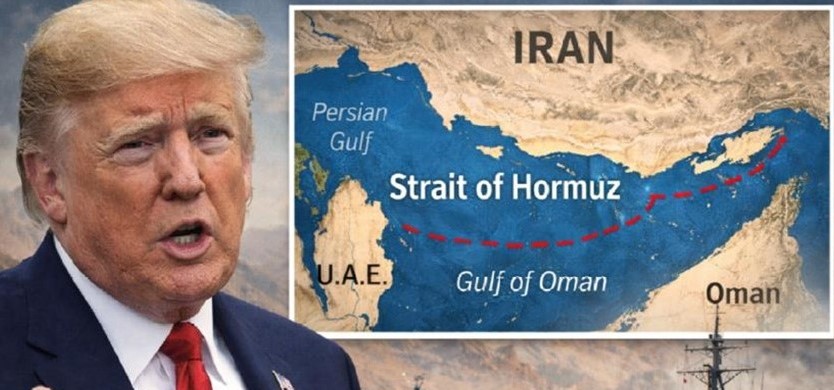
U.S. President Donald Trump has sparked fresh controversy by sharing a map on social media that labels the strategically vital Strait of Hormuz as “New U.S. Territory.” The post came amid escalating tensions between Washington and Tehran and growing disputes over control of the key maritime route.
Trump offered little explanation for the map. However, he had previously suggested that the United States could claim the Strait of Hormuz as its territory after defeating Iran. The latest post has therefore drawn renewed attention to his position.
The map prominently marks the waterway with the words “New U.S. Territory.” Trump had also claimed that, under a U.S. naval blockade, ships would not be allowed to pass through the strait without American approval.
Iran quickly rejected the claim. Iranian Deputy Foreign Minister Kazem Gharibabadi described the idea as a “misconception,” arguing that the legal status of the Strait of Hormuz cannot be changed simply through a presidential declaration, a social-media post or the use of military force.
Located between Iran and Oman, the Strait of Hormuz is one of the world’s most important maritime chokepoints. Its waters are governed by a complex framework of international maritime law, and a country cannot establish sovereignty over an international waterway simply by declaring it part of its territory.
Iranian officials have repeatedly emphasized their country’s rights in the strait. Parliament Speaker Mohammad Bagher Ghalibaf has also said that normal shipping through the waterway would not resume unless the United States accepts Tehran’s demands.
The controversy came as Trump separately said that no negotiations with Iran are currently taking place and no new talks have been scheduled. He also indicated that the U.S. naval blockade would continue.
The two countries had previously been working under a 60-day framework aimed at creating space for negotiations, but no long-term agreement was reached within that period. Tensions have since intensified again, both militarily and diplomatically.
Why Hormuz Matters
The Strait of Hormuz is crucial to the global energy market because large volumes of crude oil and natural gas move through the waterway from the Persian Gulf to international markets.
Any prolonged disruption could therefore have consequences far beyond the Middle East. Reduced energy supplies could push up global oil and gas prices, increasing transportation and manufacturing costs and adding pressure to inflation.
Asian economies such as China, India, Japan and South Korea are particularly dependent on energy supplies from the Middle East. European economies are also closely connected to the region’s energy markets.
Commercial shipping through the strait has already declined significantly amid security concerns, with some operators choosing alternative routes. A prolonged crisis could further disrupt global trade and energy supplies.
Iran Responds With a Satirical Map
Iran also responded to Trump’s territorial map with a mocking gesture. An Iranian government-affiliated social-media account posted a map depicting California as “New Territory of the Islamic Republic of Iran.” The post was presented as a satirical response to Trump’s depiction of Hormuz as U.S. territory.
Meanwhile, tensions have also affected relations between Iran and other Gulf states. The United Arab Emirates announced the suspension of certain economic and financial dealings with Iran after accusing Tehran of launching missiles in the maritime region. Iran has denied the allegation.
Iranian military officials have also warned Gulf states against assisting U.S. military operations, raising concerns that the confrontation could spread further across the region.
Trump’s latest map is not a legally recognized change in sovereignty over the Strait of Hormuz. Nevertheless, it carries significant political and diplomatic implications.
The dispute over Hormuz extends beyond the U.S.-Iran confrontation. It involves international shipping rights, maritime law and global energy security. If tensions continue to escalate, the consequences could reach international trade, fuel prices and the wider global economy.