

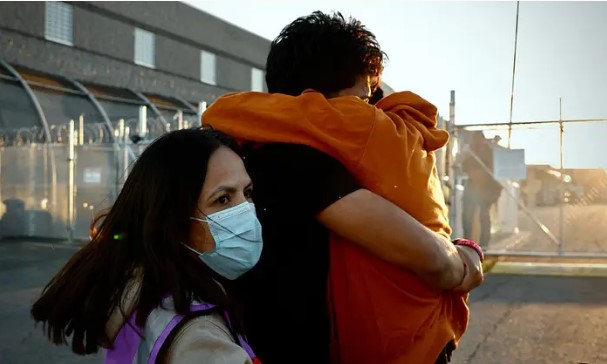
U.S. Immigration and Customs Enforcement (ICE) has been trying to paint a terrifying picture at the Delaney Hall immigration detention facility in Newark, New Jersey, by publicizing the mugshots and criminal histories of detainees. Department of Homeland Security Secretary Markwayne Mullin even took to social media to boast that the government is getting murderers, pedophiles, rapists, and gang members off New Jersey streets. However, the agency’s own internal data completely demolishes this narrative, showing that the facility is actually filling its beds with ordinary immigrants rather than the dangerous criminals the government claims to be targeting.
According to an analysis of ICE data obtained via public records requests by the academic research group Deportation Data Project, more than 10,300 people were detained at the privately run Delaney Hall between May 1, 2025, and March 10, 2026. The reality of who is inside the facility has sparked a massive backlash, prompting detainees to launch labor and hunger strikes in recent weeks to protest their treatment. The data reveals that a staggering 70% of those held at Delaney Hall have absolutely no criminal history whatsoever. Only 12% have actual criminal convictions, while 18% face pending charges that have yet to be decided in court. This makes Delaney Hall significantly less criminal-heavy than ICE facilities nationwide, where 43% of detainees have no criminal history.
This massive gap between government rhetoric and reality has fueled intense demands for the facility’s immediate closure from New York and New Jersey officials, including members of Congress, as well as the families of those locked inside. At a recent press conference outside the facility, Tatiana Barrera shared that her husband was snatched by ICE while actively applying for a U visa, which is explicitly reserved for victims of crimes. Wiping away tears, Barrera emphasized that these individuals are not criminals and face no charges, stating that their only action was coming to the country in search of a better future.
The demographic breakdown further highlights that the facility primarily targets vulnerable migrant populations. As of March 10, when the facility held 845 people against its 1,000-bed limit, the vast majority of detainees—75%—were men born in Latin America or the Caribbean. Women from the same region make up 6.9% of the population, followed by men from Sub-Saharan Africa at 5.2%. Furthermore, the data proves that this is a local crisis, as 63.2% of the detainees were arrested right in New Jersey under ICE’s Newark area of responsibility, while another third were picked up in the New York City area.
Instead of resolving these cases locally, the government is using Delaney Hall as a temporary staging ground to funnel immigrants deeper into the detention system. Nearly 60% of the 10,300 immigrants who passed through the facility were ultimately transferred to other ICE detention centers, mostly located in the Southern United States, before facing final deportation. Only 3% were deported directly from Delaney Hall, while 22% remain somewhere in ICE custody, 9% were released into the country, and 5% chose to self-deport. While the median stay at Delaney Hall is just under ten days, many find themselves trapped for much longer; one in five immigrants is held for over 30 days, and the longest recorded stay reached a grueling 266 days.