
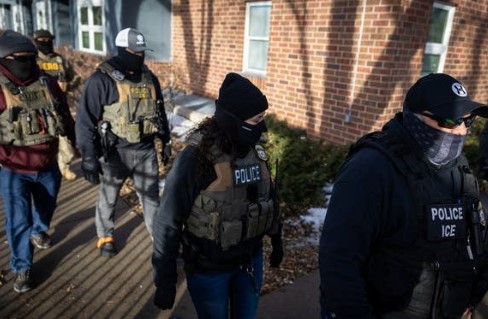
Amnesty International says it has documented widespread human rights violations during the Trump administration’s immigration enforcement operations in the United States. In a report released September 24, the international human rights organization said it found evidence of violations involving U.S. Immigration and Customs Enforcement (ICE), U.S. Customs and Border Protection (CBP), and other federal agencies during enforcement operations in Chicago, Minneapolis-St. Paul, New Orleans and Washington, D.C.
Titled “We Had Whistles, They Had Guns”: Human Rights Violations in U.S. Immigration Enforcement Operations and the Case to Abolish ICE, the report says the Trump administration is implementing a large-scale detention and deportation system fueled by what Amnesty characterizes as racist, xenophobic and false narratives. According to the organization, the system is aimed at detaining and deporting as many migrants, asylum seekers and refugees as possible while spreading fear throughout immigrant communities.
Nadia Daar, executive director of Amnesty International USA, said the report documents what she described as a “chilling pattern” of human rights violations across the country intended to create fear among migrant, asylum-seeker and refugee communities. She said ICE’s record of human rights violations is not new, but that the abuses documented in the report have reached a dangerous new level.
According to the report, the Trump administration has been responsible for a range of serious human rights abuses, including unlawful killings, some of which Amnesty says could amount to extrajudicial executions; arbitrary and discriminatory incommunicado detention, including possible enforced disappearances; detention conditions that may violate the prohibition against torture; and violent repression of peaceful protests.
Based on its findings, Amnesty International is joining community groups and advocates calling for the immediate abolition of ICE.
Amnesty calls for ICE to be abolished
Amnesty said the violations documented across the four operations were not isolated or exceptional incidents, but part of recurring patterns of abuse with devastating consequences for immigrants and entire communities.
“Masked and armed federal agents attacking people in the streets with impunity doesn’t make our communities safer — it puts everyone in danger,” Daar said. “ICE is fundamentally broken and cannot be fixed.”
She said that if the United States is to have an immigration enforcement system that complies with international human rights law and standards, the government must abolish ICE and start over.
ICE was created in the aftermath of the September 11, 2001 terrorist attacks and formally established in 2003 as part of the Department of Homeland Security. Amnesty International and other organizations have documented allegations of human rights violations, as well as concerns about oversight and accountability, since the agency’s creation.
Amnesty said, however, that the scale and severity of what it has documented since January 2025 have reached new levels, citing billions of dollars in additional funding and what it describes as persistent impunity.
Racial profiling, excessive force and detention
According to Amnesty International, the four enforcement operations resulted in alleged human rights violations against immigrants, asylum seekers, refugees, people perceived or profiled as immigrants, Black and Brown communities, and people who came to their aid or protested against the administration’s conduct.
The organization said the operations also created a pervasive climate of fear extending throughout immigrant communities.
Among the violations documented across the four operations were:
Racially discriminatory immigration enforcement operations and arbitrary detention;
Harassment, intimidation, degrading treatment and unjustified use of force by federal agents;
The use of lethal force and unlawful killings, which Amnesty says should be investigated as possible extrajudicial executions;
Suppression of protests and the use of less-lethal weapons, including tear gas and pepper spray;
Unlawful surveillance and the use of facial-recognition technology;
Inhumane detention conditions and denial of due process, which Amnesty says should be investigated as possible torture; and
Unlawful incommunicado detention and possible enforced disappearances.
The report says ICE agents operated within an institutional environment that the Trump administration openly supported and expanded. Amnesty alleges that senior government officials, including President Donald Trump, encouraged violent and racially discriminatory immigration enforcement practices.
The organization also said agents frequently operated while wearing masks and without identification, while safeguards intended to prevent and address misconduct were weakened or dismantled. Amnesty said human rights violations rarely led to meaningful investigation or accountability.
Account from Minnesota state representative
The report includes an account from Minnesota State Representative Liish Kozlowski, who is described by Amnesty as Ojibwe-Latino.
Kozlowski said her pregnant cousin was traveling by car with her husband on the way to work when ICE agents approached the vehicle, pointed guns at them and smashed the car window. She said the agents treated her cousin roughly.
According to Kozlowski’s account, her cousin’s husband shouted that she was Native American and showed the agents her tribal identification card. An ICE agent allegedly responded that the identification did not matter and said, “this is our land now.”
Amnesty said this was one of dozens of incidents documented in the report in which ICE agents appeared to engage in explicit racial profiling.
Ana Piquer, Americas director at Amnesty International, said racial profiling, removing people from the streets, separating families and arbitrarily detaining individuals are not only unlawful and cruel practices but also profoundly damaging.
“These practices violate human rights and cause fear and psychological distress and long-lasting health concerns to children, other family members and entire communities,” Piquer said.
Communities organize to protect one another
The report also describes how communities have organized to protect one another and resist immigration enforcement operations.
Amnesty said mutual-aid networks, constitutional-observer training, rapid-response networks and initiatives such as walking school buses have played an important role in protecting people most directly affected by immigration enforcement and documenting alleged human rights violations.
Protests have also become an important form of resistance, although Amnesty said protesters have frequently faced additional alleged abuses by ICE and Border Patrol agents.
In Chicago, the Broadview facility became a focal point for protests against ICE and Border Patrol operations.
The Rev. David Black, who regularly conducts religious services at the site, described what he said was increasing violence by ICE and CBP agents during prayer services and demonstrations.
According to Amnesty’s report, during one such service, Black was wearing religious clothing and standing on a rooftop, calling on three federal agents to repent, when he was suddenly struck in the face, hands and body by projectiles containing an irritant pepper substance.
The report presents his experience as one of numerous accounts collected by Amnesty during its investigation.
154 people interviewed
Amnesty International researchers interviewed 154 people across the four locations. The organization said the interviews enabled its researchers to examine the impact of immigration enforcement operations on diverse immigrant communities across different political, legal and historical contexts.
Based on those interviews and other research, Amnesty concluded that the human rights violations it documented were not isolated local incidents but reflected broader national patterns.
Daar said it was heartbreaking to see the pain and suffering caused by what she described as an administration that criminalizes and demonizes immigrants.
At the same time, she said she remained hopeful because communities had rallied around people who were targeted and, in some instances, had forced the Trump administration to back down.
Daar called for government officials responsible for what she described as a “reign of terror” to be held accountable and urged continued efforts toward an immigration system grounded in human rights and dignity rather than cruelty.