

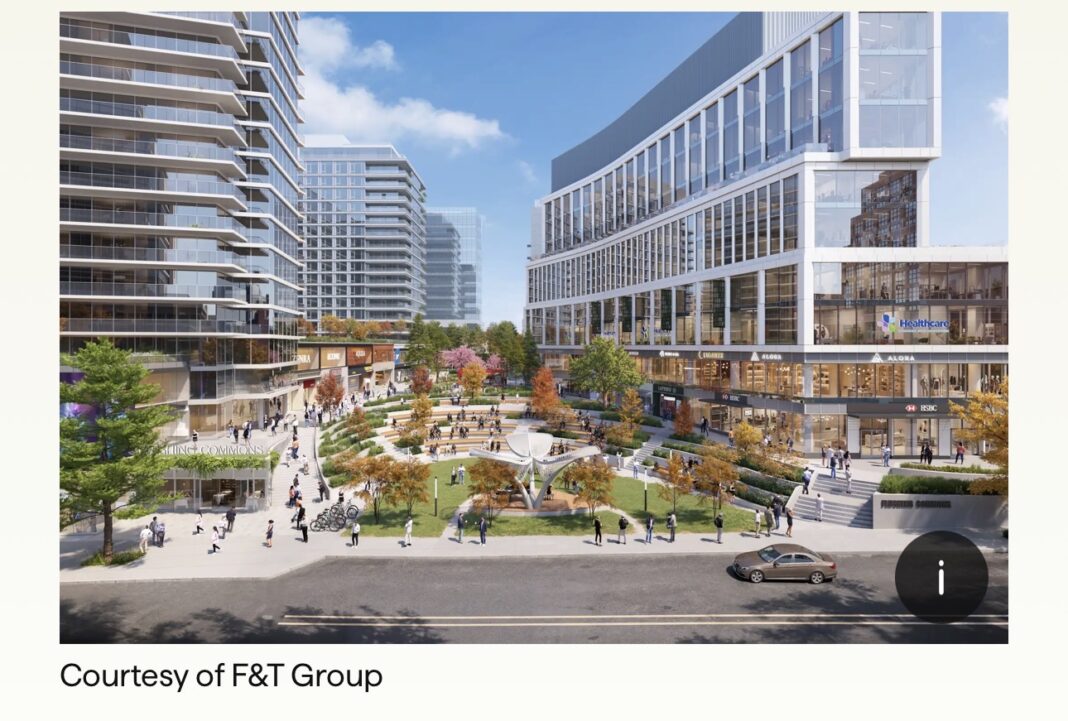
Downtown Flushing in Queens is one step closer to getting a long-awaited 1.3-acre public plaza, or “town square,” as part of the massive Flushing Commons development.
Developer F&T Group has begun construction on the plaza as well as the second of three mixed-use towers planned for the project. The development is expected to include a new YMCA, hundreds of condominium units and thousands of square feet of retail and office space.
When the City Council approved Flushing Commons in 2010, the developers and city economic-development officials promoted it as a major engine for economic growth. Located near the busy Flushing–Main Street subway and Long Island Rail Road station, the project was expected to create thousands of jobs and transform the area into a major destination.
But Flushing has changed considerably since then.
The neighborhood, historically home to large numbers of Asian middle-class and working-class residents, has seen a wave of luxury high-rise condominium construction. Housing rents and sale prices have risen sharply, raising concerns that longtime residents and small businesses could be priced out.
According to StreetEasy data, the median sale price of a home in Flushing was about $350,000 in 2010. Today, it is roughly $650,000. The neighborhood’s median household income is about $69,000, below the citywide median of approximately $85,000.
A 2016 study by the Urban Displacement Project found signs of gentrification and displacement of lower-income households in several parts of Flushing.
City-Owned Land, No Affordable Housing
Flushing Commons is being developed on city-owned land that was sold to developers for less than its market value. The project has nevertheless faced criticism because its condominium component does not include on-site affordable housing.
Units at Flushing Commons have starting prices of around $1 million.
Critics have described the development as a symbol of unequal growth and a catalyst for gentrification in Downtown Flushing.
Tarry Hum, a retired Queens College professor, has criticized the project since its early stages, calling it a “self-serving giveaway.”
“They’re creating an area that will cater to the needs of a global wealthy elite,” Hum said. “It feels like they want to build Shanghai in the heart of Queens.”
Chuck Apelian, chair of Community Board 7, has also acknowledged the stark changes brought by the development.
“It’s a different world,” Apelian said. “Today, you couldn’t get an upzoning without affordable housing.”
An affordable housing development with 140 units was approved in connection with the broader project. But Hum has criticized the arrangement from the beginning, describing it as a concession that was effectively “given away.”
A Controversial History
The land on which Flushing Commons is being built also carries a complicated history.
In the mid-20th century, city planner Robert Moses used an urban-renewal program described as “slum clearance” to displace a Black community from the area and build what was described as the city’s first municipal parking lot, according to The New York Times.
In 2004, the Bloomberg administration proposed transforming the parking lot into part of a three-part redevelopment plan covering Downtown Flushing, the waterfront and Willets Point. Flushing Commons emerged as one of the centerpiece projects of that broader vision.
The redevelopment has since transformed the physical and economic character of the neighborhood, but it has also raised questions about who benefits from the investment.
Will the ‘Town Square’ Serve Everyone?
Even the planned public plaza has generated skepticism among some local residents and community leaders.
Cody Herman, a Community Board member and artist, said previous privately owned public spaces developed by private companies have often failed to become vibrant community gathering places.
The question, critics say, is whether the new 1.3-acre plaza will genuinely function as a public space for longtime Flushing residents or primarily serve the residents and visitors drawn to the new luxury development.
F&T Group and representatives of organizations such as Asian Americans for Equality, however, see potential benefits in the project.
Thomas Yu, executive director of Asian Americans for Equality, said many small-business owners and residents remain concerned about affordable housing but also welcome new development because of the jobs and economic opportunities it could generate.
He argued that market conditions are changing and that developers are increasingly recognizing that relying solely on international capital to build luxury condominiums is not necessarily sustainable.
That shift, he said, could create an opportunity to push for more affordable housing as Flushing continues to develop.
For now, Flushing Commons represents both sides of the neighborhood’s transformation: a major investment promising new jobs, housing, retail and public space—and a source of growing concern that the people who built their lives in Flushing may no longer be able to afford to remain there.