

A powerful nor’easter has battered the northeastern United States, bringing fierce winds, torrential rain, coastal flooding and large waves that disrupted daily life across a wide stretch of the East Coast.
The storm affected major cities including New York, Boston and Philadelphia, leaving more than 130,000 customers without electricity at one point and causing widespread flooding and property damage. At least one death has been confirmed.
Authorities and utility crews have been working to restore power and clear roads as the storm gradually weakened after several days of severe weather along the East Coast. The National Weather Service said Sunday evening that conditions were beginning to improve, with the storm weakening and some coastal flood warnings being lifted.
Strong Winds and Power Outages
The storm’s strongest impacts were reported along coastal areas of New York, New Jersey and Connecticut. More than 130,000 customers across the Northeast and Mid-Atlantic were without power Sunday morning, according to PowerOutage.us.
Long Island experienced some of the most extensive outages. Wind gusts reached 81 mph (130 km/h) at Montauk Point on the eastern end of Long Island. New Jersey reported roughly 50,000 outages, while Connecticut had about 25,000 customers without electricity.
The storm’s center was near the New Jersey coast, while its cloud and rain bands extended northward across much of New England.
Fallen trees damaged homes and vehicles, blocked roads and brought down utility lines in several areas. The combination of powerful winds, heavy rain and high tides also created dangerous conditions along the coast.
Death Reported in New York City
A New York City Housing Authority employee was killed Saturday after a tree fell on him while he was walking through a parking area in Brooklyn, according to authorities.
The man, identified in local reports as 56 years old, was killed during the storm. Four other people were reportedly injured when another tree fell in Brooklyn.
The incident highlighted the dangers created by the storm’s strong winds, particularly in urban and heavily wooded areas.
Flooding and Coastal Damage
The nor’easter also produced widespread coastal flooding as powerful winds pushed Atlantic waters toward shore during a period of unusually high tides.
Flooding was reported in parts of New York, New Jersey, Maryland and Virginia. In some communities, residents used kayaks to navigate flooded streets, while emergency crews rescued people trapped by rising water.
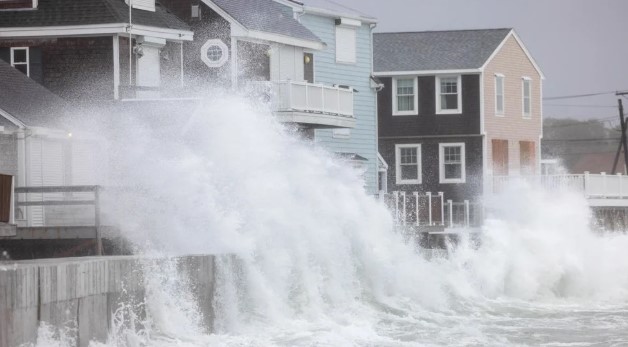
Large waves crashed over seawalls and boardwalks, while coastal homes and businesses were threatened by storm-driven water.
In North Carolina, flooding and coastal erosion damaged a section of N.C. Highway 12, a major road running along the state’s narrow Outer Banks. Parts of the road were broken apart by water and erosion, disrupting access to some coastal communities.
Images and videos from affected areas showed large waves striking coastal properties and seawalls. In some flooded communities, water covered streets and forced residents and emergency personnel to use boats.
Major Disruptions to Air Travel
The storm also disrupted air travel across the Northeast, with hundreds of flights canceled and many more delayed.
Boston’s Logan International Airport was among the airports hardest hit. FlightAware reported hundreds of cancellations and delays at Logan over the weekend. By Sunday afternoon, more than 300 flights had been canceled at the airport, in addition to hundreds of delays.
Other airports in New York and the Northeast also experienced weather-related delays as strong winds and poor conditions affected flight operations.
Travelers were advised to check with airlines before heading to airports, as cancellations and delays were expected to continue while the storm moved out of the region.
Storm Gradually Weakening
The nor’easter had remained unusually slow-moving, allowing its effects to persist along the East Coast for several days.
The National Weather Service said Sunday evening that the storm was gradually weakening. However, coastal flooding and strong winds were expected to continue in some areas into Monday, particularly during high-tide cycles.
The storm brought a combination of heavy rain, powerful winds, high tides and dangerous surf from the Mid-Atlantic to New England. Authorities continued to warn residents in low-lying coastal areas to remain alert as the final rounds of high tides passed.
The storm’s impact—from widespread power outages and transportation disruptions to flooding, infrastructure damage and a confirmed fatality—made it one of the more significant weather events to hit the Northeast during the late September period.