
The question has become one of the most closely watched issues in international diplomacy. Current Secretary-General António Guterres’ second term ends on December 31, paving the way for a new UN leader from January 1, 2027. Diplomatic activity has already intensified at UN headquarters in New York over who will take over the world’s largest multilateral organization.
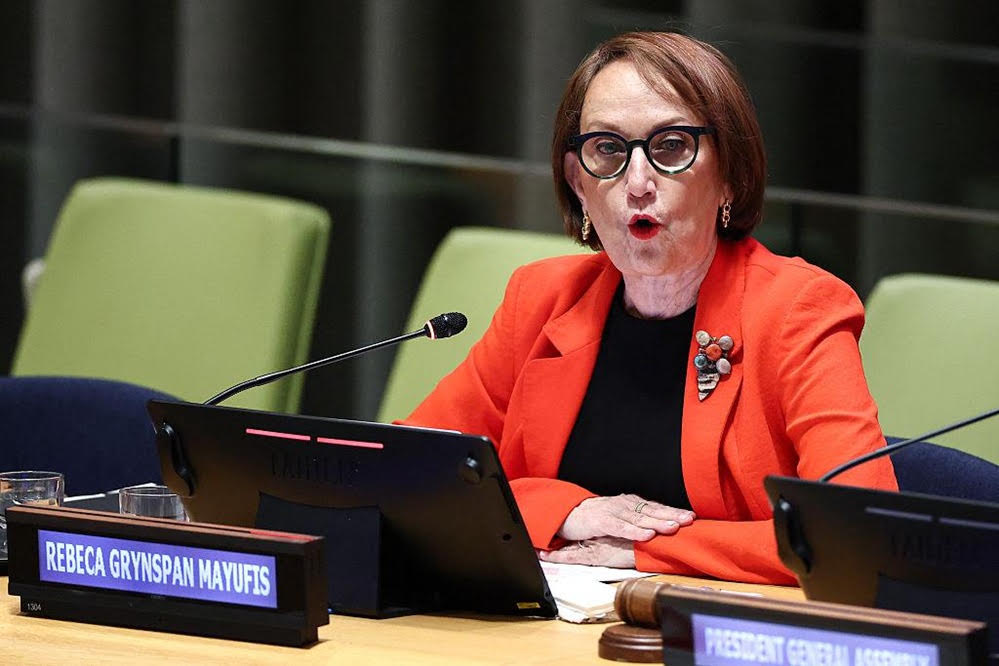
Eight candidates are currently in the race: Costa Rica’s Rebeca Grynspan, Guyana’s Carolyn Rodrigues-Birkett, Argentina’s Rafael Grossi, former Chilean President Michelle Bachelet, Ecuador’s María Fernanda Espinosa and Ivonne Baki, former Senegalese President Macky Sall, and former UN official Olara Otunnu of Uganda.
### Grynspan Leads the First Straw Poll
The 15 members of the UN Security Council held the first informal “straw poll” on July 30. The vote was not a formal election, but rather a confidential exercise designed to gauge the level of support and opposition among council members for each candidate.
Costa Rica’s Rebeca Grynspan emerged as the frontrunner, receiving 10 “encourage” votes. Guyana’s Carolyn Rodrigues-Birkett received nine, while Argentina’s Rafael Grossi received seven.
The results should not be interpreted as a final election outcome. Instead, they offer an early indication of where the candidates stand. On August 21, the Security Council is holding a second informal straw poll, with international attention focused on whether the candidates’ positions will change.
### Who Is Rebeca Grynspan?
Rebeca Grynspan, who led the first round, is a former vice president of Costa Rica. She currently serves as Secretary-General of the United Nations Conference on Trade and Development (UNCTAD).
She has extensive experience in economics, development, international cooperation and multilateral diplomacy. Her candidacy carries particular historical significance: if elected, she would become the first woman to serve as UN Secretary-General in the organization’s nearly 80-year history.
Grynspan is also viewed by some as a continuity candidate, potentially favoring a continuation of the UN’s existing multilateral framework and institutions.
### Carolyn Rodrigues-Birkett: A Strong Challenger
Guyana’s Carolyn Rodrigues-Birkett finished second in the first straw poll, just one vote behind Grynspan.
A former foreign minister of Guyana and the country’s current permanent representative to the United Nations, Rodrigues-Birkett has emerged as an important candidate for the Caribbean region.
If elected, she would not only become the UN’s first female Secretary-General but also the first from the Caribbean. Her campaign emphasizes climate change, development financing and bringing the interests of small states closer to the center of international decision-making.
### Rafael Grossi: Another Major Contender
Argentina’s Rafael Mariano Grossi finished third in the first straw poll. He currently serves as Director General of the International Atomic Energy Agency (IAEA).
His experience in nuclear security, international crises and diplomacy during wartime gives him a distinct profile among the candidates. He has played a direct diplomatic role in complex international issues involving countries such as Ukraine and Iran.
With seven “encourage” votes in the first straw poll, Grossi remains a significant contender.
### The Other Five Candidates
Former Chilean President and former UN High Commissioner for Human Rights Michelle Bachelet is another prominent candidate in the race.
Ecuador’s former foreign minister and former President of the UN General Assembly, María Fernanda Espinosa, is also considered a serious contender because of her extensive experience in multilateral diplomacy.
Former Senegalese President Macky Sall is competing as one of Africa’s best-known political figures.
Olara Otunnu, a former UN Under-Secretary-General from Uganda, is emphasizing UN reform and ethical leadership. He has argued that structural reforms are necessary to make the organization more effective and efficient.
The newest candidate is Ecuadorian diplomat Ivonne Baki. Her candidacy was formally announced on August 18, meaning she was not able to participate in the first straw poll in July.
### A Historic Opportunity for a Woman to Lead the UN
The strong presence of female candidates has given this year’s race historic significance. Five of the eight candidates are women.
No woman has ever served as UN Secretary-General since the organization was established. If Grynspan, Rodrigues-Birkett, Bachelet, Espinosa or Baki is ultimately selected, it would mark a historic first for the United Nations.
The strong performances of Grynspan and Rodrigues-Birkett in the first straw poll have further strengthened the possibility of the UN choosing its first female Secretary-General.
### Could Latin America and the Caribbean Have Their Turn?
Another notable feature of this year’s race is the strong representation of candidates from Latin America and the Caribbean.
Grynspan is from Costa Rica, Grossi from Argentina, Bachelet from Chile, and Espinosa and Baki from Ecuador. Rodrigues-Birkett represents Guyana.
There is no mandatory regional rotation system governing the selection of the UN Secretary-General. However, regional balance has long been an important political consideration. As a result, the possibility of a candidate from Latin America or the Caribbean becoming the next Secretary-General is receiving considerable diplomatic attention.
### Where Does the Real Power Lie?
The number of votes a candidate receives in a straw poll is important, but another factor may prove even more decisive: the position of the five permanent members of the Security Council.
The United States, Russia, China, the United Kingdom and France all have veto power. Even if a candidate secures broad support within the Security Council, a veto from any one of these five countries could block the nomination.
That is why Grynspan’s first-place finish does not make her the inevitable winner. Future straw polls will be closely watched for changes in the number of “encourage” votes, as well as increases in “discourage” votes against particular candidates.
### A Difficult World Awaits the New Secretary-General
The next Secretary-General will take office in 2027 at a time when the United Nations is facing an extraordinary range of challenges.
The war in Ukraine, conflicts in the Middle East, the Gaza crisis, nuclear security, climate change, the global refugee crisis, economic inequality and growing geopolitical rivalry between the United States and China will all demand attention.
The UN is also facing financial difficulties, concerns over administrative spending and growing calls to make the organization more efficient and effective.
Ivonne Baki has recently emphasized the importance of preventing conflicts before they escalate, as well as reforming the United Nations. Otunnu has similarly stressed the need to restore the organization’s effectiveness and ethical leadership.
### When Will the New Secretary-General Be Known?
Following several rounds of informal voting and diplomatic consultations within the Security Council, one candidate will eventually be formally recommended for the position.
The UN General Assembly will then appoint that candidate as Secretary-General.
The process could take several rounds, with a final decision potentially emerging between late September and October. However, if member states struggle to reach consensus, the process could take longer.
### Who Is Currently Ahead?
At this stage, it is impossible to say with certainty who will become the next UN Secretary-General.
Based on the results of the first Security Council straw poll, however, Rebeca Grynspan is currently the leading candidate, followed closely by Carolyn Rodrigues-Birkett and then Rafael Grossi.
But the decisive battle will not simply be about the number of votes each candidate receives. Ultimately, the outcome will depend on which candidate can secure broad acceptance, particularly among the five permanent members of the Security Council.
If a woman ultimately wins the necessary consensus, the United Nations will make history by appointing its first female Secretary-General in nearly 80 years.
For now, all eyes are on the Security Council’s second straw poll. Its results could provide a clearer indication of whether Rebeca Grynspan is truly emerging as the leading contender—or whether another candidate will eventually become the face of consensus.