

Election outcomes in India—the world’s largest democracy—are never just about who wins or loses; they tell a broader story of political transition and reflect the collective aspirations of the people. History shows that wartime leadership and peacetime governance often demand different qualities. Even after leading Britain to victory in World War II, Winston Churchill was voted out of power in 1945. Democracy speaks in its own language, and understanding that language is the real challenge of political analysis. The recent election in West Bengal adds another layer to that challenge.
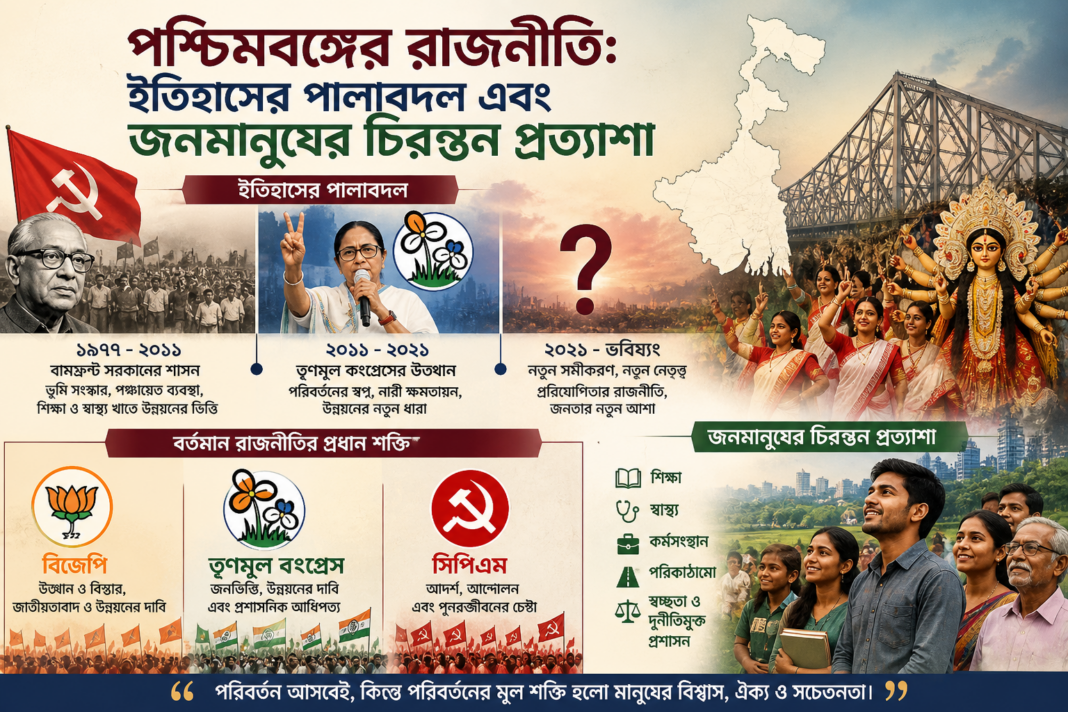
For people in Bangladesh, elections in West Bengal carry special significance—not just because of geographic proximity, but due to shared language, literature, culture, and the painful legacy of partition. The Partition of India did not merely redraw borders; it split identities, memories, and lives. That historical connection continues to bind the people of the two Bengals in ways that cannot be easily ignored. Any discussion of West Bengal’s political history must begin with the long and influential era of the Left movement. For over three decades, the Left Front dominated the state’s politics—an exceptional phenomenon
in democratic systems worldwide. While countries like Sweden saw long-term rule by social democrats, the uninterrupted dominance of the Left in West Bengal remains rare. Even as the Fall of the Berlin Wall and the collapse of the Soviet Union reshaped global politics, the Left in Bengal managed to retain its base for years. However, prolonged time in power can lead to institutional fatigue. As seen with Mexico’s long-ruling party, extended dominance can gradually distance a political force from the people it represents—and the same dynamic eventually affected the Left in Bengal.
The political landscape shifted dramatically with the rise of Mamata Banerjee. Her ascent marked the breaking of a seemingly unshakable Left stronghold. A determined and uncompromising leader, she carved out a new political chapter in the state’s history. Many have drawn comparisons between her rise and that of Margaret Thatcher in the United
Kingdom—both challenged male-dominated political structures and rose to power through resilience and determination. For more than a decade and a half, her party governed West Bengal, and her legacy as a formidable political figure is firmly established.
Yet history moves forward relentlessly. Questions around employment, public safety, and governance have led many to feel that expectations were not fully met under her administration. In democratic societies, extended time in power often brings growing challenges. People seek change—new leadership, new promises, and renewed hope. This pattern is not unique; it is a defining feature of democratic systems.
In this context, the Bharatiya Janata Party (BJP) has succeeded in gaining ground in West Bengal. This aligns with a broader global trend of rising conservative politics. From the political resurgence of Donald Trump in the United States to the leadership of Giorgia Meloni in Italy and the long tenure of Viktor Orbán in Hungary, nationalism and identity
politics have become powerful forces worldwide. India is no exception, and the BJP has effectively harnessed these sentiments.
At the same time, another important development is the emergence of a new generation of Left leaders. Just as Alexis Tsipras in Greece and movements like Podemos in Spain revitalized left-wing politics among younger voters, similar signs of renewal can be seen in West Bengal. Although they did not achieve electoral success this time, their presence signals that the political contest in the state may increasingly center around the BJP and a rejuvenated Left. Of course, political trajectories are never linear—history often takes unexpected turns.
The people of West Bengal have, for now, placed their trust in a new political force. Whether that decision proves beneficial or not will only become clear over time. History reminds us that every ruling power is eventually held accountable by the people. Democracy allows for both mistakes and corrections. That is its strength.
Ultimately, the ongoing political journey in West Bengal reflects a deeper truth: the enduring hope that governance will align with the needs and aspirations of ordinary people. In that continuous process, the belief remains that those who truly represent the public will, one day, rise to lead.