
Arif Mahmud Shaibal
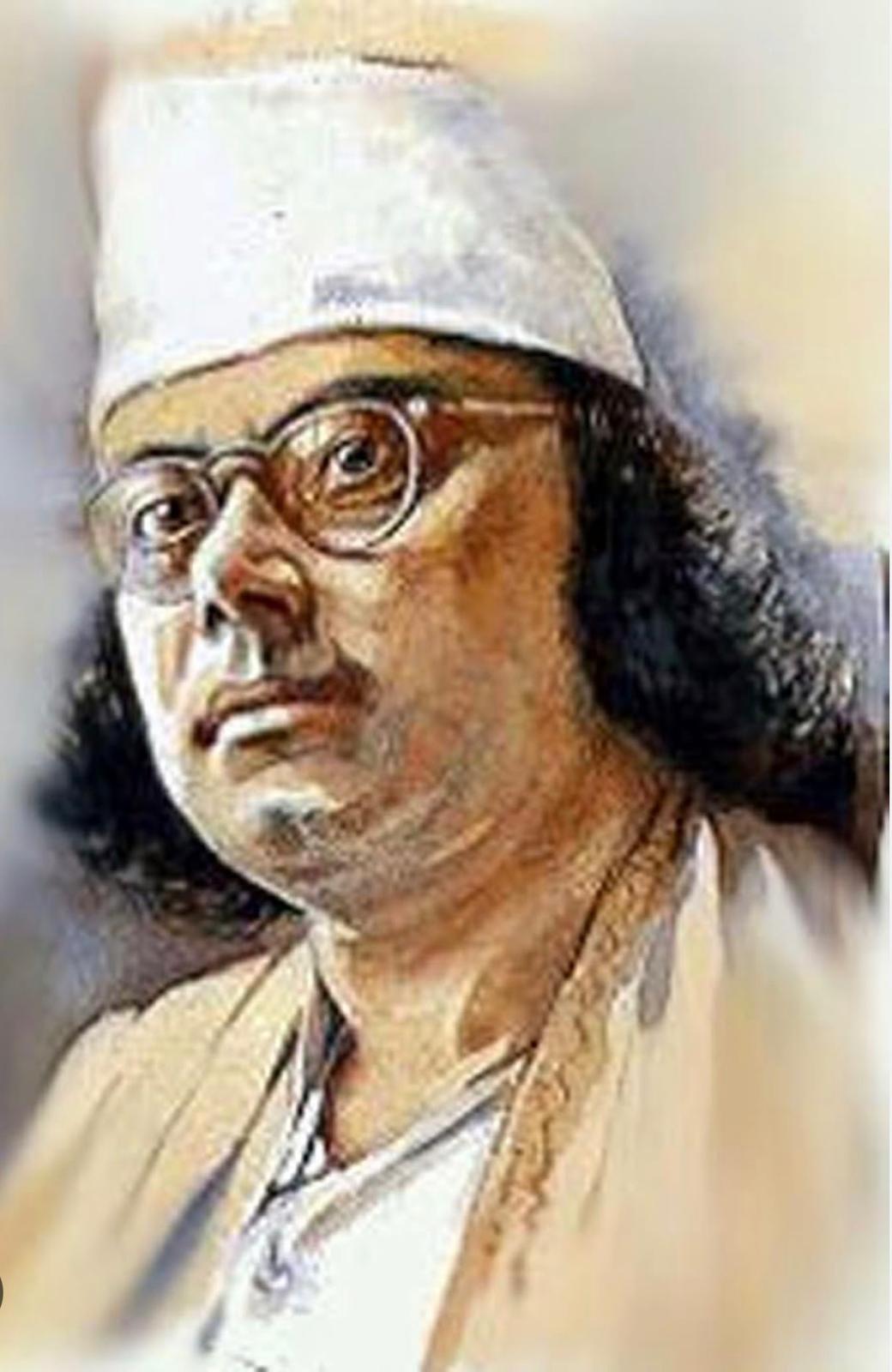
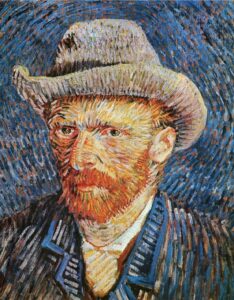
[ Vincent van Gogh (Born: March 30, 1853 – Died: July 29, 1890); Kazi Nazrul Islam (Born: May 24, 1899 – Died: August 29, 1976) ]
New York is often called the capital of the world. In the heart of Manhattan stands *The Museum of Modern Art (MoMA)*. I visit quite often.
Today, in between exploring the museum, I stepped outside for a moment.
The museum spans a vast area. Its architecture, design, techniques, and above all, its atmosphere offer a sense of relief to the urban-weary people of this bustling city.
It reminded me of the environment of Alliance Française in Dhanmondi, Dhaka—something that deeply attracted me during my student days. From Mohsin Hall at the University of Dhaka, I would go there almost every afternoon. Every day, thousands of art lovers from across the world gather in MoMA’s galleries. I watch and marvel.
Can the relative crowd sizes in art museums or libraries compared to train stations or fish markets in different countries reveal something about their educational standards and aesthetic sensibilities? Perhaps this is a topic worthy of research. But that is a different debate. Let me return to MoMA.
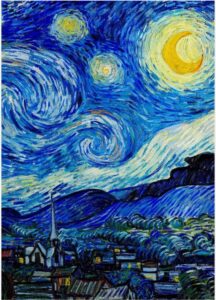
Arguably, MoMA’s main attraction is Vincent van Gogh’s oil painting *“The Starry Night.”* It is astonishing to think that around three million visitors come every year just to see this artwork. It is like the Taj Mahal of oil paintings! Standing before it, people feel like they are part of history.
Why is this 7.3-square-foot canvas a masterpiece? What is in it? What creates such an attraction? There are many other world-famous artworks in the museum—yet why does this one draw people like bees to honey? One answer may be that “The Starry Night” feels familiar, intimate, and deeply personal. It is a painting of humanity. People from any era or
region can find themselves beneath its star-filled blue sky.
Another reason for its appeal is its creator, Vincent van Gogh. He is a legendary artist. There is a common notion that some artists are eccentric, different from ordinary people. They perceive the world differently. But what if a man considered mentally unstable, undergoing treatment, emerges as an artist who shakes the world? That is exactly what happened in van Gogh’s life. No wonder he became a legend.
Although I am not writing a biography, his life is fascinating. Van Gogh’s early life was simple and ordinary. He fell deeply in love with a young woman but was rejected. At one point, he left home to become a clergyman. As a missionary, he went to a coal-mining region in Belgium.
There, the lives of poor, working-class people deeply moved him.
At the end of the day or week, these very people came to him for prayer.
Their suffering and hardship stirred his soul. Once, he gave up his comfortable room to a homeless man and slept on a pile of hay instead.
His decision to live among ordinary people was not appreciated by the powerful and comfort-loving leaders of the church. His behavior seemed inappropriate to them. Under pressure, he had to leave.
Perhaps he felt betrayed—a blow he never fully recovered from. One wonders: why did such a compassionate and sensitive human being later become mentally ill? Why did he choose the path of suicide?
Van Gogh’s extraordinary life deeply fascinates me. Among those comparable to him, I find Ernest Hemingway—and also our own Kazi Nazrul Islam. I see a shared spirit of defiance in all of them.
Although Nazrul and van Gogh belonged to different mediums, eras, geographies, and socio-political contexts, there exists a profound
similarity in their philosophy of life, the brevity of their creative periods, their rooted originality, and their timeless contributions. In the history of art and literature, these two rare geniuses appeared like comets—rejecting established norms and creating entirely new aesthetics of their own.
Nazrul’s poetic language was uniquely his own—completely outside the overly sentimental romantic trends of his time. It was fresh, powerful, and intensely appealing. His language was free from imitation of European literature.
It must be remembered that by then, Bengali literature shaped by Rabindranath Tagore had already set the standard for the tastes of the educated middle and upper classes—literature that was preserved in drawing rooms and appreciated in elite circles. Most contemporary writers followed that path. But Nazrul brought Bengali literature out of
that Eurocentric, middle-class enclosure into the open fields of the people—into the noise and vitality of everyday life.
To the literary establishment of the time, Nazrul’s language and style seemed unfamiliar, uncomfortable, even dangerous. So they hastily labeled him—“The Rebel Poet”—as if to confine him within a single identity.
Yet this “rebellion” was only one aspect of his work. His true revolution lay in language, music, subject matter, and in transforming the social position of literature itself. In that sense, Nazrul was a true originator of Bengali consciousness. His literature was not childish noise—it was a bold quest for identity for Bengalis and Indians alike.
Later, Abdul Mannan Syed wrote that beside Jasimuddin and Nazrul, even Rabindranath can seem foreign. Though uncomfortable, the statement carries a deeper truth.
Jasimuddin and Nazrul were self-taught, deeply rooted in the soil. Their literary strength and nourishment came from the lives of ordinary people. In contrast, many poets—from Michael Madhusudan Dutt to Rabindranath, even the modernists of the 1930s—often sought to “elevate” Bengali poetry to European standards. Their themes and styles were
influenced by European ideals.
The poets of the 1930s sang of urban alienation and despair inspired by European life. From this perspective, Jasimuddin and Nazrul appear far more authentically Bengali. They did not walk the path prescribed by Europe. Despite facing marginalization and communal prejudice, Nazrul broke elite barriers and brought the scent of soil into literature.
Nazrul never sought validation from colonial Europe or international awards. He consciously avoided that path. That is where he stands apart—perhaps above his contemporaries. He was free in his own creative world, and he spread that freedom among his people.
In this context, a remark b y Assamese singer Zubeen Garg about Bhupen Hazarika comes to mind: while others composed romantic songs, Hazarika was the only truly progressive musician of his time. Similarly, Nazrul had already initiated a progressive movement in poetry and music in colonial India a century ago—yet we have rarely acknowledged it.
Why did contemporary intellectuals hesitate to call Nazrul progressive? The answer is not hard to find. To recognize him as progressive like Neruda, would have rendered many of them obsolete. Calling him “rebellious” instead was politically convenient. It reflected colonial power dynamics and a subtle disregard for his identity as a poor Muslim.
Yet his consciousness harmonized Hindu mythology with universal humanism.
Here lies a remarkable similarity with van Gogh. He, too, was self-taught. At 26, when he left missionary life, he had never imagined becoming a painter. Encouraged by his brother, he picked up the brush at 30—and lived only seven more years. Of those, he could paint effectively for barely four due to illness.
Nazrul’s creative period was similarly brief. Yet within that short span, both left indelible marks on history.
Van Gogh’s brother Theo once remarked about The Starry Night —“it was style over substance.” Yet this very painting transformed modern art and opened new possibilities. His works radiate intensity, energy, and hope.
The same paints he once consumed in despair became the medium through which he created a luminous night sky.
Van Gogh’s art may be “style over substance,” but Nazrul’s strength lies in both. He arrived with immense force and quickly occupied a vast creative space. He revealed the hidden power within the Bengali language. His use of foreign words and musical elements marked a progressive evolution.
Arguably, he was one of the greatest composers of the subcontinent. No one truly rivalled the breadth and diversity of his creations. Attempts were made to dismiss him as “light” or merely “popular,” but time has restored his stature. Even today, his words remind us:
“You may lie above on the third floor, while we remain below, Yet to call you a god—such hope is false now!
Those whose bodies and souls are soaked in the love of the soil— The helm of this earthly vessel shall rest in their hands!” Van Gogh’s canvas and Nazrul’s verses—both defy conventional beauty to create what may be called a “sublime beauty.” They did not seek awards or validation from power structures. Even today, they shine as two of the brightest stars of modern human civilization.
They have proven that true art is never safe, never comfortable. It stands alone, challenges, illuminates—and that light continues to guide us through the ages.
With that feeling, I began my journey back home.