
Deshi Tribune Desk • New York • 28 March 2026
America erupted in protest on Saturday. For the third time, the “No
Kings” movement swept across the United States from coast to coast, as millions of people poured into the streets of major cities, suburbs, small towns and rural communities to resist President Donald Trump’s policies — his immigration crackdown, the war with Iran, and a cost of living crisis that is squeezing households across the country. More than 3,000 demonstrations took place across red and blue states alike, making it the most geographically widespread day of protest the country has seen in years.
The marquee event of the day was held at the Minnesota State Capitol in St. Paul, where rock legend Bruce Springsteen performed his new protest anthem “Streets of Minneapolis” — a song he released in January in memory of Renee Good and Alex Pretti, both killed by federal immigration agents in Minneapolis earlier this year. As Springsteen performed, the
crowd chanted “ICE out now.” He called Minnesota “an inspiration to the entire country,” saying, “Your strength and your commitment told us that this is still America, and this reactionary nightmare and these invasions of American cities will not stand.” Minnesota Governor Tim Walz delivered some of the sharpest words of the day from the St. Paul stage, taking direct aim at Trump’s immigration enforcement operations. “When the wannabe dictator in the White House sent his untrained, aggressive thugs to do damage to Minnesota, it was you, Minnesota, who stood up for your neighbors, who stood up for decency, who stood up for kindness,” Walz said. He paid tribute to Renee Good and Alex Pretti, and sent a message directly to Minnesota’s immigrant community: “You are seen, heard, valued and loved.” He closed with a warning to the Trump administration: “Don’t ever mistake our kindness for weakness.” Senator Bernie Sanders took the stage in St. Paul to warn of what he called “an unprecedented and dangerous moment in American history.” He drew a direct line from the lies told to justify the Vietnam War and the Iraq War to what he called the deceptions behind the current war with Iran, saying, “We were lied to about the war in Vietnam, we were lied to about the war in Iraq, and we are being lied to today about the war in Iran.” Sanders broadened his critique beyond Trump, calling out some of the country’s wealthiest men by name. “Today, we not only say no to Trump’s authoritarianism — we say no to Mr. Musk, no to Mr. Bezos, no to Mr. Zuckerberg and all the other multibillionaires.” Congresswoman Ilhan Omar, herself a refugee from Somalia, declared, “We do not cower to bullies. We are Minnesota strong,” and pledged to keep showing up. Actress and activist Jane Fonda took the stage not to deliver a speech of her own but to read a statement from Becca Good, whose wife Renee was killed by an ICE agent in Minneapolis in January. “What we need is to stop destroying life,” the statement read.
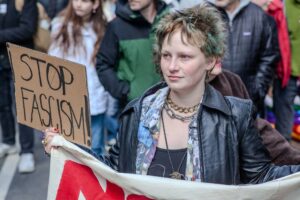
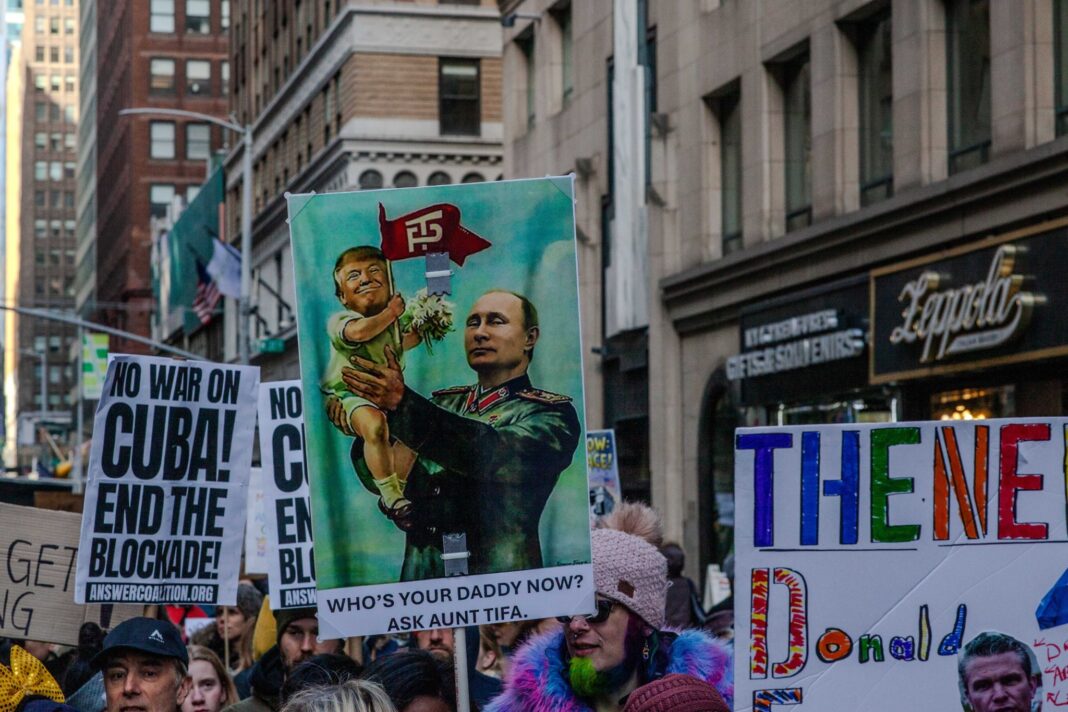
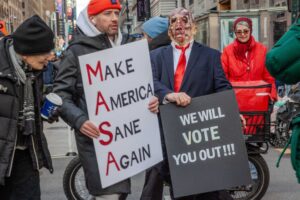
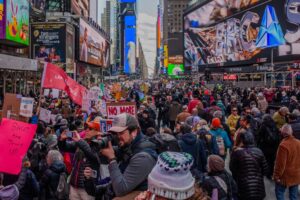
In Manhattan, thousands of protesters marched south from Midtown, filling the streets around Times Square with anti-ICE, anti-Trump and anti-Iran war signs. A protester named Yohanna told reporters, “There’s not enough room on the sign to say why I’m protesting. If we want a democracy, we have to participate in it and we have to save it.” Ginny, an 81-year-old demonstrator who first took to the streets more than fifty years ago during the Vietnam War movement, said the current moment is unlike anything she has experienced. “We were suffering then,” she said. “But not like we are now.” Progressive social media influencers Hasan Piker and Harry Sisson were also present in Times Square. Piker described the protest as a broad umbrella under which Americans are rallying for multiple causes, while Sisson, who has 2.1 million TikTok followers, said simply, “People are angry that we’re at war right now and Donald Trump is golfing. It’s a betrayal of the American people.”
In Los Angeles, classic salsa music rang through the streets around Gloria Molina Grand Park as demonstrators arrived in inflatable animal costumes, waving anti-war signs. The iconic Baby Trump blimp — a 20-foot inflatable depicting the president as a diaper-clad baby, first created ahead of Trump’s visit to the UK — bobbed above the crowd. Taco trucks
and hot dog carts lined the streets as a salsa band performed and children danced in the near-90-degree heat. The day was mostly festive, but a smaller group of demonstrators later gathered outside a federal building on Alameda Street, where police deployed tear gas after some threw concrete blocks and bottles over the fence. Several people were arrested.
The geographic spread of Saturday’s protests was remarkable. Organisers said almost half of all demonstrations took place in Republican strongholds. Texas, Florida and Ohio each had over 100 events scheduled.
Idaho, Wyoming and Utah saw protests in the double digits. One of the most remote demonstrations took place in Kotzebue, Alaska. In Chicago, veteran Chris Holy brought his son Nicholas to a protest for the first time, saying he felt compelled to come out over the injustices he sees happening across the country. In Portland, Oregon, Fedrick Ingram, secretary-treasurer of the American Federation of Teachers, told the crowd, “America has had hard times before. We’ve had bad laws before and we’ve had bad politicians, and we’ve always been able to get ourselves out of that by sticking together.”
In West Palm Beach, Florida, about 50 Trump supporters engaged in verbal confrontations with protesters, some wearing Proud Boys insignia, though those tensions did not spill into violence. In Boynton Beach, nearby, the city’s vice mayor, Thomas Turkin, described the crowd as “very enthusiastic” and “for the most part pretty peaceful,” adding that police had increased patrols to ensure protesters could exercise their constitutional rights without disruption to everyday life.
The “No Kings” movement, now in its third iteration, has grown from a reaction to Trump’s immigration blitz into something broader and angrier — a convergence of discontent over war, economic pain, and what many protesters described as a democratic system under threat.
Photo: Hredoy Anirban