
Ibrahim Chowdhury Khokon:
It was 11:45 on a Sunday night, and Flight 8646 from Montreal was doing what it had done hundreds of times before — coming in to land.
Seventy-two passengers, four crew members, a routine approach. Nobody on board had any reason to think the next few seconds would change everything.
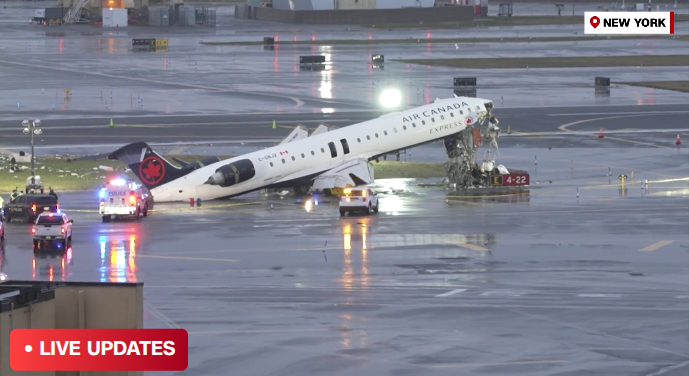
Then the Air Canada Express jet hit a Port Authority fire truck at 104 miles per hour, and the runway at LaGuardia became a place that nobody who was there will ever forget.
The front of the aircraft was destroyed on impact. The fire truck flipped over. Two young pilots — Antoine Forest and his copilot, both described by FAA Administrator Bryan Bedford as men at the very start of their careers — did not survive. More than forty people were taken to hospitals across the city. And yet, when aviation safety experts looked at what happened versus what could have happened, the word they kept coming back to was not tragedy. It was a miracle.
Former FAA safety inspector David Soucie laid it out plainly on CNN. The jet struck the fire truck directly in the middle. That one fact — the precise location of impact — is the reason this story isn’t about dozens of funerals. Had the plane hit forty feet further back or forward, it would have connected with the wing, the fuel cells, the engines. There
would have been a massive fireball. The death toll, Soucie said, would have been many, many times higher. “Just pure luck,” he called it.
Terrible, costly luck — but luck nonetheless.
The story of flight attendant Solange Tremblay is the one that stops people cold. She was seated just behind the cockpit, strapped into her jump seat with the four-point harness that crew members use. The force of the collision ejected her from the aircraft entirely. She was found on the tarmac nearly 300 feet from the point of impact — still buckled into her seat. Her daughter, Sara Lepin, speaking through tears to a Canadian television channel, said she had no other explanation for it.
“It’s completely miraculous. She must have had a guardian angel.”
Solange suffered multiple fractures and required surgery, but she is alive. Aviation experts say the specialized crew harness almost certainly saved her life in a situation where nothing should have saved anyone.
The passengers describe the moment of impact as something beyond comprehension. One traveller, Rebecca Liquori, said the plane was touching down normally when there was a sudden, violent jolt, a sensation of extreme braking, and a sound she described as an explosion — and everyone lurched forward out of their seats. Within seconds, the front of the plane was gone, cables hanging, debris everywhere.
The two Port Authority officers inside the fire truck — Sergeant Michael Orsillo and Officer Adrian Baez — were both injured but survived. How the truck ended up on an active runway at that precise moment is now the central question of the investigation. According to preliminary information, the truck had been given clearance by an air traffic controller to cross the runway, dispatched to check on a reported
unusual odour on another aircraft. What the controller apparently didn’t realize in time was that a plane was already on final approach to that same strip. Recorded audio from the control tower captures a controller frantically shouting stop commands — “Stop, stop, stop, Truck One! Stop, stop, stop!” — before the collision occurred. Nearly twenty minutes
later, the same controller can be heard on the recording, blaming himself.
Antoine Forest, one of the two pilots killed, has been identified by his family. A relative described him as someone who had loved flying since childhood, who had worked his way through two airlines over five years, and who always called her like a grandmother. He was just getting started.
The National Transportation Safety Board has deployed a 25-member investigative team to the scene. The flight data recorder and cockpit voice recorder have been recovered and sent to a Washington laboratory for analysis. Investigators had to cut through the fuselage roof to reach the recorders because the plane’s tail was resting on the ground.
By Monday afternoon, LaGuardia had partially reopened with limited runway operations, though delays and cancellations continued to ripple through the schedule. President Trump called the crash horrific.
Canadian Prime Minister Mark Carney called it deeply heartbreaking.
The investigators will spend months reconstructing exactly what went wrong on that runway. But for the people who walked — or were carried — away from it, the explanation feels simpler than any accident report will ever capture. Forty feet in either direction, and none of them would be here to tell it.