

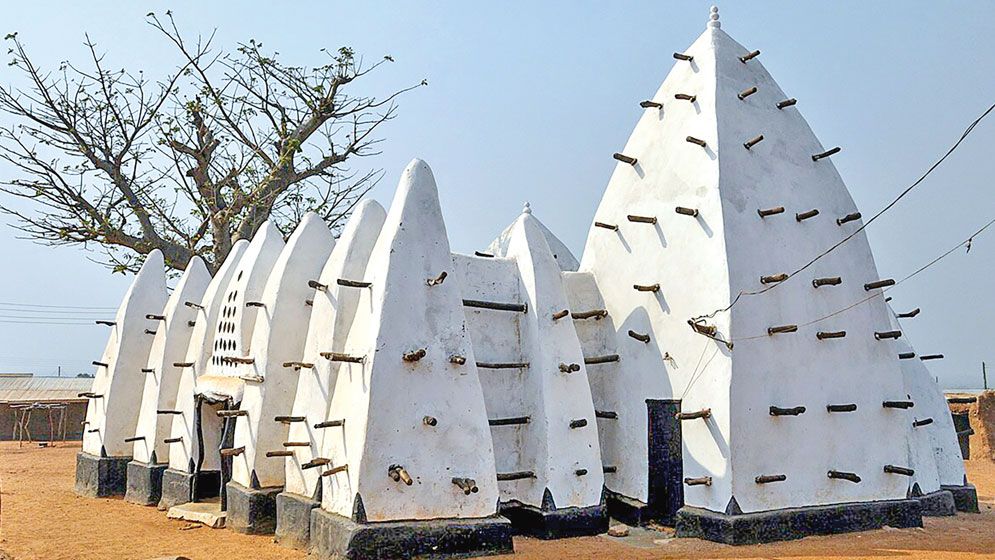
Islamic history extends far beyond the Arabian Peninsula, leaving magnificent testaments to Muslim civilization across the globe. Among the most spiritually and culturally significant of these landmarks is the historic Larabanga Mosque. Situated in the Muslim-majority village of Larabanga within Ghana’s Savannah region, this extraordinary structure stands as the nation’s oldest mosque and a defining icon of Islamic heritage in West Africa. Revered locally as the “Mecca of West Africa,” it draws thousands of tourists, researchers, and worshippers each year.
The history of the mosque is deeply intertwined with local folklore and spiritual legends. The most prominent oral tradition dictates that in 1421, a Muslim trader named Ayuba spent the night near a mystic stone while crossing the Sahara Desert. He received a divine dream instructing him to build a mosque on that exact spot. Upon waking, Ayuba discovered that the foundations of the structure had miraculously appeared overnight, allowing him to complete the construction. Following his passing, he was buried next to the mosque, where a sacred baobab tree grew over his grave. Local lore attributes medicinal and healing properties to the leaves and bark of this centuries-old tree.
Another legend surrounds the preservation of an ancient holy Quran within the mosque. Local tradition holds that in 1650, the resident Imam, Yidan Barimah Bramah, received this copy of the Quran directly from the heavens as a divine gift in response to his fervent prayers. This relic remains a source of profound spiritual reverence for the community today.
Architecturally, the Larabanga Mosque is a masterpiece of Sudanese-Sahelian design, frequently compared to the Great Mosque of Djenné in Mali. Unlike massive contemporary structures, it features a modest, compact footprint measuring approximately 26 feet by 26 feet (8 meters × 8 meters). The entire structure is built using local materials such as mud, clay, straw, and reeds—a technique known as flat-footed adobe architecture.
The exterior of the mosque is stark white and punctuated by two distinct pyramidal towers: one acting as the mihrab facing Mecca on the east, and the other serving as the minaret in the northeast corner. To support and preserve the mud walls, twelve conical buttresses wrap around the structure. Horizontal wooden beams project through these walls, providing structural stability and acting as permanent scaffolding for periodic maintenance and replastering. Standing strong through centuries of environmental and historical changes, the Larabanga Mosque remains a living testament to the rich cultural tapestry, resilience, and early spread of Islam throughout West Africa.