
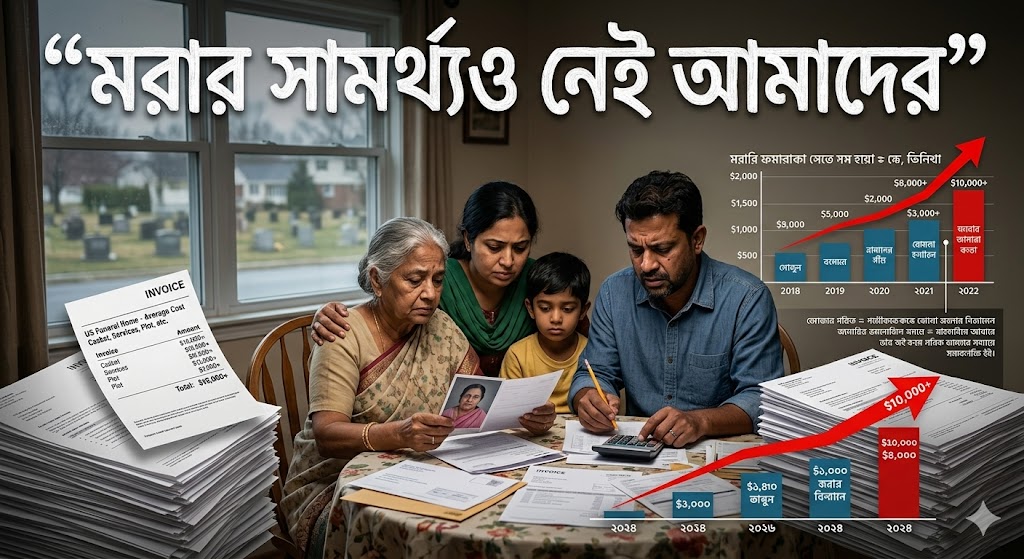
Death is inevitable, but in the United States, the cost of a funeral has become a major financial burden for many families. From a basic funeral service to the cost of burial plots, funeral home fees, embalming, and hearse rental, the expenses associated with death can quickly drain a family’s savings. For Muslim communities living in New York and
surrounding areas, the challenge is often even more severe.
According to the National Funeral Directors Association (NFDA), the national median cost of a traditional funeral with viewing and burial, including a casket, is approximately 8,300 dollars. Adding a burial vault raises that figure to nearly 9,995 dollars. A full-service
cremation costs an average of 6,280 dollars. With funeral expenses increasing at roughly 6 percent annually, a standard funeral in 2026 could cost an estimated 10,595 dollars.
Funeral costs vary significantly by region across the United States. In the Northeast, including New York and neighboring states, funeral expenses are about 8 percent higher than the national average. While funerals in southern states may start around 6,700 dollars, similar services in the Northeast can reach 8,985 dollars or more.
A full funeral package typically includes expenses such as 515 dollars for use of a ceremony room, 2,500 dollars for a metal casket, and about 3,000 dollars for a wooden casket. A burial plot in a public cemetery may cost around 1,500 dollars, while private cemetery plots can exceed 3,500 dollars. A burial vault averages 1,572 dollars, gravestones range
from 1,000 to 3,500 dollars, and hearse rental costs approximately 325 dollars.
The casket is usually the most expensive single item in a funeral. Basic metal caskets can range anywhere from 900 to 10,000 dollars. In cities like New York, where land and labor costs are especially high, funeral home operating expenses drive prices even higher.
Cremation is generally more affordable. The national average cost for direct cremation is about 2,202 dollars, though in highly competitive metropolitan markets it can be as low as 795 to 995 dollars. In contrast, states such as Connecticut, North Dakota, and Iowa may charge more than 3,000 dollars for cremation. In 2025, approximately 63.4 percent of Americans chose cremation, and that number is projected to rise to 82.3 percent by 2045.
Government assistance for funerals in the United States is extremely limited. The Social Security Administration provides only a one-time death benefit of 255 dollars, an amount that barely covers the cost of flowers. Some states offer partial assistance for low-income families, but it rarely covers the full cost.
For Muslims living in New York, funeral expenses are not only a financial burden but also a religious and social challenge. Although New York is home to an estimated 600,000 to 1 million Muslims, there is no single dedicated Muslim cemetery in the city, forcing families to rely on other burial grounds, often at much higher costs. Total funeral expenses can range from 6,000 to 50,000 dollars. This has led to a common sentiment within the community: We can’t even afford to die here.
In Islam, burial should take place as soon as possible after death. The funeral process includes ghusl (ritual washing of the body), kafan (wrapping the body in white cloth), Salat al-Janazah (funeral prayer led by an imam), and burial facing the Qibla. Because of these religious obligations, families often have little time to compare prices or shop around, leaving them forced to accept available services at whatever cost.
In Brooklyn, New York, several Muslim funeral homes provide specialized services, including Al-Rayyan Muslim Funeral Services, Islamic International Funeral Services, and Islamic Burial and Shipping Services in South Ozone Park.
In New Jersey, Masjid Al-Wali offers basic funeral services for around 2,500 dollars, including body pickup, ghusl, janazah arrangements, transportation, and death certificate processing. However, burial plot costs are not included. If refrigeration is needed overnight, families must pay an additional 150 dollars per night.
At the Islamic Center of Old Bridge in New Jersey, funeral home fees begin at 1,900 dollars, with burial opening and closing costs around 825 dollars, and imam services costing another 350 dollars. At Marlboro Muslim Memorial Park, grave opening and closing costs approximately 1,200 dollars, with burial plots costing an additional 1,000 dollars.
In New York’s Capital District, one funeral home partnered with a local Islamic center offers a Muslim discount package for 2,600 dollars, with an additional 1,050 dollars for grave opening and closing and 750 dollars for the burial plot.
A significant portion of New York’s Muslim population consists of immigrants from Bangladesh, India, Pakistan, Egypt, and other Muslim-majority countries. Many families choose to send the deceased back to their home country for burial. In such cases, international transportation, embassy clearance, customs documentation, and related
paperwork can add several thousand dollars more to the overall cost.
Organizations such as the Muslim Free Burial Association, a nonprofit run by volunteers in New York, New Jersey, and Connecticut, provide free burial services for Muslims who have no family or friends able to arrange their funeral. Their services include body retrieval,
transportation, ghusl, obtaining permits, and burial in a Muslim cemetery. The organization relies entirely on donations.
Experts advise families to plan ahead by purchasing funeral insurance or final expense policies. Since 1984, the Federal Trade Commission’s Funeral Rule has required funeral homes to provide detailed price lists and allows families to buy only the goods and services they need, helping avoid unnecessary expenses.
Overall, in New York and surrounding areas, the total cost of a Muslim funeral including funeral home services, ghusl, janazah, transportation, burial plot, and burial typically ranges between 5,000 and 15,000 dollars. If repatriation to another country is required, costs can rise significantly higher.
In today’s reality, planning ahead for yourself and your family may be the most important form of financial protection.