

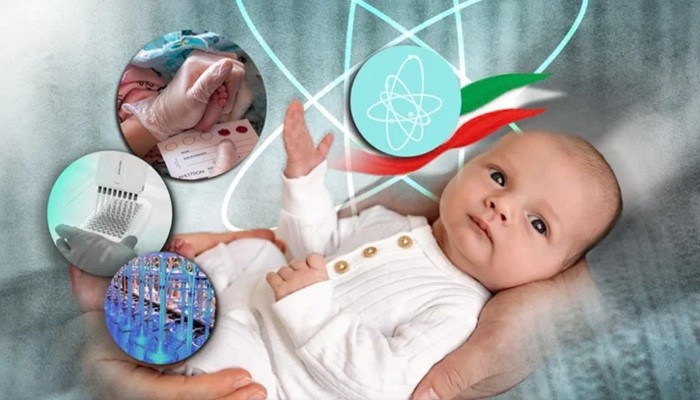
Amid ongoing international controversy surrounding its nuclear program, Iran is using advanced nuclear-related technology in a humanitarian healthcare initiative aimed at detecting and preventing serious metabolic diseases in newborns.
According to reports, Iranian scientists have developed a nationwide screening system that tests infants for 58 types of inherited metabolic disorders shortly after birth. These include amino acid metabolism disorders, organic acidemias, fatty acid oxidation disorders, and urea cycle defects.
The program has been running for nearly two decades. It began with screening for only a few diseases but has now expanded into one of the most comprehensive newborn screening systems in the region.
How the Screening Works
In Iran, a few drops of blood are taken from a newborn’s heel between the third and fifth day after birth. The sample is then analyzed using advanced techniques, including tandem mass spectrometry (MS/MS), which measures amino acids and other biochemical markers in the blood.
In Fars province alone, around 54,000 newborns are screened annually through 56 dedicated centers, with coverage reportedly reaching nearly 100 percent in recent years. The service is provided free of cost at the national level.
Role of Nuclear-Related Technology
Experts say that maintaining the precision of this screening system requires calibration and quality control materials that rely on radioisotopes. Some of these radioisotopes are produced using processes linked to enriched uranium.
Iran has stated that its 60 percent enriched uranium is partially used to produce medical isotopes such as molybdenum-99, which is used to generate technetium-99m — one of the most widely used isotopes in medical diagnostics worldwide, including for heart disease and cancer imaging.
The International Atomic Energy Agency (IAEA) confirmed in 2022 that Iran had used a portion of its highly enriched uranium stock for medical radioisotope production.
Why the Program Matters
Medical studies suggest that metabolic disorders are relatively more common in Iran compared to global averages. A 2025 study in Fars province found that about one in every 1,000 newborns had a metabolic disorder, compared to the global average of roughly one in 2,500.
Common conditions detected include phenylalanine metabolism disorders, short-chain acyl-CoA dehydrogenase deficiency, and 3-methylcrotonyl-CoA carboxylase deficiency.
Doctors emphasize that these diseases are not visible at birth but can lead to severe complications — including brain damage, seizures, physical disability, or even death — if not detected early.
Treatment and Care System
Children diagnosed through screening are referred to specialized clinics where multidisciplinary teams — including doctors, nutritionists, psychologists, and nurses — provide long-term care.
Some conditions, such as phenylketonuria, require strict dietary management along with medication and vitamin therapy.
International Attention and Expansion Plans
Iran’s nuclear-linked medical programs have received international attention. In 2025, Iranian officials reportedly shared medical radioisotope kits with foreign partners as part of scientific cooperation efforts.
The country currently produces dozens of radiopharmaceutical products and claims to serve over one million patients annually through nuclear medicine applications.
Iran is now reportedly planning to expand newborn screening to include additional diseases and extend its model to neighboring countries, positioning it as a potential regional healthcare framework.
Researchers argue that despite geopolitical controversy, the program demonstrates how advanced nuclear science can also be applied in life-saving medical care, particularly in reducing infant mortality and long-term disability.