

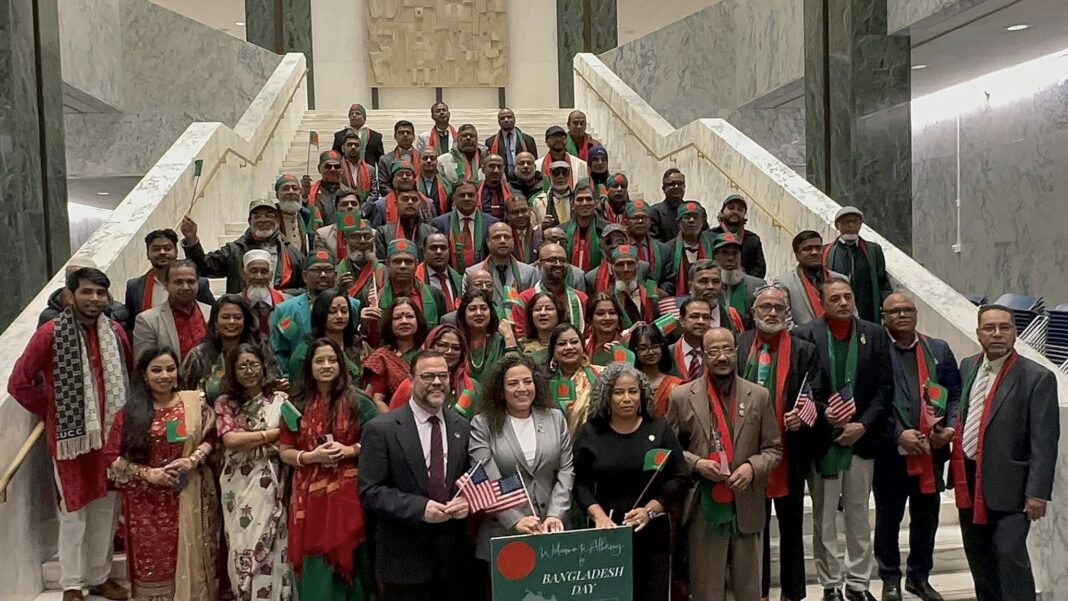
It started early. At half past eight on Monday morning, a bus and two private cars pulled out of Unionport Road in the Bronx’s Bangla Bazar neighbourhood and headed north toward Albany, the state capital — about two and a half hours away. By eleven, the Bangladeshi community leaders had arrived. By half past three in the afternoon, the New York State Senate had unanimously passed a resolution recognising Bangladesh Day.
In between, there was a procession, a luncheon, speeches, cultural performances, and a gallery packed with Bangladeshi Americans watching their community’s name echo through the chambers of the American government for the tenth consecutive year.
Outside the Senate building, more than fifty members of the community marched with Bangladesh Day banners alongside State Senators Luis Sepulveda and Nathalia Fernandez. Assemblywoman Carines Reyes joined them for a photo session on the steps of the lobby — the kind of image that gets framed and hung in community halls, a small but tangible proof that this community has real standing in New York’s political life.
After lunch, the Senate floor hosted a ceremony in the community’s honour. Senators Sepulveda, Fernandez, and John Liu all spoke, as did Assemblywoman Reyes. Awards were given. Then the Bangladesh Academy of Fine Arts — known as BAFA — took the stage, opening with the national anthem and performing a set of cultural pieces that, by all accounts, brought the room to a noticeably warmer place than your typical legislative afternoon.
The formal session came later. It was Senator Nathalia Fernandez who rose to introduce the Bangladesh Day resolution, and she did not shy away from history. She laid out the events of March 1971 — Operation Searchlight, the nine months of liberation war, the sacrifices of ordinary Bangladeshis, and the systematic violence inflicted on women by
Pakistani forces. Senators Luis Sepulveda, John Liu, Jessica Ramos, and Robert Jackson each took the floor to add their voices. They praised the Bangladeshi-American community’s contributions to New York’s growth and singled out Bangladesh’s decision to shelter nearly 1.2 million Rohingya refugees as a model of humanitarian responsibility. When the vote came, it was unanimous.
The resolution was moved by event committee convener Md. Shamim Mia, andthe speakers’ list was long — a sign of how many people had put months of work into the day. Among those who addressed the gathering were chief adviser Abdus Shahid, chairman Juned Ahmed Chowdhury, co-chairmen Rokon Hakim and Samad Mia Zakaria, joint convener Shamim Ahmed, chief coordinator Abdur Rahim Badsha, spokesperson Imran Shah Ron, and freedom fighter Manjur Ahmed, among others.
None of this would exist without a dinner at a Bronx restaurant fourteen years ago. In 2012, the Bangladesh Society of the Bronx and local community groups gathered to mark the 41st Independence Day. The late community organiser Zakir Khan had invited then-Assemblyman Rubin Diaz and attorney Luis Sepulveda as guests. At that gathering, under the chairmanship of Mohammad N Mazumder of the Bangladeshi-American Community Council, and on the proposal of then-Bangladesh Society of the Bronx president Mahbub Alam, the room decided it was time to take Bangladesh Day to the state legislature.
On March 24, 2012, Senator Rubin Diaz introduced the Bangladesh Day Bill in the New York State Senate. It passed in twenty minutes flat.
Sepulveda — who helped draft the resolution and is now a senator himself, known affectionately in the community as “Louis Bhai” — has been part of every iteration since. What began as an idea around a dinner table in the Bronx has become a ten-year tradition, a moment each spring when the red and green find their way, however briefly, onto the walls of Albany.