

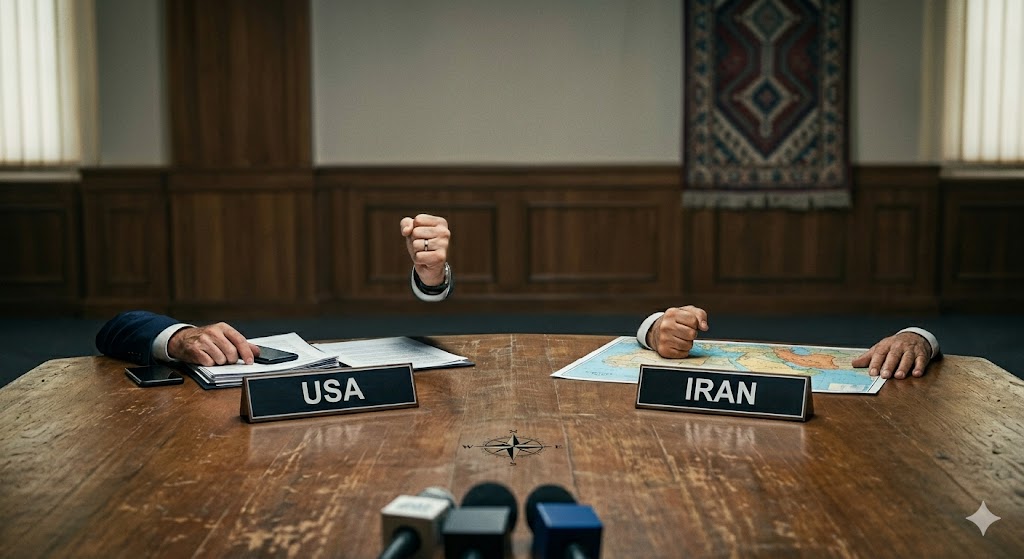
As the ceasefire deadline rapidly approaches, both the United States and Iran have made it clear they are prepared to return to war if necessary. Although a second round of talks is planned in Pakistan, Tehran has not confirmed its participation and has issued fresh warnings, calling the US naval blockade a direct violation of the ceasefire.
Iran’s powerful parliament speaker, Mohammad Bagher Ghalibaf, wrote on X that by imposing a blockade and violating the ceasefire, Donald Trump is trying to turn the negotiation table into a table of surrender or create justification for a new conflict on his own terms. He added that Iran would not accept negotiations under the shadow of threats and has prepared new options on the battlefield over the past two weeks. Iran’s Islamic Revolutionary Guard Corps also warned that any vessel attempting to pass through the Strait of Hormuz without permission could be targeted.
Trump told PBS News that Iran “is supposed to be there” for the talks and claimed there had been agreement on participation, but added that it would be fine even if they did not show up. When asked what would happen if the ceasefire expires, he responded, “Then a lot of bombs will start falling.” In remarks to Bloomberg News, he described extending the
ceasefire as “highly unlikely.” However, there has been confusion over the exact deadline, with Trump giving different timelines—Tuesday night in one interview and Wednesday evening in another. In a post on Truth Social, he also said the US blockade is “completely destroying Iran” and would continue until a deal is reached.
A US delegation led by Vice President JD Vance, special envoy Steve Witkoff, and senior adviser Jared Kushner is expected to head to Islamabad for the next round of talks. Pakistan appears to be preparing for the discussions, but without Iran’s participation, the talks risk becoming one-sided.
Tensions around the Strait of Hormuz have further complicated the situation. After briefly reopening, Iran has again shut down the waterway, causing oil prices to surge sharply on Monday. Fears of renewed conflict are adding fresh volatility to global energy markets.
There is also a clear divide over the issue of Iran’s enriched uranium. Trump has claimed that Iran agreed to transfer it, but Iranian Foreign Ministry spokesperson Nasser Kanaani rejected that assertion, stating the uranium “will not be moved anywhere” and was “never presented as an option” in negotiations.
Meanwhile, there has been some progress regarding the Lebanon-Israel ceasefire. The US State Department confirmed that Israel and Lebanon will hold a second round of talks in Washington on Thursday. However, the Israel Defense Forces has warned residents not to return to dozens of villages in southern Lebanon, accusing Hezbollah of violating the
ceasefire. Despite the warnings, thousands of displaced Lebanese civilians have begun returning home. Israeli strikes in Lebanon have killed at least 2,387 people so far.
In Tehran, airports reopened on Monday, and the city appears outwardly normal, with cafes full and people walking in parks. However, residents describe a different reality beneath the surface. A 30-year-old doctor, speaking anonymously, said that 50 days of war have shown that no one cares about the people of Iran. A 39-year-old woman named Sagar said the
economy is in terrible condition and that people are being detained without reason.
The coming hours are critical in determining the future of the Middle East. Whether diplomacy prevails or conflict resumes remains uncertain.