

April 7, 2026. 6:30 p.m., Washington time. Only an hour and a half remained before the 8:00 p.m. deadline set by Donald Trump. In Tehran, thousands of ordinary citizens were standing in human chains in front of power plants, hoping to shield them with their bodies from possible bombing. In the Persian Gulf, hundreds of oil tankers were stranded in uncertainty. Global stock markets were tense and unmoving. The entire world was asking one question: was this night about to become one of the most terrifying moments in modern history?
Then, suddenly, Trump posted on his Truth Social account: “Ceasefire between both sides.”
After six weeks of bloody conflict, the world finally took a fragile breath.
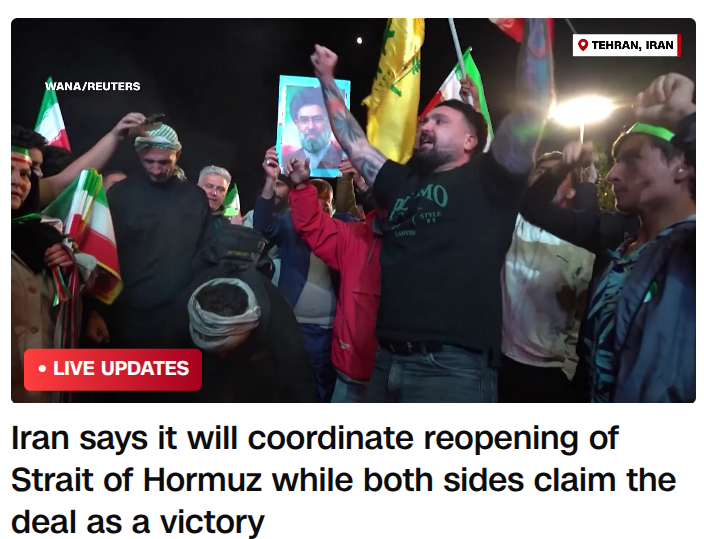
But the strangest moment came immediately afterwards. Even before the ink of the ceasefire agreement had dried, Washington and Tehran—two bitter adversaries—began declaring victory at the same time.
Trump told AFP that the ceasefire represented a “complete and total victory” for the United States. Meanwhile, from Tehran, Iran’s Supreme National Security Council announced that “nearly all objectives of the war have been achieved,” claiming that “criminal America” had accepted the general framework of Iran’s 10-point proposal.
History rarely records such moments—where two opposing sides sit at the same table, yet both claim the same agreement as their own victory.
White House Press Secretary Karoline Leavitt described the deal as “a victory for the United States,” arguing that the American military campaign had given the Trump administration leverage to negotiate firmly and reopen the Strait of Hormuz.
On the other hand, Iran’s National Security Council made its demands clear in its statement: the lifting of all sanctions, the release of frozen Iranian assets abroad, the withdrawal of U.S. military forces from the Middle East, war reparations, and recognition of Iran’s right to enrich uranium.
Placed side by side, the two statements seem to describe two entirely different agreements—yet on paper, it is the same ceasefire.
Behind this diplomatic drama stands one central figure: Pakistan’s Prime Minister Shehbaz Sharif.
Sharif has invited both American and Iranian delegations to Islamabad on Friday, April 10, in an attempt to turn the fragile ceasefire into a broader diplomatic process. The U.S. delegation will be led by Vice President JD Vance, accompanied by special envoy Steve Witkoff.
Sharif also stated that the ceasefire should apply across the region, including Lebanon. But this is precisely where a new dispute has emerged.
Israel’s Prime Minister Benjamin Netanyahu has supported Trump’s ceasefire decision but made it clear that it does not apply to Lebanon. And the words were quickly followed by action. Only hours after the ceasefire announcement, Israeli airstrikes in Lebanon’s Sidon area reportedly killed eight people.
Meanwhile, Iranian drone attacks in Kuwait damaged oil facilities, power plants, and water desalination centers. There were also reports of missile and drone strikes in the United Arab Emirates.
In other words, on the very first night of the ceasefire, attacks were reported in at least two countries. It seems that the word “ceasefire” carries very different meanings for different sides.
In the Strait of Hormuz, at least two ships have safely passed through since the ceasefire began. But the Persian Gulf remains crowded with uncertainty. Around 426 oil tankers, 34 LPG carriers, and 19 LNG vessels are still stranded in the region.
International oil prices have fallen between 13 and 17 percent, and Asian stock markets have shown modest gains. Yet economists warn that this relief may be temporary—especially if the Islamabad talks collapse.
So what lies ahead?
Analysts see three possible paths.
The first scenario is that the Islamabad negotiations succeed, leading to a more permanent ceasefire. But the obstacles are enormous. Iran’s demand for continued uranium enrichment and the withdrawal of U.S.forces from the Middle East are conditions that Washington and Israel are unlikely to accept.
The second scenario is that the talks fail within the two-week window, causing the war to return with greater intensity. The disagreement over Lebanon alone shows how deep the divisions remain between Iran and Israel.
The third possibility is a prolonged cycle of temporary ceasefires and ongoing negotiations—stretching for months or even years—leaving the Middle East trapped in a state of constant uncertainty.
Iran’s Supreme National Security Council has already issued a stark warning: “Our hands remain on the trigger, and any mistake by the enemy will be met with full force.” That single sentence reveals the true nature of this ceasefire. It is not peace. It is a fragile balance—like standing on a tightrope over a fire.
April 10, Islamabad.
That day may write the next chapter of history.
Either it will mark the beginning of negotiations capable of ending one of the Middle East’s most violent chapters—or two weeks from now, the skies over the Persian Gulf may ignite once again, perhaps even more violently.
Washington says it has won.
Tehran says it has won.
But the waves of the Persian Gulf, the ruins of Lebanon, and the burning oil fields of Kuwait tell a different story.
The war has not ended.
It has only paused.