
On his birthday, we remember with deep respect Fazle Hasan Abed. He continues to live among us through his legacy—a distinguished son of Bangladesh and a globally respected figure.
Many statesmen and ministers come and go as nations move forward. Many founders of renowned organizations fade into history, and narratives are rewritten over time. But Sir Fazle Hasan Abed remains steadfast—his legacy enduring, his head held high.
BRAC is now one of the largest and most respected NGOs in the world. It is remarkable that with over 100,000 staff, BRAC serves around 120 million people across 11 countries.
Since the creation of Pakistan in 1947, the people of East Pakistan endured years of exploitation. Courageous political leaders repeatedly resisted this injustice. Eventually, under the leadership of Sheikh Mujibur Rahman, the nation united against 23 years of oppression. Despite winning democratic elections, power was not transferred to the Bengali people, and the Pakistani military launched brutal mass killings.
In response, ordinary citizens joined the armed struggle under the leadership of Bengali forces—this became the Liberation War. In 1971, through immense sacrifice, including the lives of millions, Bangladesh achieved independence. In the aftermath of war, the country faced another struggle—survival.
At that critical moment, Sir Fazle Hasan Abed left his job in London, sold his home, and dedicated himself to rebuilding the nation in 1972. His work began with rehabilitating refugees returning from India to their devastated villages.
Quietly standing beside the suffering of ordinary people, with rare dedication and integrity, he built his institution step by step. Through vision, discipline, and commitment, he transformed BRAC into a self-sustaining organization. Beyond education, women’s empowerment, and microfinance, BRAC works across nearly every sector essential to building a just society.
At a time when corruption and self-interest often dominate societies, understanding the life and values of Sir Fazle Hasan Abed is more important than ever. He received numerous global honors. His wisdom, courage, humanity, and insight earned him deep respect from world leaders and institutions.
In 2006, while presenting him with a prestigious recognition, a senior United Nations development leader remarked that if there were just six leaders like Fazle Hasan Abed, global hunger could be eliminated. He also recalled that during the height of the war in Afghanistan, when global representatives were asked to take responsibility for community health clinics, most remained silent. Only Sir Fazle Hasan Abed stepped forward. Since then, BRAC has continued to provide healthcare services in Afghanistan despite immense challenges.
Despite global recognition and admiration, he remained humble—like a great tree offering shelter to countless people. It is remarkable that at the time of his passing, he left behind no personal wealth, no land, and no property in his name or his family’s. He had made a personal commitment: if he were to raise funds for people in need, he would not hold personal assets that could compromise the credibility of his mission.
For his contributions to education, he received the prestigious Yidan Prize, often referred to as the “Nobel Prize of education,” along with a gold medal and a significant monetary award. As always, he dedicated the entire amount to early childhood education.
The light of knowledge transcends nationality, religion, borders, and economic inequality. Education enriches humanity and transforms society and the environment. BRAC continues to bring education through play to displaced and war-affected Rohingya children aged 3 to 5, establishing schools in refugee camps to rebuild their mental strength.
In Bangladesh alone, more than 12 million children have completed pre-primary and primary education through BRAC programs. Additionally, BRAC operates 656 “Play Labs” in Bangladesh, Uganda, and Tanzania, providing daily education to around 11,500 children.
Today, the world recognizes that a country like Bangladesh can contribute meaningfully to improving lives across multiple nations.
The life of Sir Fazle Hasan Abed is a source of national pride. He never sought anything for himself. His ideals and sacrifices will continue to inspire future generations to uphold values and stand beside those in need.
After 47 years of tireless service, he retired from BRAC. We hope that his successors will not only carry forward the organization’s work but also embody his compassion and vision.
On this day, we offer our deepest respect to Sir Fazle Hasan Abed for elevating Bangladesh to a place of honor on the global stage.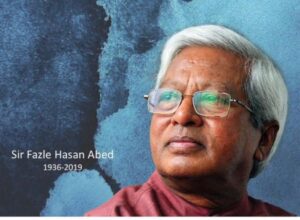
Dr. Zia Uddin Ahmed
Physician, Philadelphia, United States