
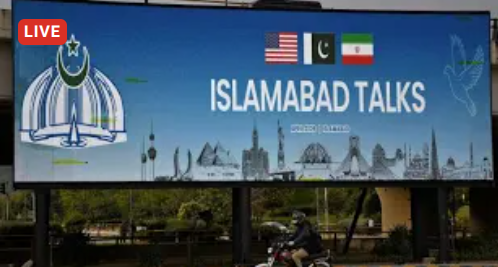
April 10, 2026 | Islamabad — Washington D.C. — Tehran
An eerie silence has settled over Pakistan’s capital, Islamabad. But this is not the silence of peace — it is the taut, breathless silence of expectation. Armed security forces line every street. Traffic diversions are in place. Police checkpoints appear at every turn. The Serena Hotel — situated in the high-security Red Zone next to the foreign ministry — asked its guests to vacate on Wednesday. Thursday and Friday have been declared public holidays. Islamabad is, for all practical purposes, in lockdown. The reason is singular: the talks between Iran and the United States are about to begin — talks upon which rests not merely the fate of the Middle East, but the energy security and stability of the entire
world.
But will these talks actually happen? And if they do, will anything come of them? The questions are simple. The answers are anything but.
The War That Made These Talks Necessary
February 28, 2026. The United States and Israel launched devastating coordinated airstrikes on Iran. On the very first day, Supreme Leader Ayatollah Ali Khamenei was killed. Iran’s military and nuclear infrastructure were severely damaged. Over five weeks of war, more than three thousand people were killed inside Iran — according to Iranian media and the U.S.-based Human Rights Activists News Agency. Among the dead: children, civilians, students.
Tehran struck back the only way it could — by effectively shutting down the Strait of Hormuz, the narrow waterway through which roughly twenty ercent of the world’s oil and gas flows. Energy prices soared. Stock markets trembled. Within a month, gasoline prices in America rose nearly forty percent. Analysts are already calling this one of the worst energy crises in recorded history.
On April 8, barely ninety minutes before Trump’s 8 p.m. deadline — beyond which he had threatened to unleash catastrophic strikes on Iranian infrastructure — Pakistan brokered a two-week ceasefire between Washington and Tehran. That ceasefire expires on April 22. And the clock is ticking.
—
Pakistan’s Improbable Starring Role
The most surprising character in this entire drama is arguably Pakistan itself. A country drowning in its own economic crisis, perpetually on edge at its borders — how did it end up at the center of the world’s most complex diplomatic mission?
The answer lies in history. When Pakistan gained independence in 1947, Iran was the first country to recognize it. The two neighbors share a 560-mile border along with deep religious, cultural and historical ties.
Pakistan is home to more than twenty million Shia Muslims — the second-largest such population in the world after Iran itself. At the same time, Islamabad has carefully cultivated working relationships with Washington, Riyadh and Beijing — three poles that rarely align.
This multidimensional positioning is what placed Pakistan in the mediator’s chair. At the end of March, Pakistani Foreign Minister Ishaq Dar traveled to Beijing, where Chinese Foreign Minister Wang Yi endorsed Islamabad’s mediation efforts as being “in keeping with the common interests of all parties.” Trump himself acknowledged that China played
a key role in bringing Iran to the negotiating table. A senior Pakistani official, speaking anonymously, told AFP that on the night the ceasefire was announced — when hope was fading fast — China stepped in and persuaded Iran to accept a preliminary truce.
—
What Is on the Table — and How Far Apart the Two Sides Are
Two proposals sit at the center of the Islamabad talks. The gap between them remains enormous.
America’s reported 15-point proposal centers on Iran handing over its stockpile of enriched uranium, the unconditional reopening of the Strait of Hormuz, and the curtailment of Iran’s regional network — Hezbollah, the Houthis and other proxy forces.
Iran’s 10-point counterproposal demands that Tehran retain control over the Strait of Hormuz and the right to charge tolls on vessels passing through it, an end to all regional military operations, the lifting of all sanctions, the release of frozen Iranian assets abroad, the right to continue nuclear enrichment, and financial reparations for the war’s
destruction.
Reconciling these two positions is, in practical terms, something like trying to bridge the North and South Poles. Theoretically possible. In reality, extraordinarily difficult.
—
Lebanon: The Sharpest Thorn Of all the unresolved issues, Lebanon is the most immediately dangerous.
Pakistani Prime Minister Shehbaz Sharif has stated publicly that the ceasefire covers Lebanon. Israeli Prime Minister Benjamin Netanyahu has flatly rejected that interpretation. Israel has continued its strikes in Lebanon against Hezbollah even after the ceasefire came into force.
Iranian President Pezeshkian posted on X that Israel’s attacks on Lebanon render the negotiations “meaningless.” Iranian sources have made clear that Tehran will not participate in Islamabad talks unless a ceasefire is in place in Lebanon.
Vice President JD Vance attempted a diplomatic softening, suggesting there may have been a “legitimate misunderstanding” about whether Lebanon was included. In diplomatic language, this is roughly an acknowledgment that a problem exists — without any indication of where the solution lies.
—
Who Is in the Room
The American delegation is led by Vice President JD Vance, joined by special envoy Steve Witkoff and presidential son-in-law Jared Kushner.
This represents the most senior U.S. engagement with Iran since then-Secretary of State John Kerry negotiated the 2015 nuclear deal.
Witkoff had previously held multiple rounds of Oman-mediated talks with Iranian Foreign Minister Abbas Araghchi before the war interrupted that process.
Iran’s delegation includes Foreign Minister Araghchi and Parliament Speaker Mohammad Bagher Ghalibaf, along with security and economicofficials — confirmed by Iranian state television and the Pakistanigovernment. Iranian state broadcaster IRIB has reiterated repeatedly,however, that talks will not begin unless Iran’s preconditions are met.
The format of the talks will be indirect: the two delegations sitting in separate rooms while Pakistani officials shuttle proposals between them — mirroring the format used in earlier Oman-mediated rounds.
—
Trump’s Confidence — and the Reality Behind It
On Friday, departing Washington for Florida, Trump told reporters there was no need for a backup plan. “The military is defeated,” he said.
“Their navy’s gone. The air force is gone. All anti-aircraft is gone.
The leaders are gone. The whole place is gone.” He wished Vice President Vance luck, noting that “he’s got a big thing” ahead of him.
But the reality on the ground tells a different story. Maritime traffic through the Strait of Hormuz has not normalized. Special envoy Witkoff,when asked how he expects the conflict to end, answered simply: “I don’tknow.” Defense Secretary Hegseth has acknowledged ongoing uncertainty.
Analysts describe the ceasefire framework as resting on “competing interpretations, uneven implementation and unresolved political
demands.”
Trump added: “I think it’s going to go pretty quickly, and if it doesn’t, we’ll be able to finish it off. One way or the other, it’s going well.”
That phrase — “finish it off” — carries within it the implicit threat that hangs over every word exchanged in Islamabad.
—
Three Possible Outcomes
At this moment, three paths remain open.
The first: talks succeed, the two-week ceasefire is extended, and a framework for lasting peace slowly takes shape. But this requires bridging the vast distance between the two sides on Lebanon, nuclear enrichment, the Strait of Hormuz and sanctions relief — all
simultaneously. The difficulty cannot be overstated.
The second: talks collapse, and after April 22, war returns with greater ferocity. This time, Iran’s remaining infrastructure — civilian andmilitary — becomes the target. The humanitarian consequences would be catastrophic, and questions of international law would become impossible to ignore.
The third: the ceasefire is renewed repeatedly, talks drag on for months, and the Middle East settles into a prolonged, unresolved limbo.
Oil markets remain volatile. Shipping routes stay uncertain. Diplomacy’s wheel turns slowly — without a clear destination.
—
The Weight of What Happens Next
Today, two delegations sit in separate rooms at Islamabad’s Serena Hotel. Pakistani diplomats move between them, carrying words from one piece of paper to another. Among those words are some that could stop a war — and others that could restart one.
The world’s oil markets are waiting for those words. The people of Lebanon are waiting. The survivors picking through the rubble of Tehran are waiting. And in Washington, a president says no backup plan is needed.
History suggests that this kind of confidence is not always warranted. But history also tells us that seemingly impossible negotiations have occasionally produced agreements that no one thought possible.
Until April 22, the world waits.