
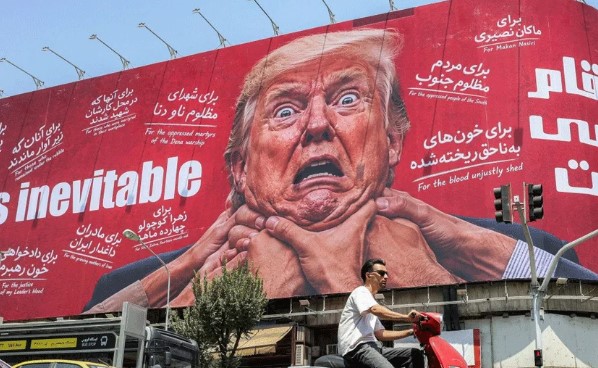
Giant billboards mocking U.S. President Donald Trump have appeared across Tehran, portraying him in a series of satirical and sometimes provocative images as Iran’s wartime propaganda campaign turns the capital’s walls into a visual chronicle of its confrontation with the United States and Israel.
Some of the most prominent displays have appeared in busy parts of the city, including the famous Valiasr Square, where large numbers of pedestrians and motorists pass every day.
One striking billboard produced by Khaneh-ye Tarrahan, or “Designers’ House,” depicts Trump with his lips sewn shut and his mouth symbolically muzzled by the Strait of Hormuz. The image carries the words “At the breaking point,” highlighting the strategic importance of the waterway in the conflict.
Mostafa Kafaei, 32, who manages the studio, said the team moves quickly whenever major developments occur.
“When news breaks, the team mobilises,” Kafaei told AFP, explaining that ideas are developed, graphic designers are briefed and the team works collectively to produce new designs.
The studio has a dedicated news-monitoring team and operates under one of Iran’s largest state-run media groups. The billboards are government-sponsored and are used to communicate official messages to large audiences across the capital.
Another billboard, produced by a different studio, shows Trump trapped inside a magician’s box while holding a Coca-Cola and a hamburger. The accompanying slogan reads, “Blink, you’re gone!”
The image refers to a reported July incident in Türkiye in which Trump was secretly moved from Air Force One to another aircraft using a catering truck because of a security threat.
Kafaei said speed has become a major priority for the designers. Teams of up to eight people can complete urgent billboard projects within just a few days.
Most of the designs are produced using Photoshop, while the studio also makes extensive use of artificial intelligence tools. Kafaei said the team uses various AI systems, including ChatGPT and Nano Banana, as part of the creative process.
Iran’s ‘Hormuz Catch’
Another recently installed billboard depicts an Iranian soldier standing on a U.S. underwater drone, accompanied by the words “Business is good.” The image refers to what Iran’s Revolutionary Guards described as a recent capture of a U.S. underwater drone in the Strait of Hormuz.
Other billboards use similarly dramatic imagery. One shows a mythical warrior standing amid raging seas while U.S. warships burn in the background, alongside the message: “Satan’s army will drown in the Persian Gulf.”
Another design borrows imagery from the cover of Nirvana’s Nevermind album, depicting Trump underwater reaching for a dollar bill. The accompanying words read: “GREAT VICTORY! Strait of Hormuz.”
Kafaei said there had initially been some hesitation about displaying such a huge image of Trump at Valiasr Square. But the team ultimately decided the image would have a powerful impact.
Asked why Trump appears so frequently in the campaign, Kafaei described him as a “media personality” and said the designers respond to his actions in the media.
The billboards are not limited to attacks on Trump. Other displays glorify Iran, its late Supreme Leader Ali Khamenei and Iran’s allies, including the late Hezbollah leader Hassan Nasrallah.
Kafaei said the imagery also serves an informational purpose, helping people who may not closely follow politics understand the broader situation in the country.
Some Tehran residents appear to view the billboards as a way of keeping up with wartime developments. Sahar Jahedi, a 24-year-old pharmacy worker, told AFP that many people struggling with everyday life may not have time to follow the news closely, and that such billboards can help keep them informed.
For Tehran’s residents, the giant images have therefore become more than political advertisements. They are part of an increasingly visible media campaign through which Iran presents its version of the conflict, portrays resistance to Washington and highlights the strategic importance of the Strait of Hormuz.