

by Ibrahim Chowdhury Khokon
During oral arguments held on Wednesday at the U.S. Supreme Court, justices expressed notable scepticism regarding President Donald Trump’s effort to limit birthright citizenship. The line of questioning suggested that the constitutional basis of this key immigration policy does not fully convince the Court.
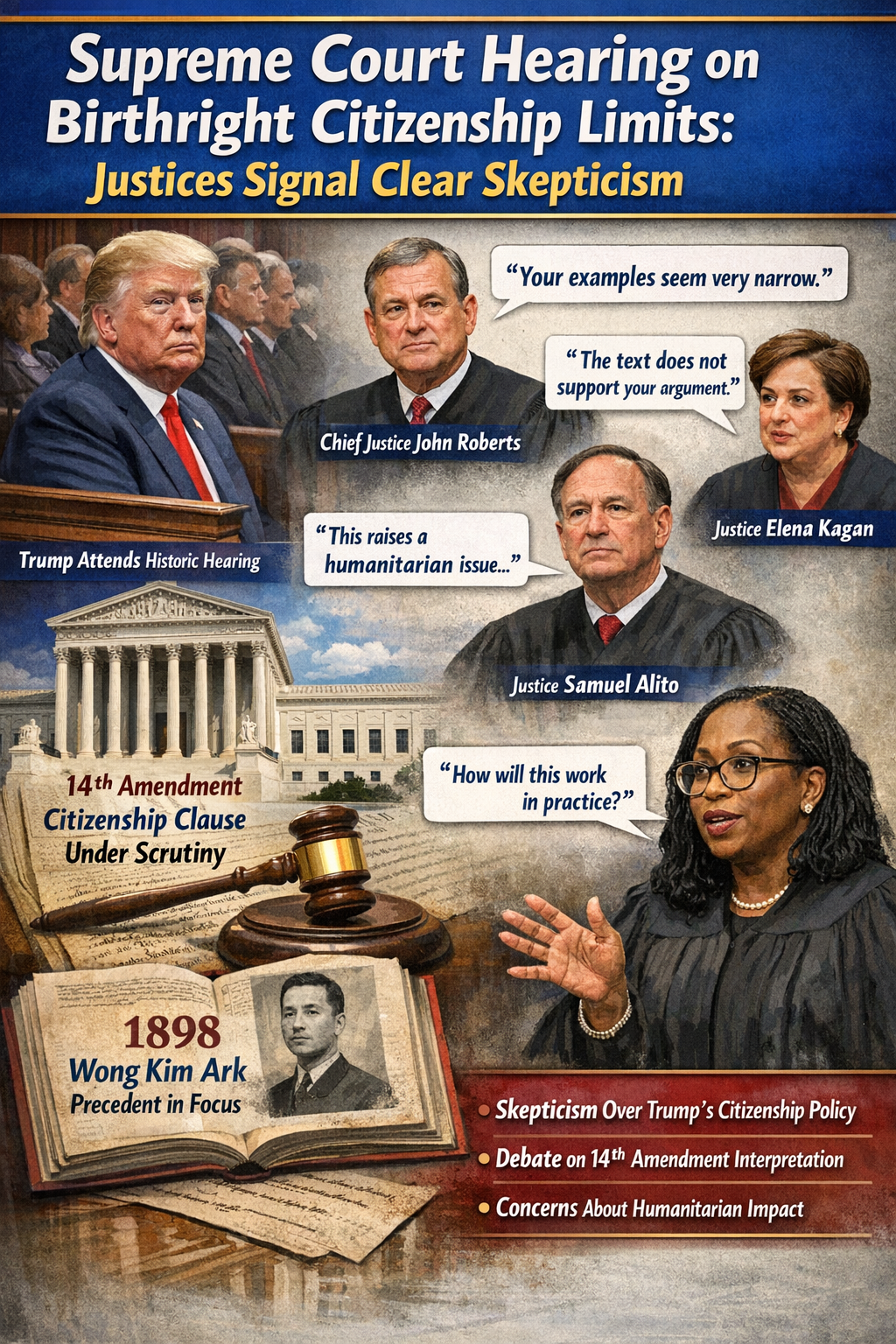
A striking aspect of the hearing was Trump’s personal attendance. Seated in the courtroom gallery, he directly observed arguments defending one of his administration’s major policies. This is considered an unprecedented moment in U.S. history, with a sitting president attending Supreme Court proceedings concerning his own policy.
Throughout the session, Trump appeared composed and expressionless. He listened quietly without visible reaction, a contrast to his behavior in lower courtrooms, where he often engaged with his legal team. In the formal setting of the Supreme Court, he remained silent and still.
Representing the administration, Solicitor General D. John Sauer presented arguments in favor of the policy. However, the justices repeatedly focused on the interpretation of the Citizenship Clause of the 14th Amendment. The clause states that all persons born or naturalized in the United States, and subject to its jurisdiction, are citizens. Historically, only limited exceptions—such as children of foreign diplomats—have been recognized.
The Trump administration argued that the children of undocumented immigrants should also be excluded. The justices appeared unconvinced. Chief Justice John Roberts remarked that the administration’s examples were too narrow to justify excluding a broad class of individuals. Justice Elena Kagan added that the constitutional text does not support the administration’s interpretation and described it as overly technical.
Even conservative Justice Samuel Alito raised humanitarian concerns, noting that many immigrants have established permanent lives and families in the United States, making the issue more complex.
Several justices also questioned the policy motivations behind the administration’s stance, including concerns about “birth tourism.” However, they emphasized that such policy considerations are not central to the Court’s legal analysis.
The discussion frequently returned to the landmark 1898 case affirming citizenship for a U.S.-born child of Chinese immigrants. This precedent is widely seen as central to the current case. While the administration did not explicitly ask the Court to overturn it, several justices indicated that upholding that precedent could undermine Trump’s policy.
Justice Ketanji Brown Jackson focused on the practical implications of enforcing such a policy. She questioned how citizenship would be determined at birth and whether it would create administrative burdens or legal complications. Although the administration suggested that disputes could be resolved afterwards, her concerns appeared largely
unanswered.
Overall, the hearing suggested that Trump’s attempt to restrict birthright citizenship faces significant legal challenges at the Supreme Court, with the justices’ questions reflecting deep constitutional and practical concerns.