

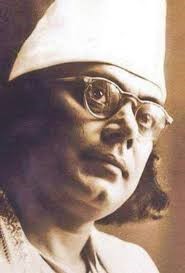
The French Revolution and the Industrial Revolution sparked the birth of Romanticism. These two Revolutions completely transformed the societal and economic structure in Europe and ushered in a revolution in literature. The poets, during that period of Romanticism, wrote their poems against classicism, social injustices, inequalities, feudalism, social oppression, tyranny, and monarchy. At the same time, the spread of poverty, disease, and death moved those poets much. They continued writing poems with the themes of love, pain, and emotions mingled with nature’s beauty. Poet Nazrul’s poems are also adorned with that new style of realism. He wrote the poems that embraced all those features of romanticism mentioned above. The metaphysics of Nazrul’s poetic works:
The twentieth-century poet Kazi Nazrul Islam is an illuminant within his own harmonious poetic cosmos. The works of Poet Nazrul mirror the values of romanticism. He was against traditionalism; he broke the traditional styles, forms, themes and thoughts of nearly one thousand-year-old Bengali literature. He is highly regarded for his sensibility and individuality. Poet Nazrul’s emotions in the poems are very much akin to a pattern of sea waves with ups and downs, billowing up with toughness and down with softness. He introduced ghazal lyrics for the first time in Bengali literature and enriched them with melodious music; he composed his lyrics with a blend of more than two Indian classical ragas. He elevated the elegance of Bengali literature by using some exotic words of Farsi, Urdu, and Arabic languages; those words were (and are still) prevalent for centuries in
the spoken language of the common people in Bengal and whole India. Poet Nazrul wanted freedom in his ingenious poetic creations. His poetic ingeniousness and spontaneity, emotions and imagination manifested the virtues of romantic literature and himself as a romantic poet.
Poet Nazrul brought the beauty of the untamed wilderness of nature into his poems and lyrics. Poet William Wordsworth, Samuel Taylor Coleridge, Percy Bysshe Shelley, and John Keats are regarded as the founders of the Romantic movement. They had a deep appreciation for nature’s beauty and its majestic ambience. Poet Kazi Nazrul Islam touched every ingredient of nature’s alluring and elusive charms and used them as a backdrop for
his romantic poems. In his ghazal- ‘Boshia bijone keno eka mone’, the Poet described:
“In the wings of geese the day ends, In her lover’s bosom the she-bird hides,
In tearful eyes, they part again, A flute emanates raga baroan!”
.
“The boatman in the bathing-ghat ties the boat, A wayfarer returns home in the shadowy twilight, walking across a secluded field.”
Poet Nazrul has painted a melancholic landscape of nature with a backdrop of a day end; its shadowy twilight spread over a village when the geese are flying to their nests, the she-bird is seeking comfort and love in the bosom of her lover-bird, the boatman is tying his boat at
the river-ghat, and the unknown wayfarer is returning home walking across a quiet field in the darkness of the setting sun. The poet has connected all these elements with the melancholic emotion of a forlorn newlywed bride who was once tied in a bond of love and
affection with her dear ones at home.
The poet created an ambience where he linked the saddened mood of a bride with the setting sun, the enshrouding darkness of the day-end adds more feelings of loneliness to the bride’s heart— ‘O bride, the sun is setting, calls the in-law, ‘Let’s go to bring water if you want to!’
The Poet used nature splendidly in the poem and created a milieu of love, separation and pain. The mention of the melancholic raga Baroan coming out of a flute and the tearful parting of the birds from each other divulge the elegance of the poet’s poetic creation. Here Poet puts an artful poetic touch on the canvas of his romantic imagination.
Nazrul’s Ghazal lyrics are the accolades to his poetic achievement:
Poet Kazi Nazrul created his Ghazal lyrics with divine, mystic and spiritual themes while contemplating love, pain, separation and dejection. The Poet urges humankind to look for a pure intention in the shadow of their heart; he asserts that veritable intention in the heart
is more sanctified than any worshipping place; the light of the love of God spreads equally over all worshipping places of all religions. A true Sufi, the lover of God keeps no fear of hell in his heart, nor does he desire heaven; he seeks only the love of God.
In Omar Khayyam Giti “Equal are not the thousands Kaba and mosques To one heart, look not for Kaba, In the shadow of the heart Look for thine intention, the light of love That illuminates the heart Spreads equally over the temple, mosque,
Church and synagogue!
For hell, he has no fear,
For heaven, he keeps no desire!”
The poet urged mankind in this world to congregate at one confluence to listen to the flute’s melody of humanism, the most powerful melody of human entity and harmony.
Some lines are quoted from the middle of the poems— Cooli and The Mankind, wherein Poen Kazi Nazrul Islam delivered the essence of humanism—
“Let all human beings of all ages, of all countries, stand At one confluence to hearken
The melody of the flute of one union! [Poem; Cooli, Sanchita,2015]
Poet Nazrul was a lover of nature; he introduced a sea of romantic poetry that illuminated both the blue and sombre sky of literature. The poet perceived the Megh-Shyam (dark clouds) within himself and addressed the Sandhya tara (The evening star) as Ghomta-Para bou (A bride in the veil); the poet called the silent sea — “O the Reticent! in profound admiration thou hast spoken out—”Graceful, what a graceful!”
Poet Kazi Nazrul wrote the poem ‘Deep in Sleep’ (‘Ghumiye geche chranta hoie’) after the tragic demise of his four-year-old son; that shattered him terribly. The poem below is an elegy for his dead son– the songbird nightingale (Bulbul). He constructed the entire lyric with the words that emanated from his wretched heart.
“From creeping tender vines, O listen! Whose Melancholic breaths in the leaves murmur!”
The narrator submits a veritable approach in bringing up the features from nature amid infinite grief and bereavement. The evening-flowers, vines and leaves bemoan the death of their companion, bulbul. Poet Nazrul depicts his son as a songbird bulbul, who is now wearied and in deep sleep.
The Poet feels the melancholic breaths coming out from the murmuring of leaves in the quiet milieu of nature; the Poet’s narration is streaming down in such a way as if the lyrics are composed wholly with a prolonged melancholic melody emanating from a violin chord. One can notice a dense layer of emotional strife that occurred and settled in Poet Nazrul’s
poetry.
Conclusion:
Poet Nazrul successfully instilled a kind of poetic music in his expressive words; he responded to the beauteous, vibrant nature with his soft romantic emotions. Poet Nazrul should not be considered as a rebellious poet in the world literature as rebelliousness is one of the salient features of Romanticism. In the world of romanticism, he is a genuine romantic poet who delivered the artistic fineness and excellence in his lyrics, poetry and prose. He divulged his emotions and urged, “unfold me!” The readers can feel the emotions in his poems like the soft rays of morning sun slipped through the clouds and laid its golden fingers upon the petals of the red lotus.
Sources:
Sandhya Malati, Lyrical Book, Nazrul Rochonabali, Vol. 7, page 210, Bangla Academy, November 2012. ‘Bethar dan’ Nazrul Rochonabali Vol 1, page 183, Bangla Academy, 1993
Sanchita—Selected poems and lyrics of Poet Kazi Nazrul Islam, Mustofa Munir, Outskirts Press Inc., 2015, U.S.A. #
Dr. Mustofa Munir
Published Author, poet and Researcher of Nazrul’s literature.
Houston, TX.