
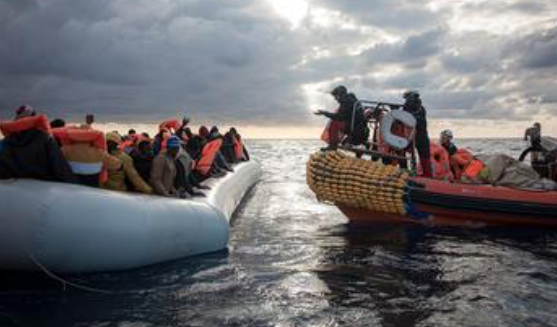
The International Organization for Migration (IOM), in newly released data on Wednesday, reported a sharp increase in deaths along migration routes around the world during the first four months of 2026. According to the agency, a combination of extreme weather, armed conflicts, economic pressures and changes in migration policies has reshaped the routes taken by people seeking better lives—from the Bay of Bengal to the Atlantic Ocean. Many have fallen victim to smugglers and fraud along the way.
IOM Deputy Director General Ugochi Daniels said more than 350 million international migrants worldwide—nearly half of the global migrant population—move primarily within their own regions in search of work, family reunification, education or safety. Yet media attention is often concentrated on only a handful of migration routes. Daniels stressed that accurate data alone cannot provide solutions, but no solution is possible without reliable data. Saving lives, she said, is not the responsibility of any single country but a shared global responsibility.
According to the report, deaths have increased on some migration routes even as the number of migrants using those routes has declined. IOM officials warn that fewer people reaching a destination does not necessarily mean that a migration route has become safer.
On the Central Mediterranean route, 821 people died or went missing, an increase of 111 percent compared with the previous period. At the same time, the number of people reaching Europe through this route fell by 46 percent to 8,577. More than half of the deaths occurred in January alone, when Cyclone Harry struck the region.
Deaths on the Eastern Mediterranean route also tripled, reaching 244. Much of the increase was reportedly linked to disasters near the island of Crete.
The report also noted significant changes along other migration routes. The number of migrants reaching Spain through the Western Mediterranean route increased by 66 percent, largely because crossings by land through Ceuta and Melilla tripled.
By contrast, the number of people reaching Spain through the Western African Atlantic route fell by 78 percent to 2,276—the sharpest decline among migration routes to Europe. The decline was attributed in part to departure points shifting farther south, making the journey longer and more dangerous.
Meanwhile, the number of migrants traveling along the Eastern route from the Horn of Africa to Yemen increased by 9 percent. Conflict in the Middle East has also contributed to new large-scale displacement in Lebanon, while the number of people crossing back into Syria has increased.
Alongside the IOM report, independent experts appointed by the UN Human Rights Council have issued an urgent appeal for stronger international action to assist nearly 1.2 million Rohingya refugees living in Bangladesh.
The appeal came after reports that two boats carrying more than 500 people sank off the coast of Myanmar in late June while attempting to flee Rakhine State.
According to UN agencies, more than 6,500 Rohingya undertook dangerous sea journeys in 2025, often falling into the hands of human traffickers. An estimated 900 people are believed to have died. Approximately 66 per cent of those who died or went missing were women and children.
According to the UN-appointed experts, approximately one in every seven people attempting to cross the Andaman Sea and Bay of Bengal has either gone missing or died. They described this as the highest mortality rate recorded on any refugee or migrant sea route in the world.
The experts have called on the international community to recognize its shared responsibility and take effective measures to prevent human trafficking. They also urged a human-rights-based response that ensures access to protection services, employment, education and health care.
Recent figures from the UN Refugee Agency, UNHCR, further illustrate the scale of the crisis. Around 1.156 million Rohingya refugees are currently living in 33 densely populated refugee camps in Cox’s Bazar. Approximately 52 percent of them are children.
In addition, between 35,000 and 37,000 Rohingya have been relocated to Bhasan Char, an island in Noakhali, under a government resettlement program that began in 2021. The relocation was intended, in part, to reduce pressure on the overcrowded camps in Cox’s Bazar.
The massive influx began in August 2017, when approximately 750,000 Rohingya fled to Bangladesh following a military crackdown in Myanmar. The Cox’s Bazar settlement subsequently became known as the world’s largest and most densely populated refugee settlement, with nearly one million people living in an area of only about 24 square kilometers.
According to UNHCR, approximately 150,000 additional Rohingya have arrived in Cox’s Bazar over the past year and a half because of targeted violence and persecution in Rakhine State. This represents the largest new influx of Rohingya from Myanmar since 2017.
The agency has warned that a global funding shortage is making the provision of food, medical care, education and relief supplies for the new arrivals increasingly uncertain.
The scale of the danger faced by Rohingya refugees at sea is also deeply concerning. According to UNHCR figures, between January 2022 and December 2023, 7,117 Rohingya embarked on sea journeys aboard 74 boats. Of them, 5,817 reached safety, while 573 were recorded as dead or missing. The fate of another 727 remains unknown.
The situation inside Myanmar has also continued to deteriorate. According to UN figures, the number of internally displaced people in Myanmar has exceeded 1.5 million since the military coup in February 2021. During the same period, at least 70,000 people have sought refuge in neighboring countries.
Approximately 88 percent of displaced Rohingya and other stateless people from Myanmar are currently sheltering in Bangladesh. Significant numbers of others are living in Malaysia and India.