
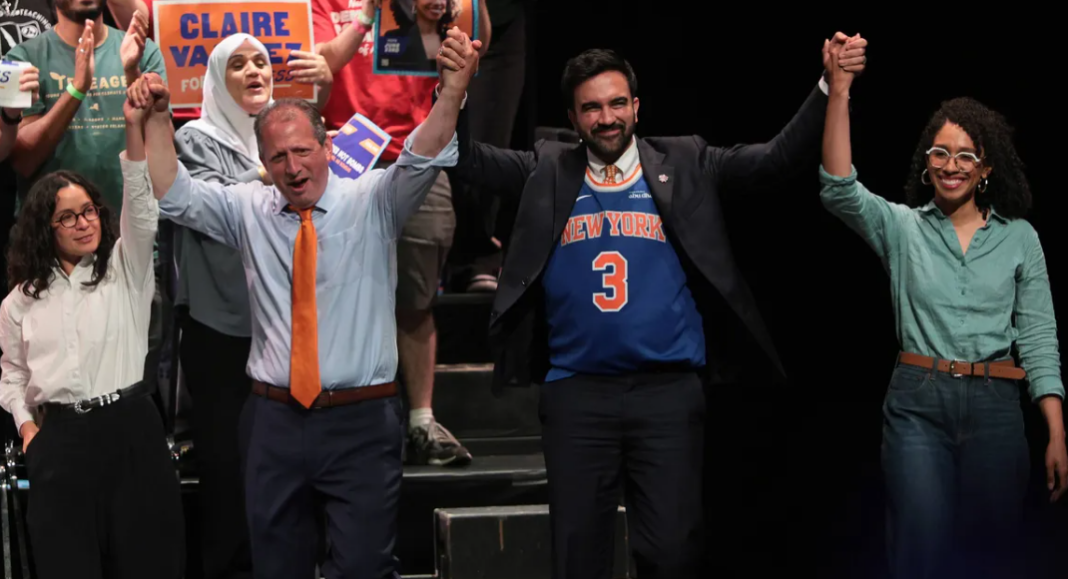
Tuesday night may be remembered for years to come in American politics. New York City Mayor Zohran Mamdani demonstrated that his mayoral victory last year was not a political accident—it was the beginning of a movement.
In New York’s congressional primaries, all three candidates backed by Mamdani emerged victorious. Two incumbent members of Congress were defeated, and the Democratic establishment in Washington received a direct challenge from a new generation of progressive politics.
The results were striking.
Brad Lander defeated two-term Congressman Dan Goldman in New York’s 10th Congressional District. Community organizer Daryaliza Avila Chevalier unseated five-term incumbent Adriano Espaillat, chair of the Congressional Hispanic Caucus, in the 13th District. In the 7th District, Claire Valdez defeated Brooklyn Borough President Antonio
Reynoso, who had been handpicked by retiring Representative Nydia Velázquez as her preferred successor.
Following the victories, Mamdani offered a simple but powerful message:
> “The question is not simply electing more Democrats. The question is > electing better Democrats. In these campaigns, I see a commitment to > bringing working people back to the center of politics.” The statement may sound straightforward, but in Washington it landed like a thunderbolt.
Perhaps the clearest message of the night was directed at House Democratic Leader Hakeem Jeffries. Jeffries had actively campaigned against Mamdani’s endorsed candidates. Before the election, he insisted that a handful of primary contests would not redefine the Democratic Party’s identity. By the end of the evening, that confidence appeared
considerably less convincing.
The three victorious candidates share a common political agenda:
abolishing ICE, recognizing Israel’s military campaign in Gaza as genocide, and increasing taxes on the wealthy. While these positions remain controversial within the Democratic mainstream, New York voters delivered a remarkably clear verdict.
The Gaza issue played a particularly significant role throughout the campaign.
Both Goldman and Lander are Jewish, yet they diverged sharply on Israel. Lander openly described the humanitarian catastrophe in Gaza as genocide, while Goldman avoided using the term. For many voters, foreign policy became a defining issue. Sarah Hyler, a 47-year-old voter from East Harlem, said she ultimately decided to support Avila Chevalier
after learning about the substantial financial support that pro-Israel lobbying groups had provided to Espaillat.
“That was my breaking point,” she explained.
The election also carried an element of political symbolism.
Jack Schlossberg, the 33-year-old grandson of President John F. Kennedy, attempted to write his own chapter in the Kennedy political legacy by seeking the seat being vacated by veteran Congressman Jerry Nadler. Yet in a crowded field, the Kennedy name was not enough. Political dynasties no longer guarantee electoral success. Mamdani had already demonstrated that reality when he defeated Andrew Cuomo in last year’s mayoral race.
The winner instead was Micah Lasher, a longtime public servant backed by much of the Democratic establishment. Even prominent anti-Trump activist George Conway entered the race and failed to gain traction.
Republicans experienced their own political surprise.
In New York’s 21st Congressional District, vacated by Elise Stefanik, Republican voters nominated Anthony Constantino, the CEO of Sticker Mule. A political outsider, Constantino became known for his unwavering support of Donald Trump. He installed massive “Vote for Trump” signs atop company buildings, released a pro-Trump hip-hop album, and even
commissioned a statue of the former president as a gift.
Trump endorsed him enthusiastically.
If Mamdani is reshaping the Democratic Party from the left, Trump continues to transform the Republican Party from the right. The common denominator is clear: establishment politics is under pressure from both directions.
What happened in New York on Tuesday was more than a local election.
It served as a reflection of a broader transformation taking place across American politics. On one side stands Mamdani’s democratic socialist movement. On the other stands Trump’s populist Republicanism. Between them, the traditional political establishment of both parties is finding itself increasingly squeezed.
The lesson from New York is unmistakable: voters are not simply choosing candidates. They are choosing competing visions of the future. And increasingly, they appear willing to challenge the institutions and political hierarchies that once seemed untouchable.