
Dr Ziauddin Ahmed
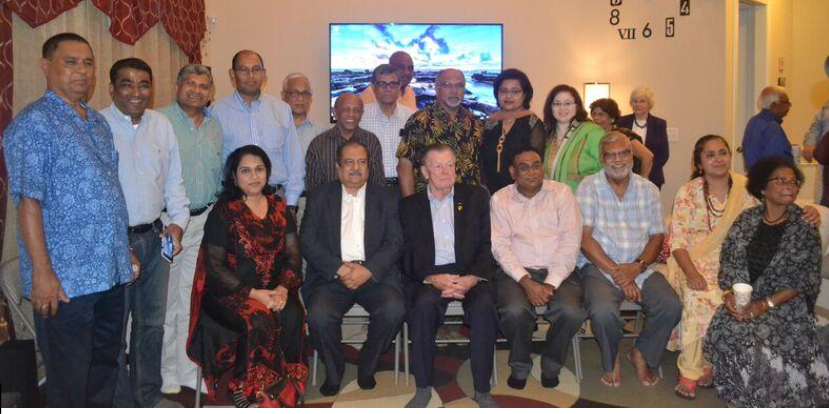
Many people are unaware of how many foreign friends risked their lives and stood beside Bangladesh during the Liberation War of 1971. One such remarkable person was Joseph L. Galloway. I had the opportunity to hear about him firsthand when Rashidul Islam Rubel and his wife Dr Tasnim Islam, residents of Raleigh, North Carolina, organized a small gathering
at their home. At their invitation, I travelled from Philadelphia to attend the event.
At that time, Joseph L. Galloway was already a well-known figure in the United States. He had become a leading voice advocating for the rights and dignity of American war veterans, particularly Vietnam veterans returning home. Even at the age of 78, he travelled extensively with his capable wife, Grace, attending various events where he strongly spoke
out against war and demanded justice and respect for veterans.
Joseph Galloway was a legendary military journalist who personally covered many wars around the world. His books later received wide recognition and acclaim. One of his most notable works on the Vietnam War, the bestselling book *We Were Soldiers Once… and Young*, was later adapted into a film that generated significant attention.
In 1971, Galloway visited Dhaka twice. The first time was during the turbulent months from January leading up to March, when the Liberation War began, and the second time was in December during the final days leading to victory.
The memories of Bangladesh’s Liberation War left a deep impression on him. As a young journalist, Joseph Galloway not only witnessed the mass killings, brutality, and crimes against humanity committed by the Pakistani military against millions of unarmed Bengalis, but he also played a courageous role in documenting and reporting these events.
From January 1971, Galloway was staying at the InterContinental Hotel in Dhaka along with other foreign journalists. Recalling those days, he described how, after the Pakistani military launched the brutal crackdown on March 25, they attempted to create the impression that normal life had returned to the country. To support this narrative, they
arranged a trip for foreign journalists, taking them on a small plane to show selected areas of what was then East Pakistan from a distance.
Afterwards, the journalists were placed on planes and sent out of the country. From the aircraft, however, burnt slums along railway lines were clearly visible.
Determined to gather more information, Galloway devised a plan.
Pretending to be ill, he told the soldiers that he had severe stomach pain and could not get out of bed, even asking them to carry him if necessary. Eventually, the soldiers left him behind while sending the other journalists away.
A short time later, Joseph Galloway stepped out onto the bloodstained streets of Dhaka. Pakistani soldiers began following him. As he walked toward Segunbagicha, he suddenly slipped through the gates of the American Embassy compound before the soldiers could react, taking refuge inside the US diplomatic mission in Dhaka.
At that time, the US Consul General in Dhaka, Archer Blood—another foreign friend of Bangladesh—expressed deep concern about the atrocities and mass killings being carried out by the Pakistani military. Taking personal risks, Archer Blood allowed the courageous journalist to use a room inside the embassy as an office.
From there, Galloway began collecting and transmitting reports.
Sometimes he gathered information secretly himself, while at other times he received accounts from local employees of the US Embassy. He documented the stories of mass killings, destruction, suffering, and grief, sending them to Reuters. Because of his reporting, the world began to learn almost immediately about the genocide taking place in
Bangladesh. After some time, he returned to the United States but continued writing about the events.
Galloway later returned to Dhaka in mid-December 1971 and witnessed several stages of the Pakistani military’s surrender. During the final days, when the InterContinental Hotel was declared a neutral zone under the International Red Cross, Galloway took responsibility for its management.
At the final press conference of the Pakistani military held there, he compelled General A.A.K. Niazi to leave his military badges and weapons outside before entering. Niazi threatened to shoot him. Galloway, along with a British journalist, protested firmly, saying that he could kill them if he wished—but then the press conference would never take place.
Eventually, Niazi was forced to leave his weapon outside before entering.
During the press conference, Niazi claimed that Pakistani forces were strongly positioned around Dhaka and ready to confront any enemy. Later that day, Galloway and several other journalists went outside Dhaka to verify the situation. To their surprise, they found that Pakistani soldiers were absent from the entry routes to the city. Their defences
had already collapsed, and many had fled in fear.
Throughout the war, Galloway continued sending reports from Dhaka. After the war ended, he visited the site of the massacre of intellectuals in Rayerbazar and strongly condemned the brutality committed there. He was one of the major witnesses to the nine-month Liberation War and the early journey of independent Bangladesh, sharing both its pain and its hope.
However, he also witnessed the public killing of Biharis at the Racecourse Ground (now Suhrawardy Udyan) by members of the Kader Bahini.
Seeing this incident made him fear that violent politics could influence Bangladesh’s future, and it left a troubling impression on him.
Fifty years later, at the small gathering of Bangladeshis in North Carolina, Galloway expressed deep regret for the US policy toward Pakistan during 1971. He also pledged to play a role in advocating for the recognition of the atrocities committed by the Pakistani regime in Bangladesh as genocide in the US Congress and internationally.
A year later, his name was proposed by retired generals and military journalists for one of the highest civilian honours awarded by the President of the United States. I was also part of that effort and promised to seek written support from the Government of Bangladesh.
Unfortunately, despite repeated attempts, the then foreign minister refused to provide any written endorsement, stating that he did not know Galloway. Eventually, we turned to the Bangladeshi ambassador in Washington for help. In a courageous step, the ambassador personally wrote a letter thanking Galloway for his contributions to Bangladesh.
Although that letter could not be used in the nomination process for the presidential medal, it still gave us some comfort.
Before the announcement of that prestigious presidential honour could be made, our friend Joseph Galloway left this world.
Wherever you are, rest in peace, our Joe.