
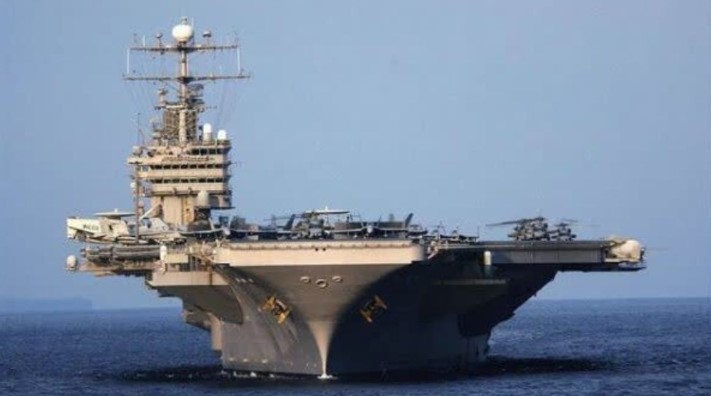
The U.S. aircraft carrier USS Abraham Lincoln has reportedly faced logistical difficulties during the ongoing conflict with Iran—not because it was directly struck by an Iranian missile, but because a key U.S. supply hub in the region was damaged in Iranian attacks.
According to a report cited by Iranian news agency Mehr, Iranian missiles and drones hit a U.S. naval facility in Bahrain. The attack was carried out as part of Iran’s response to U.S. and Israeli strikes on Iranian targets.
The Bahrain facility had served for decades as a major logistics center for U.S. naval forces operating in the Gulf. It played an important role in supplying fuel, food and other essential equipment needed to sustain military operations.
Supply Route Disrupted
The damage to the Bahrain facility forced the Pentagon to look for alternative ways to keep U.S. warships supplied.
One alternative is a British-controlled military base at Diego Garcia in the Indian Ocean. However, the base is roughly 2,200 miles from the Gulf of Oman, where the USS Abraham Lincoln and another U.S. carrier strike group are reportedly operating.
The longer supply route has created additional logistical challenges for the carrier groups, particularly as the military operation continues for an extended period.
Concerns Over Long Deployment
The disruption comes as some Democratic senators have raised concerns about the prolonged deployment of the USS Abraham Lincoln and its roughly 5,000 sailors.
According to the report, the carrier has now been deployed for close to nine months, raising questions about the strain placed on its crew and support network.
No Major Direct Hit Reported
The available account does not indicate that the USS Abraham Lincoln itself suffered major physical damage from an Iranian missile or drone strike.
Instead, the more significant impact has been indirect: the destruction of a critical Bahrain-based logistics hub has disrupted the carrier’s normal supply chain and complicated the U.S. military’s ability to sustain a prolonged operation in the region.
That logistical pressure could become increasingly important if the conflict continues, as aircraft carriers depend on a steady flow of fuel, food, spare parts, ammunition and other supplies to maintain sustained operations.