

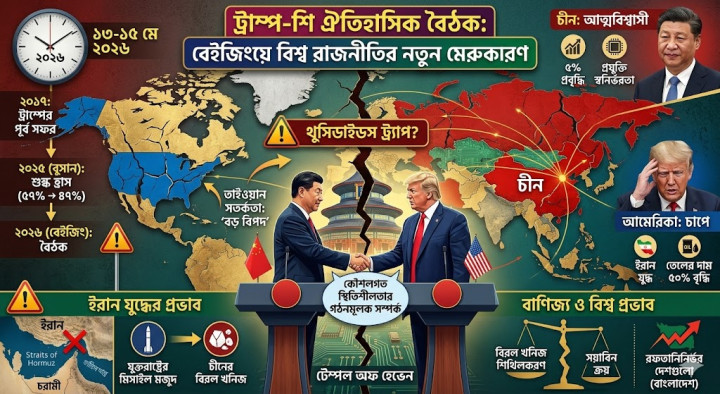
History has often witnessed moments when the entire world focuses on a handshake between the leaders of two global superpowers. For the first time in nine years, a sitting U.S. president has returned to Beijing following Donald Trump’s own visit in 2017. Trump’s current visit to China from May 13 to 15 represents one of those defining moments — one that could reshape global trade, regional security, and the balance of international power.
At the center of the summit is not merely trade or security policy, but the broader question of how the world’s two largest powers will coexist and compete in the future international order.
The framework for the visit was reportedly established during a brief meeting between Trump and Chinese President Xi Jinping in Busan, South Korea, in October 2025. During that meeting, Trump agreed to reduce tariffs on Chinese goods from 57 percent to 47 percent. The two sides also reached a temporary one-year agreement on the supply of rare earth minerals.
However, the ongoing conflict involving Iran and the United States complicated the diplomatic agenda. The trip had originally been planned for April but was postponed until May due to security concerns and geopolitical instability.
A Carefully Choreographed Welcome
Trump received a highly ceremonial welcome in Beijing. Chinese Vice President Han Zheng officially greeted him at the airport, while major roads in the Chinese capital were decorated with the flags of both nations. Children welcomed Trump and his delegation in Mandarin, and both leaders later toured the historic Temple of Heaven.
The elaborate reception was widely interpreted as a deliberate diplomatic message from Beijing, emphasizing China’s desire to maintain stable relations with the United States despite ongoing rivalry.
Analysts note that the geopolitical environment is dramatically different from Trump’s 2017 visit. China now appears significantly more confident in managing its relationship with Washington. Over the past year, Xi Jinping has reportedly succeeded in neutralizing several of Trump’s strategic pressure tactics.
China’s economy exceeded expectations with approximately 5 percent growth last year, while Chinese exporters diversified beyond American markets. The country has also made major advances toward technological self-sufficiency.
Trump Faces Mounting Pressure
In contrast, Trump entered the summit under considerable domestic and international pressure. The conflict affecting the Strait of Hormuz has intensified the global energy crisis, driving oil prices up by nearly 50 percent. Rising fuel and consumer costs have angered American voters and complicated Trump’s political outlook ahead of the 2026 midterm elections.
As a result, the Beijing summit represented an important opportunity for Trump to secure a major diplomatic achievement.
One of the most sensitive topics during the talks was Taiwan. Xi Jinping reportedly delivered a direct warning, saying that if the Taiwan issue is not handled properly, U.S.-China relations could face “serious danger.”
Xi also referenced the concept of the “Thucydides Trap,” raising the question of whether an emerging power like China and an established superpower like the United States can avoid the type of conflict that has historically accompanied shifts in global power.
Taiwanese officials had reportedly worried that Beijing might seek American support for “peaceful reunification.” Ultimately, however, both leaders agreed to pursue what they described as a “constructive and strategically stable U.S.-China relationship.” Beijing is reportedly viewing the understanding as a three-year framework for managing bilateral ties.
Iran Conflict Overshadows the Summit
Perhaps the most complicated aspect of the meeting was the ongoing Iran conflict. With disruptions in the Strait of Hormuz threatening global energy supplies, Washington hoped Beijing might pressure Iran to reopen the critical shipping route.
China, however, showed little interest in direct involvement. Instead, Beijing positioned itself as a neutral intermediary, seeking strategic advantages from both sides.
Analysts believe the crisis has created an unexpected diplomatic opportunity for Xi Jinping. Because China remains Iran’s largest oil customer and one of its key trading partners, Beijing now holds substantial leverage. At the same time, the United States increasingly depends on Chinese rare earth mineral exports for rebuilding military missile stockpiles and supporting advanced technologies.
Trade Talks Focus on Stability, Not Breakthroughs
Trade negotiations reportedly centered on easing restrictions on rare earth exports, restarting Chinese purchases of American soybeans, and establishing a joint U.S.-China trade board.
Still, most analysts agree that no major trade agreement is likely in the near future because the deeper structural rivalry between the two powers remains unresolved. Instead, the summit’s practical objective appeared to be reducing tensions and stabilizing relations.
The implications of the meeting extend far beyond Washington and Beijing. Export-dependent economies across South and Southeast Asia, including Bangladesh, could be directly affected by any easing of tariff tensions. If the trade war cools, countries that benefited as alternative manufacturing hubs may face increased competition again, potentially creating new challenges for Bangladesh’s garment industry.
Experts say it is becoming increasingly important for smaller economies to understand how global supply chains are shifting amid changing U.S.-China relations.
A Fragile Coexistence
Ultimately, the Beijing summit was not a historic breakthrough, but rather a declaration of cautious coexistence. The two superpowers remain deeply dependent on one another, while simultaneously competing and distrusting each other.
Both Trump and Xi understand that direct confrontation would carry enormous risks for both nations and the global economy. Their handshake inside Beijing’s historic halls symbolized a quiet acknowledgment that coexistence — however fragile — may be necessary for global stability.
The world is now watching closely to see whether the summit marks the beginning of a new geopolitical alignment or merely a temporary pause in an increasingly complex rivalry.