

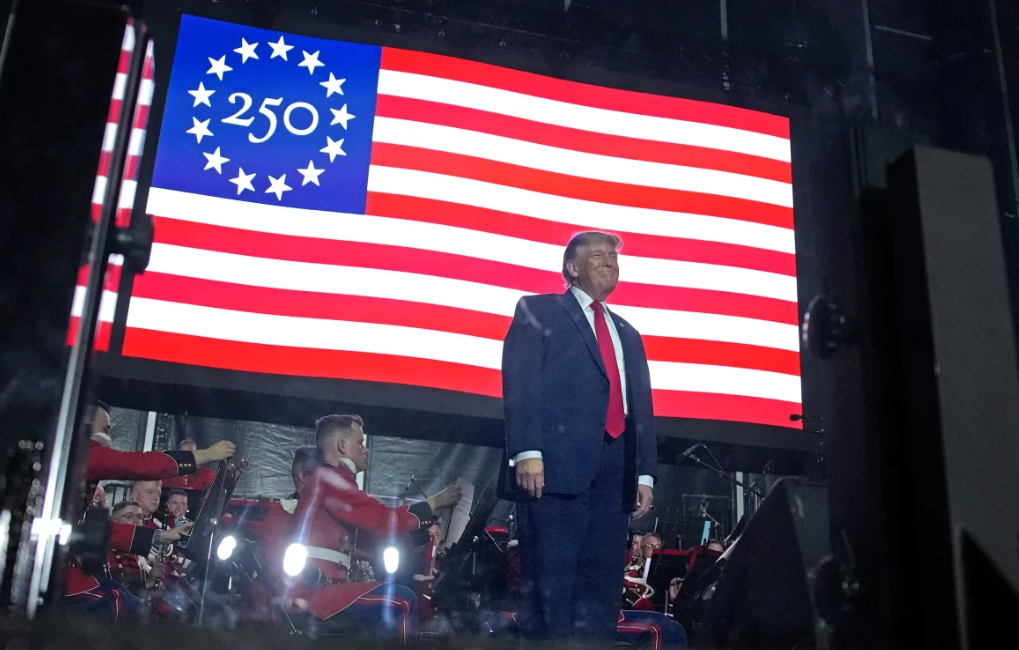
Every nation has a birthday. Unlike people, countries do not blow out candles or cut birthday cakes, but history preserves certain dates that define a nation’s identity. For the United States, July 4 is one of those sacred days. On July 4, 1776, the American colonies declared their independence from the British Empire. Two hundred and fifty years later, in 2026, the nation is preparing to celebrate its semiquincentennial—a milestone that was meant to belong to all Americans, regardless of political affiliation.
Democrats, however, argue that the celebration no longer belongs to the nation. They claim it has become personal—more specifically, that President Donald Trump has transformed America’s 250th birthday into his own political project.
Their allegations are not confined to campaign speeches or partisan rhetoric. They are laid out in a detailed 55-page report released Thursday by Democratic members of the House Natural Resources Committee. Titled From Vanity to Insanity: How the White House Cheated the American People out of Their 250th Birthday, the report accuses the Trump administration of diverting a national celebration for political and personal advantage.
The story dates back to 2016, when Congress established the bipartisan America250 Commission to oversee preparations for the country’s 250th anniversary. Republicans and Democrats alike envisioned a national, nonpartisan commemoration that would reflect the country’s shared history and democratic values.
According to the report, that vision changed after Donald Trump returned to office for a second term. Unable to reshape the existing commission to his liking, the administration created a separate organization called Freedom 250.
Established through an executive order and incorporated as a limited liability company (LLC) in October 2025, Freedom 250 operates under the National Park Foundation. Its governing board includes several close Trump allies, among them senior advisers from his 2024 presidential campaign.
Although Freedom 250 describes itself as a national and nonpartisan initiative, Democrats argue that it functions as a shadow organization directed by the White House.
The report outlines a series of serious allegations.
The first concerns federal funding. Congress appropriated $150 million for the 250th anniversary, with the expectation that $100 million would be directed to the America250 Commission. Instead, according to the report, America250 received only $25 million, while much of the remaining funding was diverted to Freedom 250 and projects closely associated with the Trump administration.
The second allegation involves donor confusion. Many individuals and organizations believed they were contributing to the congressionally authorized America250 Commission. Instead, they were reportedly provided with banking information for Freedom 250, resulting in donations being transferred to a different entity. Democrats argue that this could constitute wire fraud under federal law.
The third allegation centers on foreign fundraising. Freedom 250 Chief Executive Officer Keith Krach, a former Trump administration official, reportedly encouraged foreign governments and organizations to purchase Freedom 250 promotional packages during the World Economic Forum in Davos. Critics argue that these actions contradict the organization’s public assertion that it does not solicit foreign donations.
The fourth allegation raises ethical concerns. According to the report, major corporate sponsors were offered opportunities to meet President Trump and pose for photographs with him. Many of those companies have significant business interests tied to federal contracts, government funding, or regulatory decisions, raising questions about whether financial contributions provided privileged access to the president.
The fifth allegation focuses on federal contracting. The report claims that Event Strategies Inc.—the company that organized President Trump’s rally preceding the January 6, 2021, Capitol attack—received multimillion-dollar federal contracts connected to the anniversary celebrations.
Democrats contend that President Trump has long sought to make America’s 250th anniversary part of his own political legacy. They point to several examples, including a military parade commemorating the Army’s 250th anniversary that coincided with Trump’s birthday, a major White House sporting event held on the same occasion, and his proposal to build a 250-foot “Victory Arch” in Washington, D.C. That project has already drawn legal challenges from veterans’ organizations.
Freedom 250’s programming has also generated controversy. Critics argue that its exhibitions present an overly Christian-centered interpretation of American history while downplaying the nation’s diversity. In one instance, performers reportedly withdrew from a planned concert after learning it was no longer a nonpartisan event. The program was subsequently transformed into a political rally supporting President Trump.
Representative Jared Huffman of California, the committee’s ranking Democrat, said the report was the product of months of investigation involving whistleblower interviews, sworn congressional testimony, and internal organizational documents.
Huffman argues that what should have been a unifying national celebration has instead become an instrument of political promotion. He further alleges that public funds were used to benefit political allies and that repeated requests for information were met with resistance. If Democrats regain control of the House after the next election, he suggested that subpoenas and even criminal referrals could become possibilities.
Freedom 250 strongly rejects the allegations.
Spokesperson Daniel Alvarez dismissed the report as politically motivated and entirely false. He maintained that major donors clearly understood they were contributing to Freedom 250 before any funds were transferred.
Yet questions remain. Large corporate donors may have known exactly where their money was going. But what about ordinary citizens? Did they fully understand whether they were donating to the official congressional commission or to a separate private LLC?
Researchers from public-interest organizations estimate that more than $120 million in public funds has been spent—or is in the process of being spent—on the anniversary celebrations. They argue that a significant portion of that money has benefited projects and organizations closely aligned with the Trump administration.
Perhaps the most significant concern is transparency. Because Freedom 250 operates through the National Park Foundation and an LLC structure, donor identities and financial arrangements are subject to far less public disclosure than those of a congressionally established commission. Questions about who contributed, how much they contributed, and what they may have received in return remain largely unanswered.
Ultimately, this debate extends beyond dollars and cents. It raises fundamental questions about the character of government itself.
America250 was created by Congress as a bipartisan institution accountable to the public. Freedom 250, by contrast, is a private corporate entity with considerably fewer transparency requirements. That distinction lies at the heart of today’s controversy.
Two hundred and fifty years ago, the United States was founded in defiance of concentrated personal power. If, on the nation’s 250th birthday, its signature national celebration is accused of being transformed into the personal brand of a single political leader, history may view the irony with quiet reflection.
The celebrations will go on. Fireworks will light the sky. American flags will wave. President Trump will deliver remarks. Supporters will applaud. Critics will continue to investigate.
A birthday lasts only a day.
History’s questions, however, have a way of demanding answers long after the celebrations are over.