

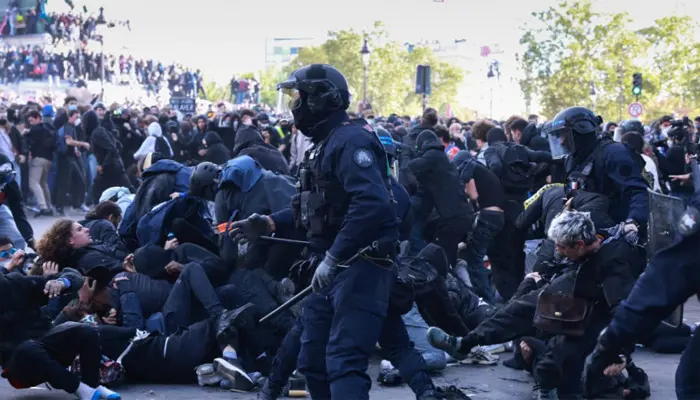
French students began returning to their classrooms on Friday, October 9, following several days of continuous protests demanding better learning conditions. However, students have announced plans for larger demonstrations next week, while the United Nations has expressed concern over occasional violent clashes. The report was published by Agence France-Presse (AFP).
Since late September, thousands of students across France have taken to the streets, blocking entrances to high schools and prompting the deployment of riot police to contain the unrest.
The protesters, most of whom are between 15 and 18 years old, have raised concerns about teacher shortages, excessive academic workloads, deteriorating classroom facilities, and school buildings that are unable to cope with increasingly high temperatures.
France’s Justice Ministry said Friday that more than 6,800 people had been detained since the protests began, with minors accounting for 86% of those detained.
The United Nations said Friday that it was monitoring the situation “with concern” and called on all parties to remain calm.
Shabia Mantoo, a spokesperson for the UN human rights office, said, “We are following with concern reports of incidents of violence linked to student protests and high school blockades in France.”
Although most demonstrations have remained peaceful, some protesters have set fires in the streets and vandalized bus stops.
In response, police have used tear gas, batons, and blast balls, a type of explosive crowd-control device. Human rights organizations and students have accused police of using excessive force. Following allegations of misconduct, police have launched 18 internal investigations into their own officers.
On Monday, a 15-year-old boy lost his hand when a police stun grenade exploded. The government subsequently announced a suspension of the weapon’s use.
In Paris, police said Thursday evening that they had deployed tear gas at Place de la Bastille to disperse groups in potentially dangerous situations.
In an effort to ease tensions, Education Minister Édouard Geffray announced late Thursday that approximately 3,000 substitute teachers would be deployed in the coming days to replace absent staff at 114 of the worst-affected high schools.
Prime Minister Sébastien Lecornu has promised a plan to resolve the crisis by the end of October. Meanwhile, Finance Minister Roland Lescure said the government could still meet demands for additional school resources despite the tight constraints of the proposed 2027 budget.
Under the current draft budget, education is set to receive the second-largest funding increase after defense. Funding for the education sector is projected to rise by 1.4% to €90.9 billion.
The Education Ministry reported that only 141 of France’s approximately 3,700 high schools, known as *lycées*, remained closed on Friday. By comparison, protests had forced nearly 800 schools to close the previous Friday.
Despite the decline in school closures, many students have told AFP that they are not backing down. Protest organizers have called for larger demonstrations next week.
“We are saving our energy for next week,” said a 16-year-old student in Toulouse.
Alice, a high school student in Marseille, said the education minister’s announcements represented a first step but were not enough to address the problems.
Marius Mesnil, a student union representative, called for a new round of demonstrations next Tuesday, saying, “We are only being offered a few token concessions.”
With students preparing to resume their protests, pressure is mounting on the French government to address concerns over staffing shortages, school infrastructure, classroom conditions, and the broader challenges facing the country’s education system.