
Shamsul Haque has emerged as a new political possibility for the Bangladeshi-American community in the New York State Assembly District 30 race. His candidacy has already generated enthusiasm and discussion across the community. But this conversation goes beyond the campaign of a single candidate—it points to a larger reality: how urgently Bangladeshi-Americans need representation in New York’s mainstream politics, and how prepared the community is to achieve that goal.
The significance of this election lies not only in the contest for one Assembly seat, but also in what it reveals about the political maturity of the Bangladeshi immigrant community. Over the last three decades, the Bangladeshi population in New York has grown significantly, along with its economic and social influence. From Jackson Heights to Jamaica, Astoria to Ozone Park, the visibility of Bangladeshis is now impossible to ignore. Yet political representation remains limited. That is why many view Shamsul Haque’s candidacy as both symbolic and consequential.
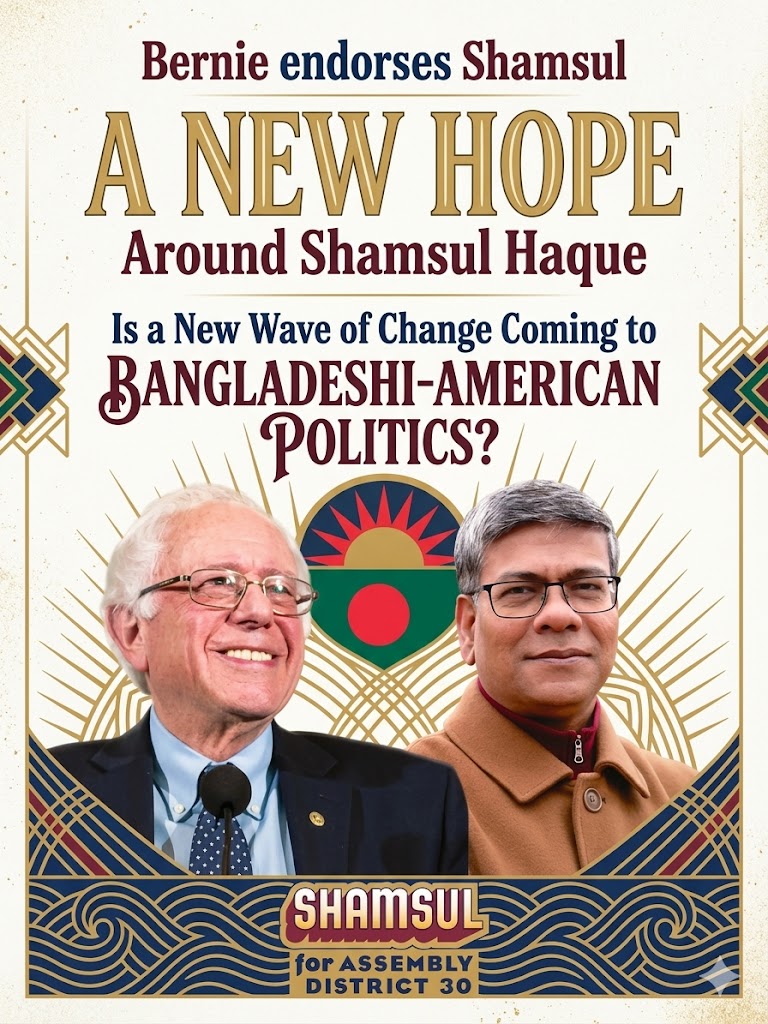
His campaign has gained additional momentum through the endorsement of one of America’s most influential progressive political figures, U.S. Senator Bernie Sanders. The endorsement adds both political and moral weight to his campaign. Progressive voters continue to play a major role in New York’s Democratic politics, and Sanders remains a trusted figure among them. As a result, this support is more than campaign messaging—it has the potential to shape voter perception and influence electoral outcomes.
However, electoral politics is rarely driven by emotion alone. Elections are won through organization, voter turnout, and coalition-building. This may prove to be the greatest challenge facing Shamsul Haque. Uniting Bangladeshi voters alone will not be enough; he must also establish credibility among South Asian, Muslim, Latino, and younger progressive voters. New York’s political history consistently shows that candidates who build broad, multicultural alliances tend to have the strongest path to victory.
Supporters argue that Shamsul Haque has earned public trust through years of community service and grassroots engagement. His campaign has focused on issues such as education, immigrant rights, small business development, public safety, and youth empowerment—issues that resonate deeply with voters. Yet the real challenge lies in converting public enthusiasm into votes on election day.
One long-standing weakness within Bangladeshi-American politics has been internal division. Too often, the community has fractured into competing factions, weakening its collective political influence. This pattern has surfaced repeatedly in previous elections. For that reason, Shamsul Haque’s success may depend not only on individual support, but also on whether the community can unite behind a common message: this is the moment for meaningful representation.
Political observers believe the District 30 election will send an important signal. If Shamsul Haque performs strongly, it will represent more than a personal achievement—it could mark the beginning of a new era of political confidence for the Bangladeshi-American community in New York. If he falls short, that outcome will also carry a lesson: demographics alone do not create political power. Without organization, strategy, and sustained participation, numbers remain only statistics.
Ultimately, Shamsul Haque’s campaign has become more than a race for public office—it reflects a broader struggle over political identity, visibility, and belonging. For Bangladeshi-Americans, this is a defining moment. The question now is whether the community is truly ready to shape its own political future.