
The history of Bangladesh’s Liberation War is not only a tale of courage on the battlefield. It is an extraordinary epic of humanity, responsibility and sacrifice. One of the most distinctive yet comparatively overlooked chapters of this epic is the contribution of the physicians, students and healthcare workers of Sylhet MAG Osmani Medical College and Hospital. In 1971, as the Pakistani occupation forces unleashed a merciless genocide against an unarmed Bengali people, Sylhet Medical College became a unique and extraordinary theatre of resistance. With limited resources, a severe shortage of medicines, and the constant shadow of death, its doctors and health workers staked their lives to serve the wounded and the dying. At the very heart of this human service stood Professor Dr. Shamsuddin Ahmed, Head of the Surgery Department — a physician, a leader and a symbol of humanity. As early as the beginning of March, sensing the approaching storm of
violence, he established an emergency blood bank and intensive care team at the hospital. That foresight would later save countless lives.
After the genocide of 25 March, when bloodshed spread to Sylhet, Dr. hamsuddin did not retreat into caution. He told his students plainly — the only answer to this barbarity is independence. Inspired by his call, many students left to join the liberation struggle directly. But Dr.
Shamsuddin himself demonstrated something rarer still: a commitment to medical ethics that went beyond all boundaries. He treated wounded Pakistani soldiers in the hospital alongside Bengali fighters and pleaded with freedom fighters not to attack them. His unwavering adherence to the principles of medical conduct elevated him to a
singular moral height.
As the war intensified, Sylhet emptied. People fled to the villages. But the hospital remained full — full of the bullet-ridden and the broken.
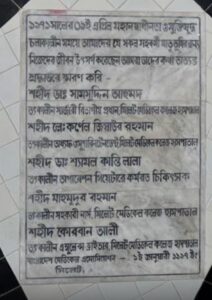
Most physicians left for their safety. Dr. Shamsuddin did not. “I will not leave my patients,” he said. At his side remained a small band of brave colleagues — trainee physician Dr. Shamal Kanti Lala, Abdul Hakan Qurban Ali, nurse Mahmudur Rahman and a few others. They knew the risk they were taking. They stayed regardless.
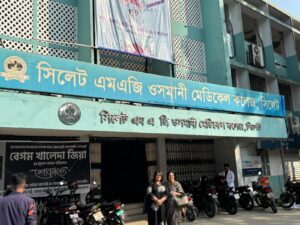
The morning of 9 April 1971. Fierce fighting raged around Sylhet Medical College. A freedom fighter attack had inflicted losses on a Pakistani military convoy. In revenge, Pakistani soldiers entered the hospital and dragged Dr. Shamsuddin Ahmed and his colleagues out of the operating theatre. He was still wearing his white apron. He tried to explain that they were only doctors. No argument was heard. In the hospital courtyard, they were lined up and shot dead. Dr. Shamsuddin Ahmed, Dr. Shamal Kanti Lala, Qurban Ali, Mahmudur Rahman and others were martyred.
This massacre stands not only as one of the most savage crimes of Bangladesh’s Liberation War but as a war crime against humanity in the broader history of armed conflict. The killing did not stop there. On 14 April, the principal of Sylhet Medical College, Lieutenant Colonel Dr. Abul Fazal Ziaur Rahman, was abducted and later included in the list of martyred intellectuals. In the days that followed, many more physicians and health workers were tortured and killed.
Yet the contribution of this institution was not confined to martyrdom.
Students of Sylhet Medical College crossed the border into India and joined the Medical Corps of the liberation forces. They ran field hospitals in refugee camps in Meghalaya and Tripura and provided medical support to freedom fighters in their field camps. Many took up arms and fought directly in Sectors 4 and 5.
Beyond the battlefield, students and staff secretly gathered medicines, bandages and surgical supplies from the hospital’s stores and delivered them to freedom fighters in the dead of night, defying curfews and risking their lives with every journey. Discovery meant certain death.
They went anyway.
The sacrifice of this institution was not limited to its doctors.
Lower-ranking staff, nurses and ordinary students also paid with their lives. Among the notable martyrs were Mahmudur Rahman, Qurban Ali and many others who supported the liberation movement in every way they could throughout the nine months of war.
After liberation, the bodies of the martyrs were buried in the hospital grounds. That site today stands as a preserved killing ground and a memorial to the martyred intellectuals. Every year, people come in great numbers to pay their respects. This memorial is not merely a structure — it is a silent witness to history. The sacrifice of Sylhet Medical College served as a vital source of inspiration and strength for the freedom fighters of Sectors 4 and 5. Medical support, logistical assistance and human solidarity — taken together, this institution played a role in the Liberation War that was entirely its own.
More than half a century after independence, this history demands fresh reflection. These physicians did not fight with weapons. But the courage, the sense of duty and the humanity they showed in standing by the wounded — that is not less than any act of valour on the battlefield. It is something more.
This history must be brought before the new generation. Because here we see that the service of humanity never bows to fear, and that in the face of true responsibility, even death becomes a small thing.
The history of Sylhet MAG Osmani Medical College reminds us of something we must never forget — independence is not won only through war. It is preserved through humanity. The men and women who could have walked away from that hospital chose to stay. They stayed because inside, there were still people who wanted to live. And within that act of staying lies the deepest meaning of the Liberation War.
But a question remains — have we honoured this sacrifice as it deserves?
The extraordinary contribution of the physicians, students and health workers of Sylhet MAG Osmani Medical College has still not received the national recognition it is owed. And yet this is not merely the history of one institution. It is the symbol of an entire nation’s moral strength. National recognition of this sacrifice would not only be an act of respect toward the past — it would inspire the generations to come. Young doctors, students and citizens would learn that their profession is not merely a livelihood. It is a responsibility. It is a right — the right to serve humanity. A nation truly grows when it learns to recognise its real heroes, to honour them and to carry their ideals forward. That recognition could become the solid foundation upon which we build a humane, ethical and responsible Bangladesh for tomorrow.
** The writer is the Principal of Sylhet MAG Osmani Medical College, Sylhet, Bangladesh.