
Sylhet Correspondent:
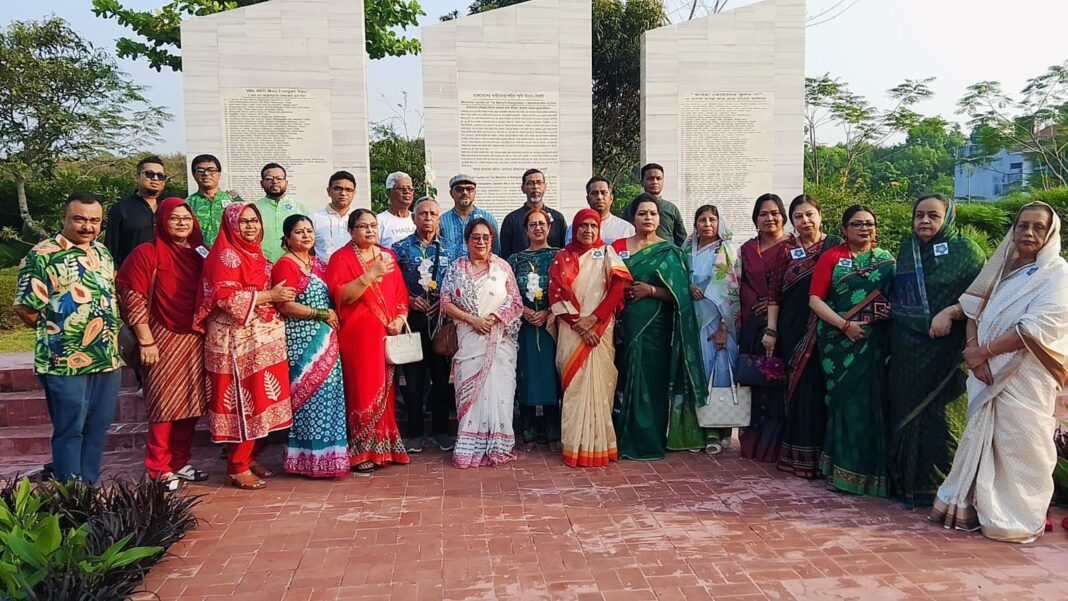
The martyrs of Bangladesh’s Liberation War were remembered with deep reverence at the Shaheed Smriti Udyan in Sylhet on Thursday, as various social and civic organisations gathered at the historic site to mark the country’s Independence Day through floral tributes, recitations of the national anthem, poetry readings, and personal testimonies of the 1971 war.
The memorial garden stands on the grounds adjacent to Sylhet Cadet College, where the Pakistani military had established a camp during the Liberation War. Bangladeshis, including freedom fighters, were brought there, tortured and killed. More than two hundred individuals were buried in a mass grave behind the college, a site long known to locals
as the Cadet College killing ground. For decades, the restricted location made it difficult for the general public to access.
Fifty-two years after the war, the site was finally transformed. On 3 March 2023, through the initiative of freedom fighter Colonel (Retd.) Mohammad Abdus Salam Bir Pratik and freedom fighter Professor Dr. Ziauddin Ahmed, the site was developed into the beautifully designed Shadhinatar Shaheed Smriti Udyan, where each martyr is honoured with an
individual epitaph.
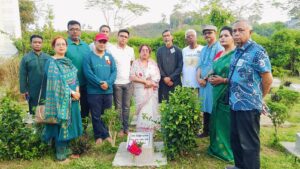
Among those who gathered on Thursday was expatriate journalist and poet Shamim Azad, who stood before the epitaph of her maternal uncle, Syed Sirajul Abdal. He had been the assistant manager of the Lakkatura Tea Garden in Sylhet when Pakistani forces took him from his home one morning in May 1971. He never returned. He was tortured and killed at
the very killing ground that is now this memorial garden.
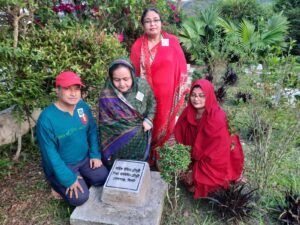
Elsewhere in the garden, three nieces — Husna Begum, Hasina Begum, and Kazi Taslima Sayera — along with nephew Abdul Karim Kim, sat in quiet grief before the epitaph of Shaheed Sufi, a freedom fighter from Golapganj’s Bagha village. Sufi had set out for India with two young men from the village, Faruk and Jalil, but was captured by Razakars,
imprisoned at Sylhet Cadet College, tortured, and ultimately killed by Pakistani forces.
At 4:00 p.m., floral tributes were laid at the memorial on behalf of Kidney Foundation Sylhet, Dharitri Rakkhay Amra (Dhara) Sylhet Chapter, the Environment and Heritage Conservation Trust Sylhet, and the Jalalabad Inner Wheel Club. The tributes were led by poet Shamim Azad, joined by Father Joseph Gomez, a member of Dhara’s central convening committee; Dr. Mostafa Shahjaman Chowdhury, convener of Dhara Sylhet;
Abdul Karim Kim, member secretary; Advocate Syeda Shireen Akhtar, president of the Conscious Citizens Committee Sylhet; Farida Nasrin of Kidney Foundation; former president of Sylhet District Press Club Hasina Begum; and advocates, academics, cultural organisers and civil society members from across the city.
At 5:00 p.m., a poetry reading session was held at the garden, presided over by poet Shamim Azad. Poems were recited by Masuda Siddiqua Ruhi, Rowshan Ara Banshi, Nasima Chowdhury Mili, Mukta Chowdhury, and poet Dhrubo Gautam, among others. Personal recollections of the Liberation War were shared by Shamim Azad, Father Joseph Gomez, Dr Mostafa Shahjaman Chowdhury, and former Sylhet District Press Club president Hasina Begum.
The event was organised by Bijoy Phul, the cultural organisation founded by poet Shamim Azad — its name and symbol inspired by a flower of five green petals surrounding a red circle, reflecting the colours of the Bangladeshi flag and the spirit of victory.