
By Ibrahim Chowdhury Khokon
Cox’s Bazar and the surrounding border areas of Bangladesh are no longer defined solely by a refugee crisis. Increasingly, these regions are becoming a dangerous hotspot for human trafficking, particularly involving women and children. According to estimates from international human rights organisations, around 150,000 Rohingya refugees living in the area continue to face extreme uncertainty, poverty, and insecurity.
This fragile reality has created fertile ground for trafficking networks to exploit vulnerable people.
According to the July–September 2024 dashboard of the Anti-Trafficking Working Group, a total of 86 Rohingya individuals were identified as victims of human trafficking during that period. Among them, 72 percent were men and 28 percent were women. Forced labour accounted for the majority of trafficking cases, representing 76 percent of the incidents.
Additionally, 6 percent involved sexual exploitation and another 6 percent involved forced marriage. Four cases of attempted organ removal or organ trafficking were also identified. In another alarming incident, a 16-year-old boy was reportedly taken to Myanmar for the purpose of participating in armed conflict.
The report states that in 83 percent of cases, victims were recruited through false promises of employment, often beginning within the refugee shelters themselves. Alarmingly, 50 percent of traffickers were
individuals known to the victims, such as neighbours or acquaintances.
Among 22 documented cross-border trafficking cases, 50 percent had Malaysia as the destination and 30 percent involved India. Three cases were linked to Myanmar and one to Indonesia. In terms of transportation routes, 88 percent of trafficking incidents occurred via land routes, while 12 percent involved sea routes. Overall, these statistics indicate
a troubling and systematic pattern of trafficking within refugee camps.
Since 2024, renewed conflict in Myanmar’s Rakhine State has triggered further displacement of Rohingya populations, with a significant number seeking refuge in Bangladesh in 2025. At the same time, humanitarian conditions in the camps have become increasingly fragile. Food insecurity, lack of income opportunities, and funding shortages have heightened the vulnerability of refugees. These social and economic uncertainties create favourable conditions for trafficking networks to operate.
Although most of the identified victims are men, women, and children emain particularly vulnerable, especially in cases of sexual exploitation, forced marriage, and trafficking through maritime routes.
Due to extreme poverty and uncertainty about the future, some families agree to send adolescent girls abroad in hopes of securing a “safer future,” a situation that traffickers frequently exploit. Deception, detention, ransom demands, and dangerous sea journeys—often resulting in loss of life—have turned the crisis into a deeper humanitarian tragedy.
The most alarming dimension of this crisis involves women and children. Reports from human rights organisations and international media indicate that trafficking networks deliberately target women, teenage girls, and children because they are among the most vulnerable and least able to resist exploitation. In many cases, traffickers lure them out of refugee camps with promises of high-paying jobs, secure marriages, or opportunities to travel abroad with their families. In reality, these journeys often end in captivity, physical and psychological abuse, sexual exploitation, or detention for ransom. Trafficking of children constitutes a serious violation of international law and has transformed the situation into a full-scale humanitarian emergency.
Many Rohingya families, struggling with severe poverty, decide to send their daughters to Malaysia in hopes of ensuring a more secure future.
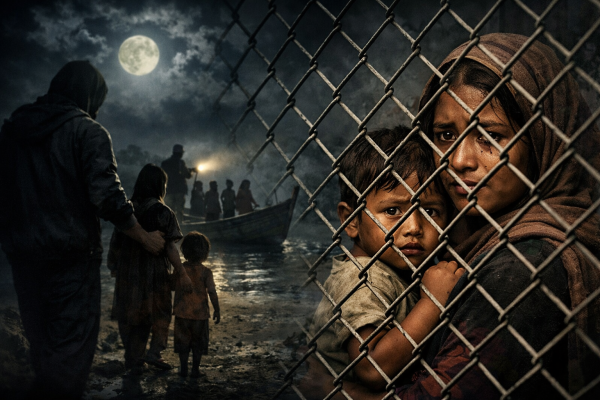
Trafficking networks take advantage of this desperation. Victims are typically transported by small boats across the sea, but during the journey women and children are often separated and detained in different locations. Families are then forced to pay large sums of money as ransom, pushing them into deeper debt and vulnerability.
These dangerous sea journeys frequently lead to tragedy. According to human rights organisations, numerous boat accidents in the Andaman Sea and surrounding waters have resulted in hundreds of Rohingya women and children going missing or losing their lives. In many cases, bodies are never recovered, making the crisis even more devastating and largely invisible.
At the local level, the activities of trafficking networks are increasingly visible. In recent months, law enforcement agencies have rescued nearly 200 Rohingya men and women from trafficking attempts in the coastal areas of Teknaf and Ukhiya. In October 2025, the Bangladesh Coast Guard rescued 26 Rohingya women and children who were being
trafficked to Malaysia. In another operation in Teknaf, authorities rescued 66 Rohingya individuals, including women.
Experts warn that the crisis extends beyond the refugee populationitself. Trafficking networks are contributing to increased crime and security risks in border regions such as Cox’s Bazar, Bandarban, and likadam. The trafficking of women and children is affecting local communities as well, turning the issue into a broader regional security
concern.
Under international law, human trafficking is recognised as a serious crime. According to the United Nations, the recruitment, transportation, or exploitation of women and children through deception or coercion constitutes a direct violation of international law. Bangladesh has taken initiatives to strengthen legislation in line with international protocols, but effective enforcement, swift justice, and adequate protection for victims—particularly women and children—remain significant challenges.
Human rights analysts warn that unless urgent steps are taken to ensure special protection for women and children, along with access to education and sustainable livelihood opportunities, the trafficking crisis will worsen. This is not merely a refugee issue—it is an
international humanitarian crisis in which the lives, dignity, and future of women and children are at risk every day. Without effective international cooperation and immediate action, the situation is likely.