

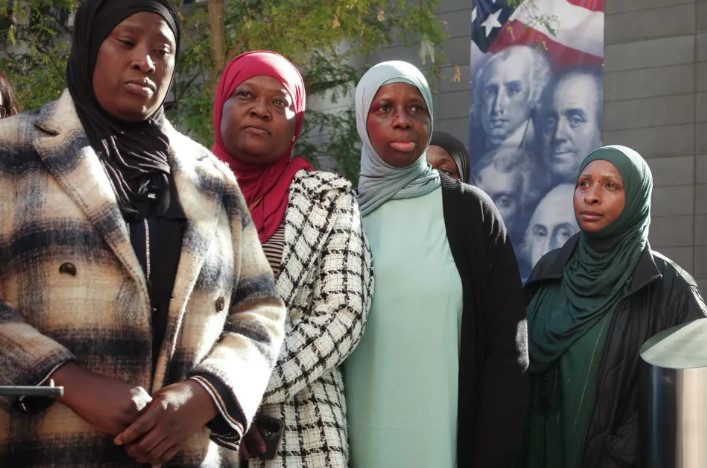
A house cleaner, a certified nursing assistant, a hair braider and a home health aide are among the West African immigrant women who have been summoned to 26 Federal Plaza in Lower Manhattan in recent weeks and arrested by U.S. Immigration and Customs Enforcement (ICE), according to immigrant advocates and a review of six federal habeas corpus petitions filed over the past two weeks.
The women, all immigrants from West African countries, had lived in New York City for decades. Each had a legal status protecting them from deportation to their home countries after immigration judges determined they would face danger if returned.
But a new U.S. Supreme Court order issued Tuesday could leave them vulnerable to rapid deportation to third countries.
Immigrant advocates fear the recent arrests signal an effort by the Trump administration to expand the use of third-country deportations. The Supreme Court is expected to consider the broader issue later this year. The policy is the latest administration effort to circumvent protections that prevent the deportation of people who could face persecution or other serious harm in their home countries.
In response to questions about the arrests, a Department of Homeland Security spokesperson described third-country removals as “an essential public safety tool” for removing what the administration calls dangerous undocumented immigrants.
“Additionally, if an illegal alien chooses to file a claim in court refusing to go to their home country, they should not be surprised when we find a safe and secure nation for them to go to,” the spokesperson said.
Third-Country Deportations Rise
The overall number of people deported to third countries remains relatively small. But the number has increased sharply this year.
According to data from the Deportation Data Project, ICE had deported 147 people arrested in New York City to third countries by early August, compared with 86 during the same period last year.
The cases reviewed by The City Reporter showed that most of those facing third-country deportation had no criminal history. Only one of the six cases reviewed mentioned a criminal record—a 2008 disorderly conduct conviction.
Data also shows that the share of third-country deportees without criminal histories has increased. In 2025, 73% had no criminal conviction or pending criminal charge. That figure rose to 85% in 2026.
At a press conference outside 26 Federal Plaza on Wednesday, immigrant advocates and family members of detained immigrants called attention to the recent arrests. They urged New Yorkers who receive “call-in letters” from the Department of Homeland Security to seek legal assistance before appearing for their appointments.
The letters reviewed by The City Reporter and Documented provided few details. Recipients were simply instructed to report to 26 Federal Plaza at a specified date and time, without being warned that they might be arrested.
One letter listed the reason for the appointment as “DOCUMENT ISSUANCE.” Another said only “ICE CHECK IN.”
‘Withholding of Removal’
Adama Bah, founder of Afrikana, a Harlem-based nonprofit that advocates for and provides direct assistance to immigrants, said she began receiving a flood of calls about two weeks ago.
“Two weeks ago, my phone was flooded with calls and text messages,” Bah said.
“It’s a very scary moment, where you’re following the law, you haven’t been to court in 20, 40 years,” she said. “There was a woman who reached out to me, who’s been in this country since 1987. I wasn’t even born. [She] got the letter, trusted her government, walked into this building and was handcuffed.”
Advocates with the New York Legal Assistance Group, the Amadou Ly Foundation, UnLocal and Make the Road New York, among other organizations, have been working to respond to the cases. They have filed a series of habeas corpus petitions challenging the detention and potential deportation of West African immigrants.
Many of the cases involve people with a status known as “withholding of removal.”
Withholding of removal is granted when an immigration judge finds that a person faces a high likelihood of persecution if returned to their home country. It provides fewer protections than asylum but can allow a person to remain and work legally in the United States. Unlike asylum, it can also be sought after the one-year deadline that generally applies to asylum applications.
The status prevents the U.S. government from deporting recipients to countries where they face persecution. But the Trump administration has argued that such individuals can still be deported to third countries that agree to accept them.
A Mother’s Arrest
One recent case involved the mother of Madeliene, a 20-year-old Harlem resident. Her mother had immigrated from The Gambia in 2003 and had been granted withholding of removal because of the danger she faced if returned.
Advocates asked that the mother’s name be withheld because her case remains pending.
“My mother is not only my best friend but she’s the glue of our family. Having her being taken away from us was devastating,” Madeliene said at Wednesday’s press conference, fighting back tears.
Her mother received a letter instructing her to report to 26 Federal Plaza. Madeliene accompanied her, expecting the appointment to be routine.
The two took the No. 5 train to Lower Manhattan. Her mother entered the building while Madeliene waited outside, planning to attend a college class later that day and have her hair redone by her mother, who had worked for decades as a hair braider along Harlem’s 125th Street.
Hours passed.
“Every single minute, my worries got worse,” Madeliene said.
Family members called her mother’s phone, while Madeliene tried reaching her through WhatsApp. There was no response.
More than five hours later, just after noon, her mother called and said she had been detained.
The family soon received more disturbing news.
“She called me, she was like, ‘They said they’re gonna hold me here, and in one week they’re gonna send me to Ghana,’” Madeliene said.
Her mother had fled The Gambia more than two decades ago after experiencing gender-based violence, according to her family.
Human rights lawyers filed a federal lawsuit against the government of Ghana in June, alleging that deportees sent there from the United States were being transferred to their home countries within hours or days of arrival, potentially violating international protections against persecution.
Through the Amadou Ly Foundation, Madeliene’s family found pro bono legal representation. Her attorney filed a habeas corpus petition on Sept. 22, the day she was arrested.
A federal judge subsequently ordered that she not be moved out of New York or New Jersey. ICE nevertheless transferred her to Atlanta and then Louisiana before returning her to New Jersey, according to her family.
“Every time she would get transferred, it was like she would just vanish from the website,” Madeliene said.
A day after Madeliene spoke publicly about her mother’s case, a federal judge ordered her release. Prosecutors did not oppose the request.
Madeliene reunited with her mother at the Delaney Hall immigration detention center in New Jersey on Friday morning, 10 days after her arrest.
Supreme Court Order Opens the Door
The recent arrests came after a legal battle over the administration’s authority to deport people to countries other than their countries of origin.
A federal court in Massachusetts had blocked third-country removals in February, ruling that immigrants should have an opportunity to challenge deportation if they feared being sent to countries where they could face persecution or other harm.
On Sept. 24, the Trump administration asked the Supreme Court to intervene and issue an emergency stay.
On Tuesday, the justices granted the administration’s request, overturning the lower court’s order and allowing the government to resume rapid third-country deportations while the broader legal dispute continues.
In New York City, such deportations had previously been uncommon. But the recent data suggests the practice has accelerated during the Trump administration’s second term.
‘You Ready to Fly to Ghana?’
The City Reporter and Documented reviewed five additional habeas corpus petitions involving longtime New Yorkers facing possible deportation to third countries.
One case involved a certified nursing assistant from Burkina Faso who lives in the Bronx with three U.S.-citizen children, all younger than 12.
Another involved a Gambian home health aide with no criminal record. According to the filings, the government intended to send her to Sierra Leone.
In a legal brief in that case, Assistant U.S. Attorney Brandon Waterman argued that ICE can remove immigrants to any “country whose government will accept the [noncitizen] into the country.”
Another woman, a 52-year-old house cleaner who had lived in the United States since 1993, was arrested at 26 Federal Plaza on Sept. 23. She had received withholding of removal to The Gambia in 2013.
While she was being held at the federal building, ICE agents told her she would be sent to Ghana, according to her account, which was also described in a habeas corpus filing reviewed by The City Reporter and Documented.
“‘You ready to fly to Ghana?’” an ICE agent asked her, she recalled.
“But I’m not from Ghana,” she replied. “How am I going to fly to Ghana? I don’t know nobody there.”
She spent nearly a full day in holding cells at 26 Federal Plaza before being shackled and transferred to the Elizabeth Detention Center in New Jersey.
Each morning around 4 a.m., guards removed several women from her dormitory while new detainees arrived. For a week, she lived with the fear that she could be placed on a plane and sent to a country she had never visited.
After her attorney filed a habeas corpus petition, ICE released her.
She said the other detainees applauded as she walked out.
“Everybody’s telling me, ‘You are a hero.’ They were clapping,” she said.
The experience left her deeply shaken. She said she has struggled to sleep since her release.
“I’m never gonna forget this my entire life.”