

The death of a rookie New York City transit worker who was struck by a subway train last week has brought back painful memories for a retired MTA flagger who survived a similar tragedy nearly a decade ago.
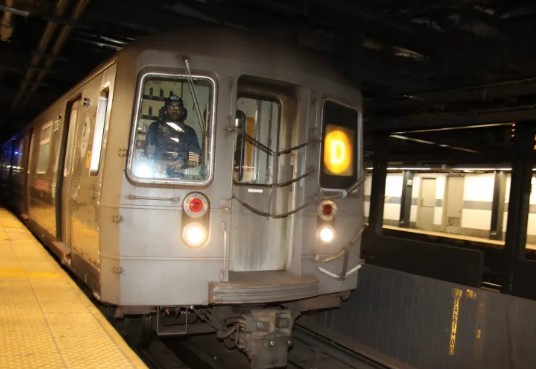
Moet McCullum, 41, was fatally struck by a southbound D train on Sept. 3 while working as a flagger with a track crew near the 161st Street–Yankee Stadium station in the Bronx.
For Jeffrey Fleming, the incident reopened memories of Nov. 3, 2016, when he and his co-worker Louis Gray were placing warning lights along a curved section of subway tracks in Brooklyn. A G train struck them, killing Gray and pinning Fleming against a tunnel wall.
“It’s like it happened all over again,” Fleming, 59, told The City Reporter. “You think that after all these years, they would have figured something out for it not to happen again.”
Fleming suffered multiple broken ribs in the 2016 incident. The National Transportation Safety Board later criticized New York City Transit for lapses in protecting workers.
Another Worker Killed on the Tracks
McCullum, a mother of three who normally worked as a subway conductor, is the first transit worker to die on the tracks since November 2023, when Hilarion Joseph was killed while performing flagging duties south of the 34th Street–Herald Square station in Manhattan.
Following Joseph’s death, the Federal Transit Administration cited what it described as an “escalating pattern” of safety failures at New York City Transit. The agency said near-miss incidents involving transit workers had increased 58% since 2022. The MTA appealed those findings.
The MTA declined to comment on McCullum’s death beyond remarks made Friday by Demetrius Crichlow, president of NYC Transit, at a news conference held at the Brooklyn headquarters of Transport Workers Union Local 100.
“We stand together with the union and the investigative agencies to ensure that … the root cause is found and we do what’s necessary to protect our employees and the millions of people that we serve,” Crichlow said.
The National Transportation Safety Board, NYC Transit and TWU Local 100 are investigating the incident.
‘I Started Running’
For Fleming, McCullum’s death is a stark reminder of the dangers involved in flagging, a critical safety procedure in which workers use lights and flags to warn approaching trains about crews working on the tracks.
“You have to be fully alert,” Fleming said. “Fully alert.”
He recalled that he heard “nothing” before the train struck him and Gray in 2016.
“Something told me to look to my right, and I looked to my right and I see my co-worker running, and I was like, ‘What is he running for?’” Fleming recalled. “So then I started running.”
An internal MTA account of McCullum’s death obtained by The City Reporter said members of the crew felt the wind from an approaching train, heard it coming around a curve and saw its headlights before most of them cleared the tracks.
McCullum, however, “froze,” according to the preliminary account.
John Chiarello, president of TWU Local 100, described the aftermath of her death as “total devastation.”
“She didn’t come to work that day to be killed by a train, you know?” Chiarello said Friday. “And then the person operating the train certainly didn’t think that they would come and kill one of their fellow workers.”
Questions Over Train Speed
The preliminary MTA account said the operator of the D train continued at normal speed while traveling south from the 167th Street station, even after being warned there about workers in the area.
The account also said the operator “did not see any lights” before approaching the 161st Street–Yankee Stadium station.
McCullum’s brother-in-law, Thomas Tyrell, told the Daily News that he was troubled by the initial account. Tyrell is married to McCullum’s twin sister, who also works as an MTA subway conductor.
“When you’re going through the tunnel and you know there’s flaggers, slow down,” Tyrell said. “You’re supposed to be driving slow.”
The circumstances remain under investigation.
Safety Recommendations After 2016 Tragedy
After the 2016 accident that killed Gray and severely injured Fleming, the NTSB recommended changes to NYC Transit’s flagging procedures.
Among other measures, the federal board recommended prohibiting trains from traveling faster than restricted speed while flagging protection was being established.
It also called for NYC Transit’s rail control center to communicate a flagger’s location to train dispatchers, train operators and tower operators.
Fleming said transit workers receive extensive training on how to protect themselves while working on active subway tracks. Workers may use niches and designated refuge areas along tunnel walls to escape passing trains.
But when a train is suddenly bearing down on them, he said, training can become difficult to recall.
“But when you got a big train coming on you, all that safety stuff is out the window,” said Fleming, who previously worked as a station cleaner and conductor before becoming a construction flagger. “You’re not going to remember nothing of what to do, you’re just trying to outrun that train.”
“You’ve got to expect the unexpected,” he added. “And that night, that was the unexpected.”
Fleming said he hopes to eventually meet McCullum’s family and share his condolences.
“I feel their pain,” he said.