
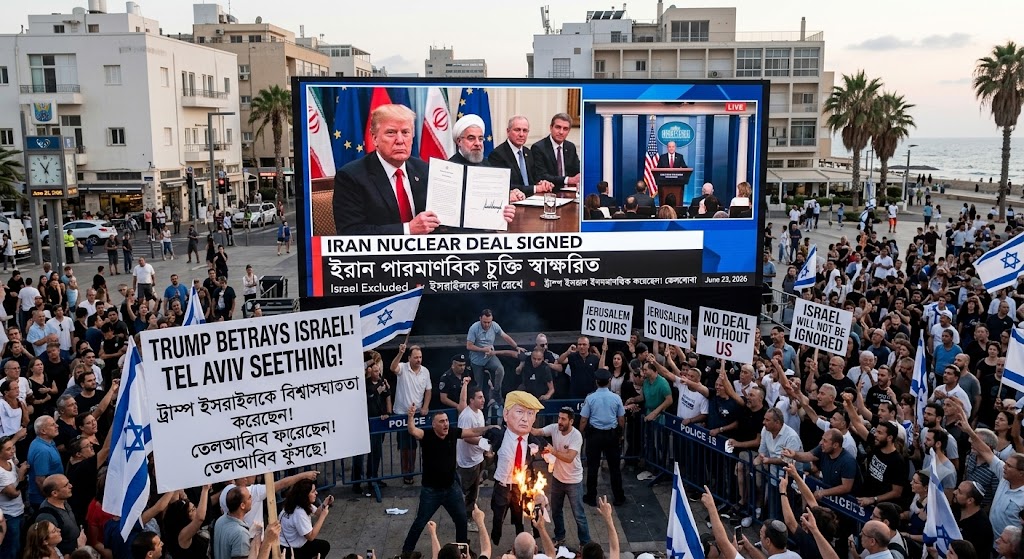
The man long regarded as Israel’s strongest ally in the White House is now facing growing anger from Israel itself. The reason is simple: the United States has entered peace negotiations with Iran, but Israel was left out of the room.
Since the recent high-level U.S.-Iran talks held on the shores of Lake Lucerne in Switzerland, criticism has been mounting across Israel. The negotiations, led by Vice President JD Vance and Special Envoy Steve Witkoff, produced a framework agreement that immediately sparked controversy. The first item on the agenda was Lebanon—a country where Israel and Hezbollah remain locked in active conflict.
For many Israelis, that was enough to raise an alarm.
Shima Shine, a former Mossad official and senior researcher at Israel’s Institute for National Security Studies (INSS), told the New York Post that excluding Israel from discussions directly affecting its security was a serious mistake.
“What did the Americans think?” she asked. “They are discussing Lebanon with Iran, asking Israel to exercise restraint, trying to bring Israelis and Lebanese into talks—yet Israel is not even part of the conversation with Iran. It’s a complete mess.”
The backlash has spread beyond security circles into Israel’s political and media establishment.
Danny Zaken, a columnist for *Israel Hayom*—the newspaper owned by billionaire Miriam Adelson, one of Donald Trump’s most prominent pro-Israel supporters—published a blistering critique of the former president.
“You claim you could have been the greatest president of all time,” Zaken wrote. “But you have failed.”
He went further, warning that unless Trump distances himself from the advice of his vice president and special envoy, history may remember him as the president who weakened America’s global leadership and undermined its credibility among allies.
The criticism has become even more personal.
Inon Magal, a leading right-wing television host on Israel’s Channel 14, openly labeled Trump a “loser” and referred to Vice President Vance as “scum” on social media. He also accused Trump’s son-in-law Jared Kushner and envoy Steve Witkoff of “selling out” Israel.
Such language would have been almost unimaginable only a few years ago. Many of Trump’s most enthusiastic Israeli supporters are now among his loudest critics.
Israel’s ambassador to the United States, Yechiel Leiter, reportedly described the Lebanon component of the negotiations as a “train wreck.” Meanwhile, a recent Channel 12 poll found that 71 percent of Israelis believe the Trump administration can no longer be fully trusted to safeguard Israel’s security interests under the terms of the proposed agreement.
Analysts argue that the problem is not merely political—it is structural.
Kelly Campa, a Middle East analyst at the Institute for the Study of War, noted that placing Lebanon at the top of the agenda gives Iran leverage to delay discussions on more critical issues, including its nuclear program.
According to Campa, any sustainable solution would require a comprehensive framework involving the United States, Iran, Israel, Hezbollah, and Lebanon.
“Otherwise,” she argued, “nothing meaningful will be achieved.”
She also pointed out that Lebanon has already witnessed multiple ceasefires that eventually collapsed. As long as Israeli military operations and territorial disputes continue, there is little reason to expect Hezbollah to commit to a durable agreement.
Israeli Prime Minister Benjamin Netanyahu has attempted to manage the growing tensions diplomatically. Publicly, he has emphasized that Israel will always protect its own interests regardless of external negotiations. Behind the scenes, however, domestic pressure is mounting.
Members of the Knesset have begun demanding assurances that Israel will be formally represented in any negotiations affecting its security and regional interests.
There is a certain irony in the current moment.
For years, criticism of Israel largely came from progressive activists, human rights groups, and left-leaning political movements, particularly over the Gaza conflict. Today, some of the harshest criticism of Trump is coming from Israel’s own conservative media figures, right-wing commentators, and longtime supporters of the U.S.-Israel alliance.
Whether this emerging rift represents a temporary disagreement or a deeper realignment remains uncertain. What is clear is that Washington’s approach to the Middle East is entering a new phase—one in which even America’s closest regional allies are questioning whether they still have a guaranteed seat at the table.
The geopolitical consequences of that shift may only become visible in the months ahead.